
You have a business idea that keeps you up at night. You’re excited, but terrified of wasting weeks, or money, on something nobody wants.
I’ve been there. I spent three weeks building a logo, buying a domain, and tweaking a “coming soon” page that nobody visited. Then I discovered you can learn how to test a business idea for free in a day and actually get a real answer. No guessing. No wasted months.
This guide walks you through the exact 24-hour sprint I still use. You’ll question your riskiest assumption, find real people to talk to, and build a zero-cost test before tomorrow morning.
What Does It Really Mean to Validate a Business Idea?
Most people think validation means building something and seeing if it sells. That’s too slow and too expensive.
Real validation means finding out if anyone has the problem you’re solving, and whether they’ll pay to fix it, before you build anything.
You’re not looking for compliments. You’re looking for signals: people who ask “when can I buy this?” or who offer money upfront. Everything else is noise.
Pre-Validation: The 5-Minute Prep That Saves You Hours
Before you start the clock, do this one thing. Write down your riskiest assumption in a single sentence.
Not your idea. Your riskiest assumption about your idea.
For example: “Busy parents in my city will pay $15/week for a done-for-you meal-prep checklist.” That sentence tells you exactly what you need to prove or disprove in 24 hours.
Why does this matter? Because most people validate the wrong thing. They ask “do you like this idea?” instead of “would you pay for this?” Those are very different questions with very different answers.
Write it down. Pin it to your screen. Every step in the next 24 hours points back to that one sentence.
Hour 0–2: Pinpoint Your Riskiest Assumption
You’ve written your assumption. Now tear it apart.
Ask yourself three questions:
- Who exactly is the customer? Not “everyone” or “small businesses.” Get specific. Busy parents. Freelance designers. Gym owners with under 50 members.
- What is the specific problem? Not a vague pain. A concrete, describable frustration they probably Google at 11pm.
- Why would they pay money to solve it? Convenience, time savings, fear, status. Pick one.
If you can’t answer all three, your assumption is still too vague. Tighten it before moving on.
One thing I do at this stage: I search Reddit and Facebook groups for complaints that match my assumption. If I can find 10 posts where strangers describe the exact problem I’m solving, that’s already a signal worth paying attention to.
Hour 2–8: Run Free Customer Discovery (Scripts Included)
This is where most people freeze. Talking to strangers feels awkward. Skip this step and you’re flying blind.
Here’s the truth: you only need five to eight honest conversations to get a clear signal. That’s it.

Where to find people:
- Facebook groups related to your niche
- Reddit communities (search your problem keyword + “help” or “frustrated”)
- LinkedIn connections who fit your customer profile
- WhatsApp groups, Slack communities, Discord servers
What to say (copy this):
“Hey, I’m doing research on [problem area] and I’d love your honest opinion. Would you be open to a 10-minute chat this week? No selling, just questions.”
Most people say yes. People like being asked for opinions.
Questions to ask during the call:
- Tell me about the last time you dealt with [problem]. What happened?
- How are you handling it right now?
- What have you already tried?
- How much is this problem costing you in time or money each week?
- If there were a solution that [your specific promise], what would that be worth to you?
Do not pitch. Do not describe your idea until they ask. Just listen.
What counts as a positive signal: They describe the problem in detail without prompting. They use strong emotional words. They ask “does something like this already exist?” or “let me know when it’s ready.”
What does not count: “That sounds interesting.” “Cool idea.” “I’d probably use that.” These are polite. They are not buyers.
Hour 8–16: Build a Zero-Cost Smoke Test
You’ve talked to real people. Now you build a simple test to see if strangers, not just your contacts, respond to your offer.
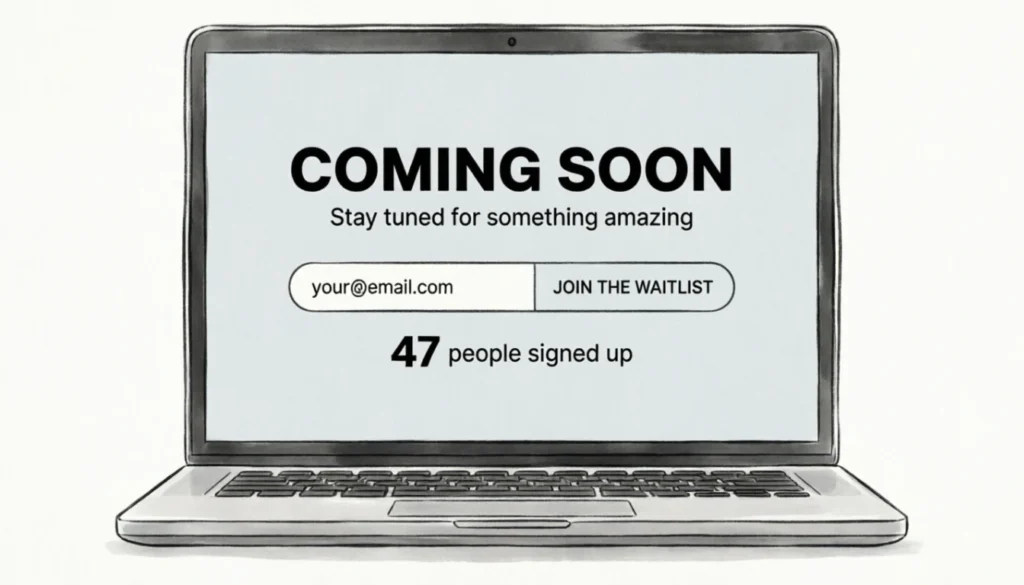
A smoke test is a page, post, or message that presents your solution and asks for a commitment. That commitment can be an email signup, a waitlist entry, or even a small prepayment.
Free tools to build your smoke test:
- Carrd.co (free tier): Build a one-page site in 20 minutes. Add a headline, one sentence of value, and an email signup.
- Google Forms: Simpler but works. Ask for name, email, and “would you pay X for this?” at the end.
- Gumroad: List your product for $1. If someone buys, that’s stronger proof than 100 survey responses.
- Twitter/X or LinkedIn post: Write a post describing the problem and offer. Count replies, DMs, and saves.
Your smoke test page needs only three things:
- A headline that names the exact customer and the exact result. “For freelancers who can’t stop chasing late invoices.”
- One clear ask. “Join the waitlist” or “Get early access.”
- No product description yet. Just the problem and the promise.
Now put it in front of people. Post it in the same Facebook groups and Reddit threads where you found your interviewees. Send it to the people you spoke with. If you have a small email list, send it there.
Set a target before you launch. For example: “If 10 people sign up in 16 hours without me personally asking each one, I have a signal.” Define the number now, before you see the results. Otherwise you’ll rationalize any outcome.
When I ran my first smoke test for a meal-prep checklist idea, I messaged 10 parents in a Facebook group and posted a Carrd page. Eight replied to my message. Two offered to prepay $10 for a prototype. That $20 in my PayPal told me more than three weeks of planning ever had. I got my answer in one evening, for free.
Hour 16–24: Analyze Signals and Make the Go/No-Go Call
The clock is almost up. Now you decide.
Pull out the success criteria you set before you started. Did you hit your number? Look at three types of signals:
Strong signals (move forward):
- People described the problem without prompting
- Two or more people asked how to pay you
- Your smoke test hit your signup target
- At least one person offered real money
Weak signals (keep testing):
- You got polite interest but no concrete commitments
- People signed up but only after you personally asked them
- Everyone said “interesting” but nobody asked about price
Stop signals (pivot or kill):
- Nobody described the problem the way you imagined it
- The problem exists but people are happy with their current solution
- Every conversation ended with “I’d do it myself” or “my company already has something for that”
Weak signals don’t mean your idea is dead. They mean your assumption needs adjusting. Maybe the customer is slightly different. Maybe the price point is off. Tweak one variable and run another 24-hour sprint.
Free Tools That Do the Heavy Lifting for You
Here’s a quick list for people who want to validate a business idea quickly without money:
- Google Trends: Check if interest in your problem is growing, flat, or dying.
- AnswerThePublic: Find the exact questions your customers are already typing into search.
- SparkToro (free tier): See where your audience spends time online.
- Typeform (free): Build a cleaner survey than Google Forms if you need more questions.
- Notion: Track your 24-hour sprint, notes from calls, and signal count in one place.
None of these cost money. All of them take under 10 minutes to set up.
Common “Validation” Traps That Give You False Hope
These traps catch smart people. Watch out for all of them.
Trap 1: Asking friends and family. They want you to succeed. They will say yes to almost anything. Their opinion is not data.
Trap 2: Counting compliments. “Love this idea!” is not a validation signal. A credit card number is.
Trap 3: Building before testing. A working product is not proof of demand. It’s proof you can build. Those are different things.
Trap 4: Surveying too broadly. A 200-response survey where 60% say “maybe” tells you almost nothing. Ten targeted conversations with your exact customer tell you everything.
Trap 5: Changing your success criteria after you see the results. Set the number before you start. Stick to it.
Your First 24 Hours Are Over, Now What?
If you got strong signals, take one next step today. Not a business plan. Not a logo. One concrete step: open a waitlist, take a $10 deposit, or write the first piece of content.
If you got weak signals, change one variable in your assumption and run another sprint. You’re not failing. You’re learning faster than 99% of people who sit on ideas for years.
If you got stop signals, be grateful. You just saved months of your life and probably thousands of dollars.
The goal of learning how to test a business idea for free in a day is not to get a green light. It’s to get the truth, fast, so you can act on real information instead of hope.
Download the free 24-hour validation checklist below, work through the three phases, and share your results in the comments. If two people offered to pay you before you built anything, that’s worth celebrating.