
It was a Sunday night. I had spent the past 48 hours building what I thought was going to be a fully-loaded product. Custom dashboard. Onboarding flow. Three pricing tiers. Animations everywhere.
Nobody signed up.
Not one person.
That moment stung. But it taught me the most important lesson in product building: you don’t need to build everything. You just need to build enough.
That’s exactly what a minimum viable product is about. And in this guide, I’m going to walk you through what an MVP actually means, why it matters, and how you can build one yourself, in just one weekend.
What Is an MVP? (The Real Definition)
A minimum viable product is the simplest version of your product that lets you test a real idea with real users.
It’s not half-baked. It’s focused. You strip everything down to the one core thing your product does, ship it, and then see what happens.
The term comes from Eric Ries and the lean startup movement. The idea is simple: stop guessing what people want. Build something small, put it in front of users, collect feedback, and iterate from there. That cycle is called build-measure-learn.
The minimum viable product definition, at its core, is about speed and learning, not perfection.
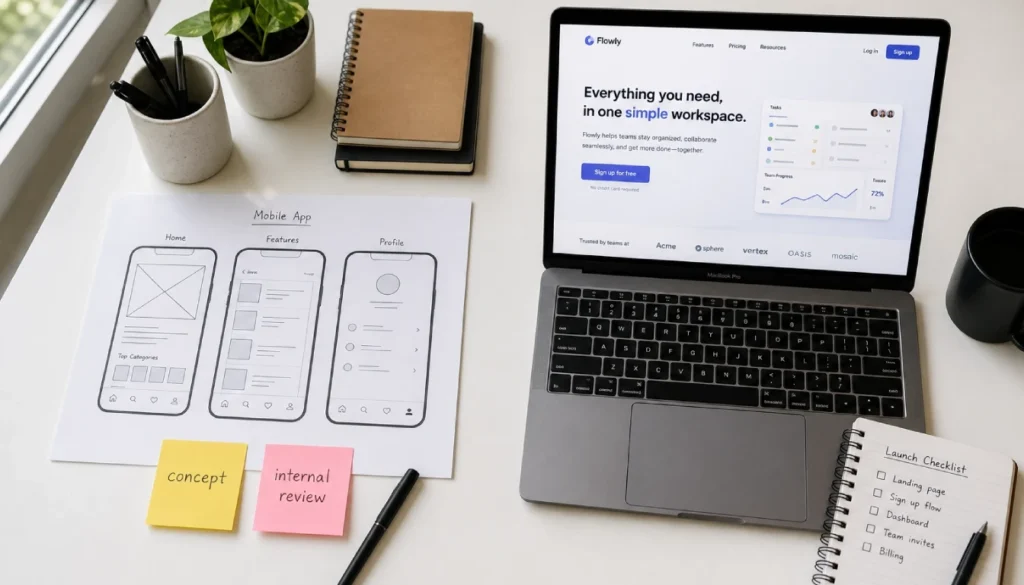
MVP vs Prototype: What’s the Difference?
A lot of people mix these two up. Here’s the quick breakdown.
| MVP | Prototype | |
|---|---|---|
| Purpose | Test a real idea with real users | Test design or concept internally |
| Functional? | Yes, users can actually use it | Often not, it’s usually a mockup |
| Shipped? | Yes, publicly or to early adopters | Usually not, it stays in-house |
| Feedback source | Real users | Internal team or stakeholders |
A prototype is something you show. An MVP is something you ship.
If you want to validate your idea, you need an MVP, not just a prototype.
Why Build an MVP First?
Here’s why skipping the MVP and building the full product first is one of the most common startup mistakes.
You save time. Instead of spending months building features nobody asked for, you build one thing in 48 hours and see if it lands.
You reduce risk. The startup failure rate is high, and most failures come from building the wrong thing. An MVP helps you find out early, before you’ve burned your savings.
You find product-market fit faster. You learn what your early adopters actually care about. Then you build more of that.
You can get funding with just an MVP. Investors want to see that real people care about your idea. A working MVP with a few users is far more convincing than a pitch deck.
What Should You Include in Your MVP?
This is where most people overthink it.
Your MVP should do one thing well. Ask yourself: what is the core action my user needs to complete to get value from this product?
That’s your MVP.
Everything else is a nice-to-have. Save it for version two.
A good MVP checklist looks like this:
- One core feature that solves one specific problem
- A way for users to sign up or access it
- A way to collect feedback (a simple form works fine)
- Enough polish that it doesn’t look broken
- A clear value proposition on your landing page
That’s it. You don’t need a settings page. You don’t need a dark mode toggle. You don’t need ten integrations.
How to Build an MVP in a Weekend (Step by Step)
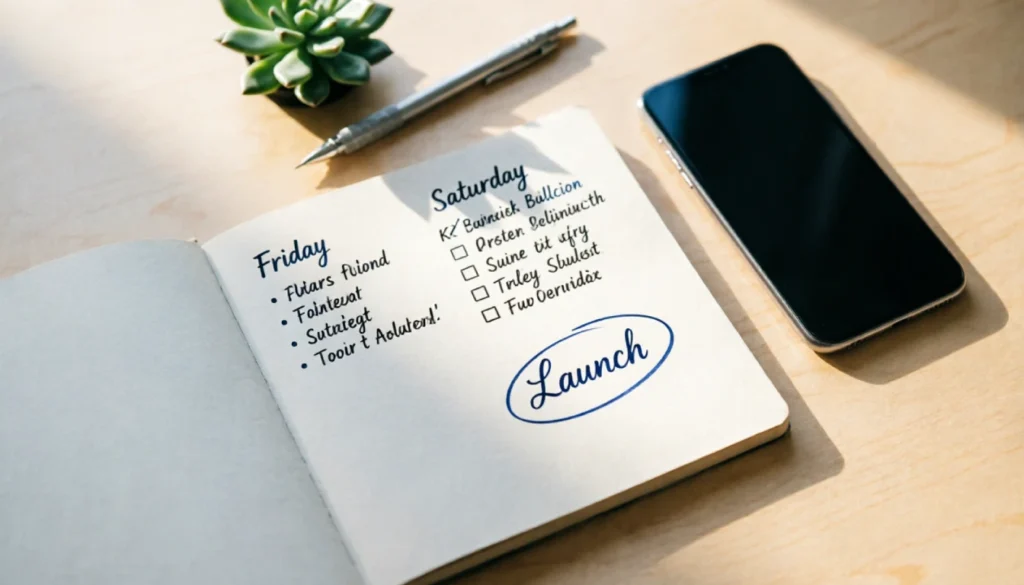
Here’s a realistic scope for a weekend MVP project. This is the exact approach I now use every time I want to test a new idea.
Friday Evening: Define and Plan (2 to 3 Hours)
Before you write a single line of code or design a single screen, get clear on three things:
- Who is this for? Name your target user. Be specific.
- What problem does it solve? One sentence, no jargon.
- What is the one thing my MVP will do? Strip it to its core.
Write these down. Print them out if you need to. Tape them to your monitor. When you get distracted building extra features, this paper pulls you back.
Also on Friday evening, pick your tools. More on that below.
Saturday: Build (8 to 10 Hours)
This is your main build day. Keep your scope ruthlessly tight.
Start with your landing page. Even if you’re building an app, your landing page MVP is often enough to test demand. Build a clean page that explains what you’re building, who it’s for, and what they should do next. Add an email signup form.
If you’re building a functional product, focus only on the core user flow. User signs up, completes the core action, gets value. That’s the whole loop.
Avoid perfecting things. Avoid adding animations. Avoid rewriting your code because it “doesn’t feel clean.” Ship it.
Sunday: Launch and Learn (4 to 6 Hours)
On Sunday, you launch.
Post it in relevant online communities, Reddit threads, Facebook groups, Discord servers, anywhere your target users hang out. Send it to five to ten people you know who fit your target user profile.
Your job now is to get your first feedback. Watch how people use it. Note what confuses them. Ask them what they expected to happen.
This user feedback loop is more valuable than any extra feature you could have built instead.
Best Tools to Build an MVP in a Weekend (2026)
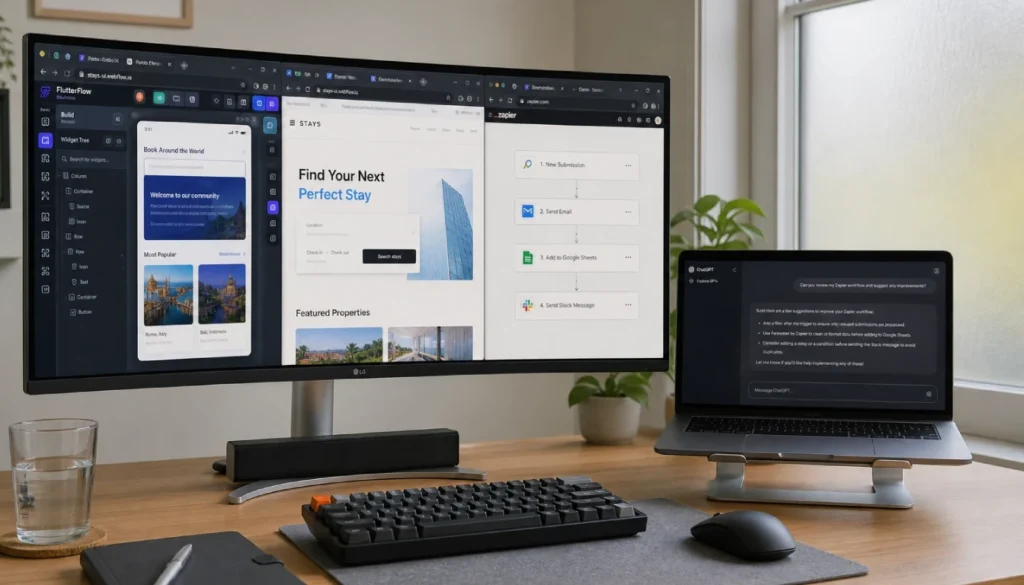
You have more options now than ever before, especially if you want to build an MVP without coding.
For no-code MVPs:
- Webflow or Framer for landing pages
- Bubble for web apps
- Glide or Adalo for mobile apps
- Softr for client portals and internal tools
- Airtable as your MVP backend
- Zapier or Make to connect everything
For AI-powered MVPs (the big trend in 2026):
- Cursor for AI-assisted coding
- Lovable or Bolt.new for generating full app prototypes fast
- V0 by Vercel for UI design
- Replit Agent for rapid full-stack builds
For validation-only MVPs:
- A simple landing page with a Typeform or Tally form
- A Google Sheets backend with a Softr front-end
- An email-based MVP where you manually deliver the service
The best free tools to build an MVP in a weekend depend on your skill set. If you can code, use Cursor plus a Next.js SaaS boilerplate. If you can’t, use Bubble or Lovable and go from there.
Common Mistakes When Building an MVP
I’ve made most of these myself.
Building too much. You decide your MVP needs five features instead of one. You spend all weekend on features nobody asked for.
Waiting until it’s perfect. There’s no such thing as a perfect MVP. Ship the imperfect version. Learn. Fix it.
Skipping the landing page. Even if you have a working product, if your messaging is confusing, nobody will try it. Your landing page is part of your MVP.
Not talking to users. Launching and waiting is not the same as launching and learning. Reach out. Ask people directly. Read their responses carefully.
Ignoring the metrics that matter. After you launch, track meaningful things. How many people signed up? How many completed the core action? How many came back? These MVP success metrics tell you whether your idea has legs.
Different Types of MVPs You Can Build
Not every MVP is an app or a website. Here are a few approaches worth knowing:
Landing page MVP. You build a page explaining your product and collect email signups to measure demand before building anything.
Concierge MVP. You do the service manually for a small group of users before automating it. A great way to validate without writing code.
Wizard of Oz MVP. Users think they’re using a product, but behind the scenes, a human is doing the work. Lets you test the experience without building the backend.
Email MVP. You send a weekly email to a small list to test whether your content idea has an audience.
Each of these is a valid, real way to validate an MVP idea without spending a full weekend coding.
What Comes After Your MVP?
You launched your weekend MVP. You got some users. You collected feedback. Now what?
Look at your data. Did people complete the core action? Did they come back? Did anyone pay, share, or tell a friend?
If yes: double down. Build the next layer of features your users asked for. Focus on activation and retention.
If no: don’t panic. A failed MVP is still a win. You just learned something valuable without wasting months on it. Pivot. Change the problem you’re solving. Try again next weekend.
The minimum lovable product comes after the MVP. Once you know people want what you’re building, you make it delightful.
Frequently Asked Questions
Can you really build an MVP in 48 hours?
Yes, if your scope is tight. A landing page MVP can be done in a few hours. A functional no-code app can be built in a full weekend. An AI-powered product using tools like Cursor or Lovable can ship in 48 hours if you stay focused and avoid feature creep.
What does MVP stand for in business?
MVP stands for minimum viable product. In business, it refers to the simplest working version of a product that can be tested with real users to validate an idea before investing in full development.
How do I validate my MVP idea before building?
Start with simple validation techniques: run a quick survey, post your idea in communities where your target users hang out, or build a landing page and measure signups. Pre-selling your MVP before building is also one of the strongest forms of validation you can do.
What is the lean startup MVP approach?
It’s a method developed by Eric Ries that encourages founders to build small, test with real users, measure results, and learn quickly. The goal is to avoid spending time on things that don’t matter by getting real-world feedback as early as possible.
How long does it take to build an MVP normally?
It depends on complexity, but a focused MVP with a tight scope can take anywhere from a few hours (landing page) to a few weeks (functional app). A weekend MVP is entirely realistic for most early-stage ideas, especially with modern no-code and AI tools available in 2026.
You’re Ready. Start This Weekend.
Building an MVP is not about shipping something bad. It’s about shipping something honest. It’s about saying, “here’s my best idea in its simplest form, does this help you?”
Start small. Define your one core feature. Pick your tools. Build Friday to Sunday. Then put it in front of real people and listen.
You don’t need a full team. You don’t need a big budget. You need a weekend, a clear idea, and the willingness to learn from whatever happens next.
So, what’s your idea? Drop it in the comments. I’d love to hear what you’re planning to build, and if you’ve already built a weekend MVP, share how it went. Your story might be exactly what someone else needs to take that first step.