

Have you ever caught yourself scrolling for an hour, not even enjoying it, just… stuck? If the words “dopamine detox for non-techies” make you picture biohackers with color-coded spreadsheets, take a breath. This guide walks you through the whole thing in plain language. No brain-science lecture, no impossible rules, and zero judgment. Just a simple, honest look at what a dopamine detox actually is and how you can try one without losing your mind.
What Exactly Is a Dopamine Detox? (In the Simplest Words Possible)
Let me explain what dopamine detox is in simple words, without a single complicated term.
Dopamine is a chemical your brain releases when something feels good. You get a little hit of it when you eat something tasty, get a like on a post, or hear a notification ping. That is normal and healthy.
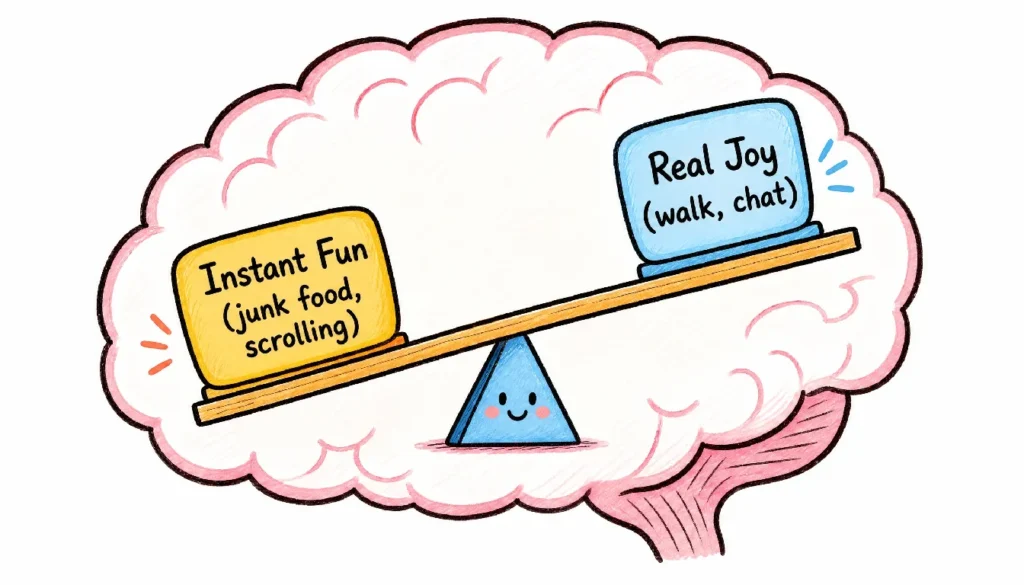
The problem starts when your brain gets flooded with these tiny hits all day long. Scrolling, binge-watching, online shopping, constantly checking messages. Over time, your brain adjusts. It needs more stimulation to feel anything. Quieter moments, like a walk or a conversation, start to feel boring or even uncomfortable.
A dopamine detox, sometimes called a dopamine fast, is simply a break from those high-stimulation activities. You give your brain space to reset so that ordinary things feel enjoyable again.
Why Would Anyone Do This? (The Real-Life Benefits You’ll Notice)
You do not need to feel broken to benefit from a dopamine detox. Most people who try one just feel a bit off. Restless. Scattered. Unable to sit quietly for five minutes without reaching for their phone.
Here is what people commonly notice after a short detox:
- Better focus. Tasks that felt impossible to start become easier.
- More patience. You stop needing constant input to feel okay.
- Actual enjoyment. A walk, a meal, a book starts to feel satisfying again.
- Less anxiety. The constant noise in your head quiets down.
None of these results are instant. One afternoon off your phone will not rewire your brain. But even a short break often gives people a genuine sense of relief.
The Dopamine Detox Rules, Plain English Version
Here are the dopamine detox rules in plain English. No complicated charts, no timers with five alarms.
The core idea: Reduce or remove activities that give your brain a fast, easy reward with little effort.
What most people cut during a detox:
- Social media scrolling
- Online videos or streaming shows
- Video games
- Junk food snacking (optional, but common)
- Checking messages every few minutes
- Online shopping just to browse
What you keep:
- Conversations with people in front of you
- Slow-paced reading (actual books or long articles)
- Walking, light movement, or stretching
- Cooking, drawing, journaling, or crafts
- Music listening (with your full attention, not as background noise)
You do not have to quit everything. Pick two or three high-stimulation habits and take a break from those. That is enough to start.
Your Beginner-Friendly Dopamine Detox Plan (No Meditation Required)
This is the section where most guides get complicated. They tell you to wake at 5 a.m., sit in silence, and fast from all technology. That works for some people. For most, it is a fast track to quitting by noon.
Here is a beginner dopamine detox plan that fits actual life.
24-Hour Gentle Reset for First-Timers
Pick a Saturday or a day off. You do not need to do this on a Monday during a work week.
Step 1. The night before, write your “hard no” list. Choose two or three things you will skip for 24 hours. For most beginners, that is social media and online videos.
Step 2. Prepare a boredom kit. A physical book. A puzzle or coloring book. A notebook. Anything that gently occupies your hands without a screen.
Step 3. Tell someone at home what you are doing. Not because you need permission, but because it stops the “why aren’t you replying?” texts.
Step 4. When boredom hits (and it will), do not fight it. Sit with it for five minutes. Then open your boredom kit. That uncomfortable feeling is your brain adjusting. It passes.
Step 5. At the end of the day, write down one thing that surprised you. Did you notice something? Feel something unexpected? That moment of awareness is the whole point.
7-Day Challenge That Fits Real Life
This is not a strict cleanse. It is a gentle week of cutting back.
- Day 1 and 2: Remove social media apps from your phone’s home screen. You are not deleting them. Just making them one step harder to reach.
- Day 3 and 4: Set a two-hour window each evening where you do not watch anything. Read, cook, talk, or do nothing.
- Day 5: Spend an hour outside without earbuds.
- Day 6: Write a list of ten things you used to enjoy before you had a smartphone. Pick one and do it.
- Day 7: Reflect. What felt hard? What felt good? Decide which one or two changes you want to keep.
What Can You Actually Do During a Dopamine Detox? (15 Low-Tech Ideas)
This is the question nobody wants to admit they are asking. Here is an honest list.

- Read a physical book (fiction works great; your brain will thank you)
- Write letters or journal entries by hand
- Cook a recipe you have never tried before
- Go for a slow walk without music or a podcast
- Call someone you have not spoken to in a while
- Do a puzzle or a crossword
- Sketch, doodle, or color in an adult coloring book
- Organize one small area of your home
- Stretch or do yoga without a guided video
- Sit in a park and watch what is happening around you
- Make something with your hands (knitting, baking, building)
- Read the paper edition of a magazine or newspaper
- Play a board game or card game
- Write down ten things you are grateful for
- Simply sit quietly for ten minutes and let your thoughts go where they go
None of these need to be productive. The goal is gentle engagement, not achievement.
Rookie Mistakes I Made (And How You Can Skip Them)
I personally faced the problem of thinking I had to be perfectly bored and “productive” every second. I white-knuckled it through the first afternoon, felt miserable, and gave up before dinner.
The second time I tried a softer approach. I allowed coloring books, slow walks, and cooking. I let myself sit and do nothing when nothing felt right. I finished a full 24 hours and felt genuinely calmer. Not transformed. Not enlightened. Just quieter.
Here are the mistakes I see most beginners make:
Going too hard, too fast. Cutting every screen for 48 hours on your first try is like going from couch to marathon with no training. Start with three to six hours.
Not preparing for boredom. Your phone fills every gap. Without a boredom kit ready, you will pick it back up within an hour.
Beating yourself up for “failing.” If you check Instagram at 2 p.m., the detox is not ruined. Just close it and carry on. This is not a test with a pass or fail grade.
Doing it alone with no support. Tell one person. Even just saying it out loud makes it more real.
“But What If I Need My Phone for Work?” A Realistic, No-Judgment Guide
Most people cannot disconnect completely. That is fine. A dopamine detox does not require you to quit your job or miss urgent messages.
Here is how to work around it:
- Separate work use from idle use. Checking email for a task is different from scrolling your feed out of habit. One is intentional. The other is automatic.
- Use app timers. Most phones let you set a daily limit on specific apps. Set a 30-minute limit on social media and let the phone do the work of cutting you off.
- Create phone-free windows. Block out one hour in the morning and one after dinner. No checking, no browsing, no news. Just those two hours.
- Turn off all non-essential notifications. Every ping is a tiny pull on your attention. Remove the pull and the craving drops.
You are not aiming for perfection. You are aiming for a little more intention around how you use your phone.
Frequently Asked Questions
Can I listen to music during a dopamine detox?
Yes, with full attention. Put on an album and actually listen. Do not use music as background noise while scrolling.
Is a dopamine detox backed by science?
The strict term “dopamine detox” was coined by a psychologist and has been debated in scientific circles. What is broadly agreed upon is that reducing constant digital stimulation improves focus and wellbeing. The practice works even if the name is imprecise.
How long should I do it?
Start with three to six hours. Work up to 24 hours. Repeat once a month or whenever you feel scattered and unable to focus.
Will I feel worse before I feel better?
Possibly. The first hour or two can feel restless and irritating. That is normal. It usually settles.
Can kids or teenagers do this?
Yes, and many find it surprisingly enjoyable once they get past the initial boredom.
Let’s Recap and Start Small
A dopamine detox for non-techies does not require a personality overhaul. It requires one decision: to give your brain a short break from the things that overstimulate it.
You pick two or three habits to pause. You prepare a low-tech boredom kit. You start with just a few hours. You notice how you feel.
That is the whole plan. No spreadsheets, no cold plunges, no 4 a.m. wake-up calls.
If you leave this guide with just one action, let it be this: tonight, put your phone in another room for two hours. Sit with whatever comes up. That small act is your first dopamine detox, and it counts.
The next time you feel scattered and overstimulated, come back to this beginner dopamine detox plan and give yourself another quiet afternoon. You deserve a brain that can enjoy the small things again.