

Ever opened Netflix, seen “Limited Series” stamped on a title, and thought, “So… is this just a short show? Will it end on a cliffhanger? Do I have to commit to six seasons?” You’re not alone. The limited series vs TV show difference for beginners is one of the most common questions new streaming fans ask, and it’s completely understandable. These labels aren’t always explained. But once you know the difference, you’ll pick your next watch faster and enjoy it more. Here’s exactly how they work.
What Is a Limited Series? (With Netflix and HBO Examples)
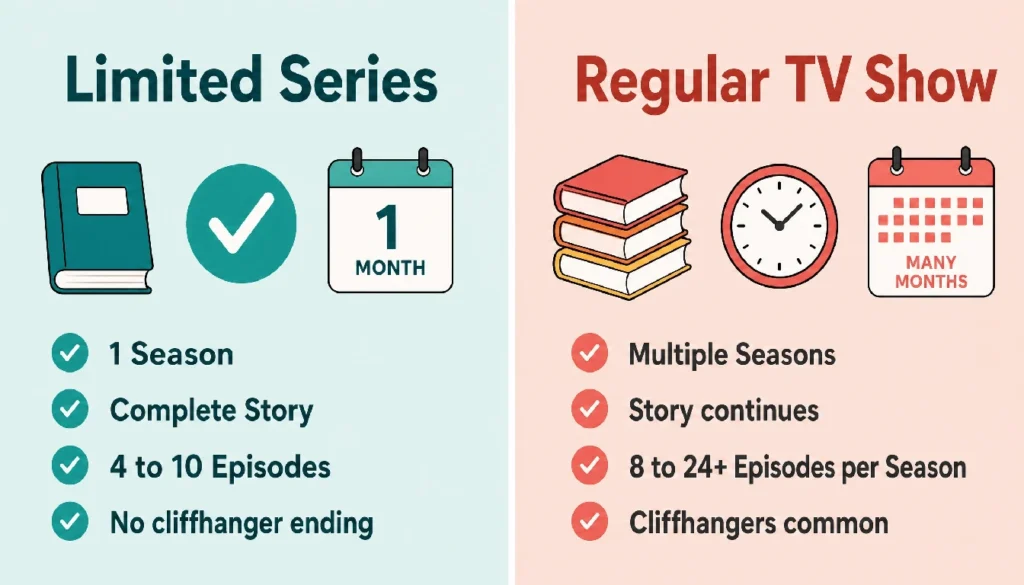
A limited series is a TV show with a planned beginning, middle, and end, all told in one season. The story is complete when the final episode rolls credits. You don’t need a Season 2 to feel satisfied.
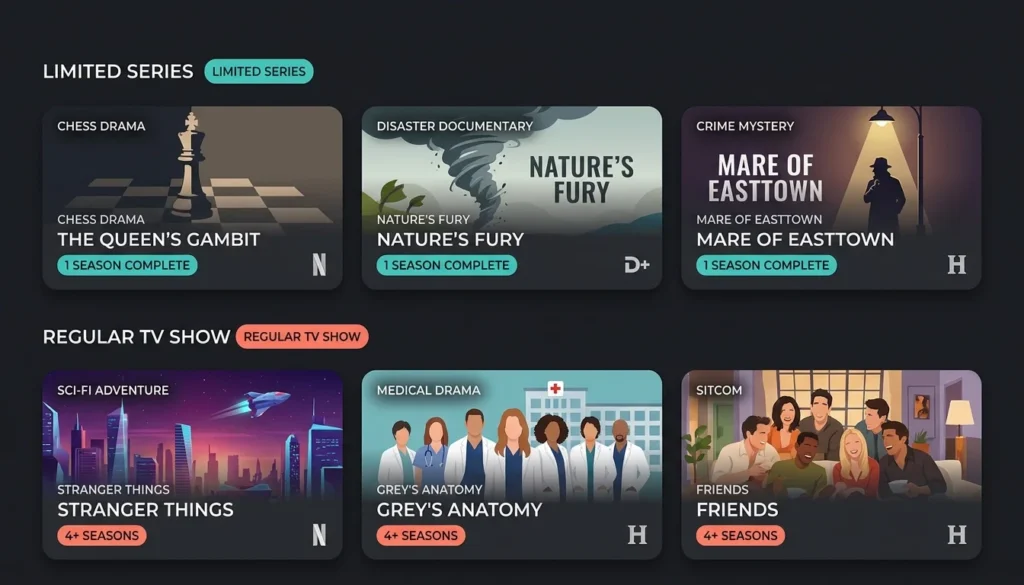
Think of The Queen’s Gambit on Netflix. It ran for 7 episodes, told Beth Harmon’s full story, and ended. Done. No loose threads left dangling on purpose. Same with Chornobyl on HBO, 5 episodes, a complete account of the nuclear disaster. Mare of Easttown is another great example, a 7-episode murder mystery that wraps up neatly.
I personally almost skipped The Queen’s Gambit when I first saw it labelled “Limited Series.” I assumed it meant unfinished or too short to be worth my time. After watching it, I realised that it was completely backwards. A limited series is often more satisfying precisely because every episode earns its place in the story.
The label “what is a limited series on Netflix” gets searched thousands of times a month, and the simple answer is: it’s a self-contained story told in one run of episodes, usually between 4 and 10.
What Is a Regular TV Show? The Ongoing Story Format
A regular TV show, also called an ongoing series or multi-season series, is built to continue. Each season moves the story forward, introduces new conflicts, and often ends on a cliffhanger to pull you back for the next one.
Grey’s Anatomy has run for over 19 seasons. Stranger Things kept expanding across 4 seasons. Friends gave you 10 years of the same characters growing, changing, and coming back. These shows are designed for long-term investment.
The format works well for character-driven stories where seeing people change over years is the whole point. You get used to the characters. You root for them across multiple storylines. But you’re also signing up for potentially hundreds of hours of content, and sometimes the show runs longer than it should.
Key Differences at a Glance (Simple Comparison Table)
Here’s a quick side-by-side view of the two formats:
| Feature | Limited Series | Regular TV Show |
|---|---|---|
| Number of seasons | 1 (planned) | Multiple (ongoing) |
| Story | Complete, self-contained | Continues each season |
| Episode count | 4 to 10 usually | 8 to 24+ per season |
| Cliffhanger endings | Rare | Common |
| Time commitment | Low | High |
| Examples | The Queen’s Gambit, Chernobyl | Stranger Things, Grey’s Anatomy |
Miniseries vs. Limited Series: Are They the Same?
This is where a lot of people get confused. The difference between miniseries and limited series is mostly a matter of era and naming convention, not format.
“Miniseries” is the older term. Networks used it from the 1970s through the 1990s to describe short, standalone dramas such as Roots (1977) and Band of Brothers (2001). They meant the same thing: a story told in a fixed number of episodes with no plans to continue.
“Limited series” became the preferred industry term in the streaming age. Netflix, HBO, and other platforms adopted it to describe the same concept. So if you see “miniseries” on an older title and “limited series” on a newer one, they’re describing the same format.
The only real difference you’ll notice is when award shows categorise them. The Emmys, for example, now use “Limited or Anthology Series” as a category. Some anthology shows, like American Horror Story, reset their stories each season with new characters, which sits somewhere between the two formats.
Bottom line: Miniseries = Limited Series. The name changed, the idea didn’t.
Can a Limited Series Get a Second Season? (The Truth)
Yes, it happens, and it causes real confusion. The most famous example is Big Little Lies.
Big Little Lies aired in 2017 as a 7-episode limited series on HBO. It told a complete story. It won 8 Emmy Awards, including Outstanding Limited Series. Then HBO brought it back for Season 2 in 2019. Technically, it stopped being a “limited series” the moment renewal happened, but the label stuck in people’s memory.
This is why the label alone doesn’t tell the whole story. A show labelled “limited series” reflects the original intent, not a permanent guarantee. If a show performs exceptionally well, networks sometimes reverse course.
Other examples where this happened:
- Big Little Lies (renewed but later dropped)
- Sharp Objects (stayed limited, no Season 2)
- Mare of Easttown (creator has resisted renewal)
So what should you do? Check when the show originally aired. If it’s been years with no Season 2 news, it’s probably staying limited. If it aired recently and got massive viewership, a second season is possible.
Popular Examples: Limited Series vs. Regular TV Shows
Sometimes a list of real titles makes the difference click faster than any definition.
Limited Series (one season, complete story):
- The Queen’s Gambit (Netflix, 7 episodes)
- Chornobyl (HBO, 5 episodes)
- Mare of Easttown (HBO, 7 episodes)
- Sharp Objects (HBO, 8 episodes)
- The Watcher (Netflix, 7 episodes)
Regular TV Shows (multiple seasons, ongoing):
- Stranger Things (Netflix, 4 seasons)
- Grey’s Anatomy (ABC/Netflix, 19+ seasons)
- Friends (NBC, 10 seasons)
- The Crown (Netflix, 6 seasons)
- Breaking Bad (AMC, 5 seasons)
The Crown is an interesting case because it had a planned ending from the start, but still ran 6 seasons. It sits closer to a limited series in spirit, though it’s categorised as a drama series.
Which Is Better for You? Binge-Watching, Time and Commitment
There’s no universal answer to limited series vs TV series. It depends entirely on what you want from a watch session.
I went through a phase where I only watched limited series because my schedule was packed. I needed stories I could actually finish. Sharp Objects in a weekend. Chornobyl in two evenings. No guilt about abandoning a 7-season commitment halfway through.
Then I got through a slow month and needed something to fill the time. I started Grey’s Anatomy and didn’t look up for three weeks. Both choices were right for that moment.
Here’s a simple 3-step process to pick what fits you right now:
Step 1: Check your time commitment. Do you want a complete story this week, or are you happy investing months? A limited series runs 4 to 10 episodes total. A regular show might ask for 5 to 10 seasons. Be honest with yourself about how much time you have.
Step 2: Look for the label. On Netflix, check under the title. It will say either “Limited Series” or show a season count. On HBO Max, look for the same. If there’s only “Season 1” listed and no “Limited” tag, the show may still be ongoing or awaiting renewal.
Step 3: Match the format to your mood. Craving closure? Want to watch something and feel genuinely finished? Go limited. Love getting deeply attached to characters over years, and don’t mind cliffhangers? Pick a regular series. There is no wrong answer, just what works for you right now.

Frequently Asked Questions
Is a limited series the same as a miniseries?
Yes. “Miniseries” is the older term. “Limited series” is what streaming platforms call it today. Same concept, different decade.
Can I start a limited series and leave it unfinished?
You can, but you probably won’t want to. They’re designed to pull you through to the end. The story wraps up, so there’s real motivation to finish.
Do limited series have cliffhangers?
Occasionally inside episodes, but the final episode is meant to feel complete. That’s the main appeal.
How long is a typical limited series?
Most run between 4 and 10 episodes, each 45 to 60 minutes long. So you’re looking at roughly 4 to 10 hours total.
Are anthology shows the same as limited series?
Not exactly. An anthology show like American Horror Story or Black Mirror resets its story each season with new characters. A limited series tells one specific story from start to finish. Both are short-form, but the structure differs.
Which streaming service has the most limited series?
HBO and Netflix both have strong libraries. HBO is widely respected for quality: Chornobyl, Mare of Easttown, Sharp Objects. Netflix has volume: The Queen’s Gambit, Maid, The Haunting of Hill House.
Final Thoughts: Choosing Your Next Watch with Confidence
The limited series vs TV show difference for beginners comes down to one core idea: limited series tell a complete story in one season, and regular TV shows continue across multiple seasons.
If you want something satisfying and contained, a limited series is your best bet. If you want a long investment with characters you’ll grow with over the years, pick a regular show.
Check the label on Netflix or HBO before you start. Look at the episode count. And use the 3-step process above if you’re still unsure.
Now that you know exactly how to spot each format, you can stop guessing and start watching. What’s next on your list? Drop it in the comments, and share this with a friend who’s always confused about what to watch.