You’re 35,000 feet up. The cabin lights dim. And sleep still feels completely out of reach. Your neck already aches, the person next to you keeps shifting, and the engine hum is relentless. If you’ve ever wondered how to sleep on a plane in economy, you’ve probably tried the neck pillow, the window lean, maybe a glass of wine. None of it worked. Here’s what actually does: a specific seat choice, a 5-step routine you can do in your seat, and a short list of gear that makes a real difference. No upgrades. No sleeping pills.
Why Economy-Class Sleep Is So Brutal (It’s Not Just the Seat)
Most people blame the seat. The seat is part of it, but not all of it.
The average economy seat pitch is between 28 and 31 inches. That’s the distance between your seat and the one in front. For context, you need at least 40 inches to recline at a comfortable angle for sleep. So the geometry is already against you.
But the bigger problems are environmental. Cabin pressure at cruising altitude sits around 6,000 to 8,000 feet above sea level, which reduces oxygen levels enough to make you feel mildly altitude-sick. That alone disrupts sleep cycles. Cabin humidity drops to around 10 to 20 percent, which dehydrates you faster than you’d expect and triggers micro-arousals during sleep.
Then there’s noise. Aircraft cabins measure between 75 and 85 decibels during cruise. That’s comparable to a busy restaurant. Normal conversation sits around 60 decibels.
And light. Even when overhead lights dim, other passengers keep screens on. Blue light from those screens tells your brain it’s daytime and suppresses melatonin production.
None of this is your fault. The environment is genuinely hostile to sleep. But you can neutralize most of it.
Pre-Flight Prep: The 24-Hour Countdown for Better Airplane Sleep
What you do the day before your flight matters more than anything you do on the plane.
Adjust your sleep timing. If you’re flying overnight, start shifting your bedtime 60 to 90 minutes earlier for two nights before. This gives your body a head start on syncing with your destination or the flight schedule.
Hydrate aggressively. Drink at least 2 liters of water the day before. Arriving on the plane already dehydrated makes everything worse, including your ability to fall asleep.
Limit alcohol and caffeine. Both disrupt sleep architecture. One drink on the plane feels relaxing, but it reduces REM sleep and causes you to wake more often. Cut caffeine by 2 p.m. the day before a red-eye.
Pack your sleep kit the night before. When you’re scrambling at the gate, you forget things. Have everything in one small pouch, zipped and in your personal item.
Wear comfortable layers. Cabin temperature fluctuates. Dress in layers you can add or remove without waking your neighbor.
The One Seat Choice That Makes or Breaks Sleep
Book a window seat. This is the single most important decision you make before boarding.
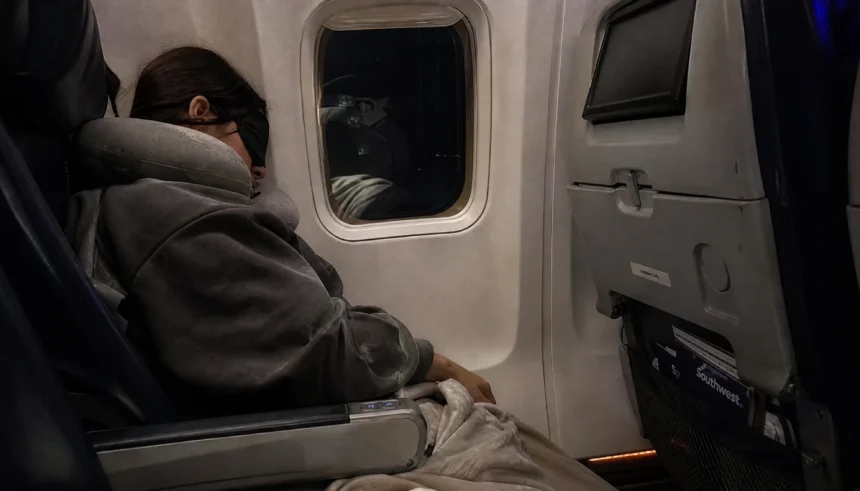
Here’s why it works. The window seat gives you a hard surface to lean against. You control your own space on one side. Nobody climbs over you during the flight, which means fewer interruptions. And you can press your head against the fuselage wall using a travel pillow as a buffer, which stops the “head bob” that wakes most people up.
The middle seat is the worst option for sleep. You have no wall, no elbow room, and two neighbors who may need to get up.
Aisle seats are better than middle, but you still get clipped by the cart and disturbed by your row-mates.
Seat placement within the cabin also matters. Choose seats behind the wing, not in front of it. Wing seats sit over the engines, the loudest point in the cabin. The rear cabin is also louder due to engine proximity. The sweet spot is roughly rows 15 to 25 on most narrow-body aircraft.
Avoid seats near the galley and lavatories. Light, noise, and foot traffic increase around both.
If you’re sleeping on a plane in economy overnight, the window seat becomes even more essential. A red-eye without a wall to lean on is a rough night.
A 5-Step Routine to Fall Asleep Fast on a Plane
This routine works. I used to board every flight knowing I’d arrive exhausted. On one 9-hour red-eye from London to Singapore, I tried everything: neck pillow, wine, audiobook, white noise. Total sleep: zero minutes. Then I started following a consistent pre-sleep sequence, and the next long-haul I got four solid hours. Here’s the exact setup.
Start as soon as the seatbelt sign goes off.
Step 1: Set your light and sound barrier immediately. Put on your sleep mask and earplugs or noise-canceling headphones before you do anything else. The longer you wait, the more stimulation your brain absorbs.
Step 2: Do 60 seconds of box breathing. Inhale for 4 counts, hold for 4, exhale for 4, hold for 4. Repeat 4 times. This drops your heart rate and signals to your nervous system that it’s time to wind down. It sounds small. It works.
Step 3: Assume your sleep position. See the section below on positions. Pick one before the flight, not during it.
Step 4: Play a 10-minute guided sleep meditation. Download one before you board. No internet needed. Apps like Calm or Insight Timer have offline options. Don’t use music. Guided voice gives your brain something passive to follow, which stops the mental chatter.
Step 5: If you’re still awake after 20 minutes, reset. Get up for 2 minutes in the aisle. Return, repeat Steps 1 through 4. Don’t lie there frustrated. Frustration is the enemy of sleep.
Economy Sleep Positions That Don’t Wreck Your Neck
Most people use a neck pillow the wrong way. They lean back into a seat that barely reclines and wonder why their neck is stiff. The seat isn’t designed for that angle.
These three positions actually work in the economy:
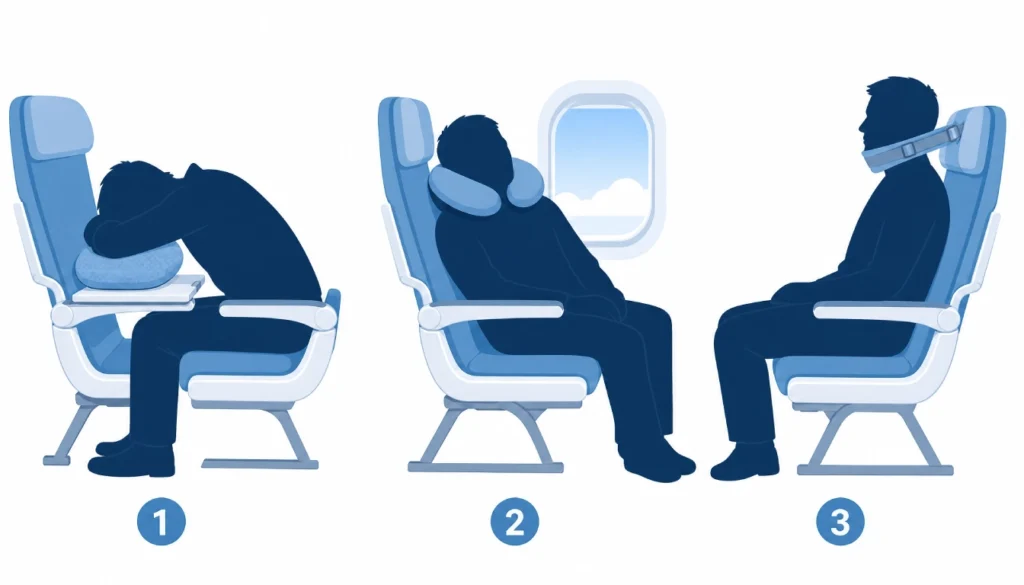
Position 1: Forward lean on the tray table. Lower your tray table and place your travel pillow on top. Fold your arms and rest your forehead on the pillow. This distributes your weight forward and takes pressure off your lower back. It feels odd at first. After five minutes, it’s one of the most comfortable options in the economy.
Position 2: Window lean. Press a U-shaped or wraparound pillow between your head and the window. The window gives you a fixed surface to rest against, which stops your head from dropping forward. Use the tray table armrest to support your elbow.
Position 3: Upright with a strap support. Strap-style head supports (like the Trtl pillow) wrap around your neck and clip to the headrest, holding your head in a neutral position. This works when you’re too cramped to lean. Your head won’t fall to the side.
For sleeping on a plane in economy overnight, Position 1 or Position 2 will get you the longest uninterrupted stretch. Position 3 is best for shorter naps.
Your Minimalist Airplane Sleep Kit (Only What Actually Works)
You don’t need a 12-item travel kit. You need five things.
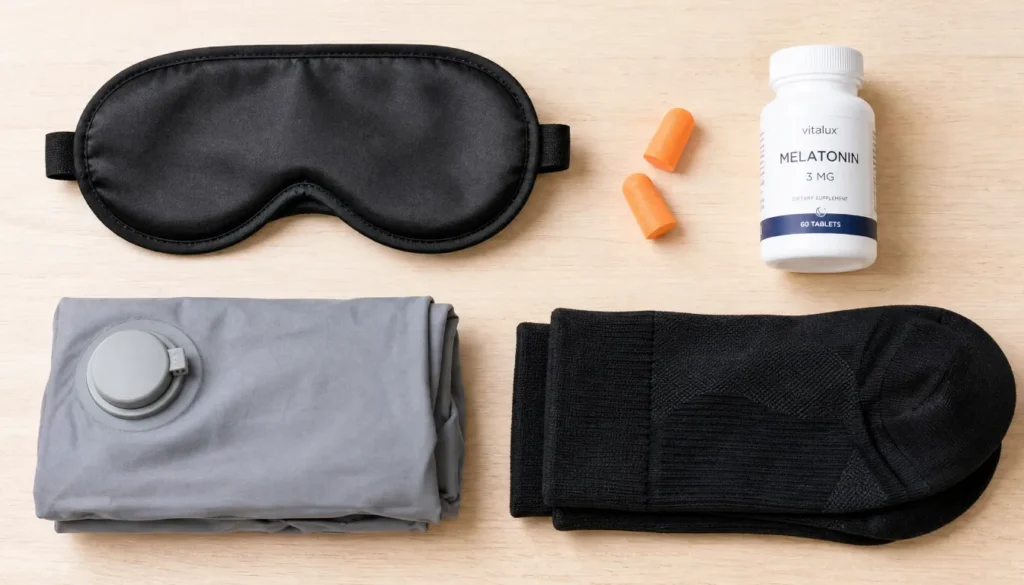
1. A contoured silk sleep mask. Flat masks press on your eyelids. Contoured masks create a small blackout dome around your eyes. The silk version won’t irritate skin on long flights.
2. Foam earplugs (NRR 32+). These are cheap, small, and more effective than most over-ear solutions for blocking the specific frequency range of engine noise. Pair them with noise-canceling headphones if you have them; the combination is noticeably better than either alone.
3. Low-dose melatonin (0.5 mg to 1 mg). High-dose melatonin (5 mg or 10 mg) gives many people a groggy morning. A low dose taken 30 minutes before you want to sleep is enough to shift your body clock. Check whether your destination country permits it, as some have import restrictions.
4. A compact travel pillow. Inflatable options weigh almost nothing and pack flat. Avoid the classic foam horseshoe; it rarely fits the space you actually have. The Trtl or an inflatable wrap pillow is the best way to sleep in economy class.
5. Compression socks. These aren’t just for DVT risk. They reduce leg swelling and the discomfort that wakes you up mid-flight.
How to Stay Asleep and Wake Up Feeling Human
Falling asleep is one problem. Staying asleep for more than 40 minutes in economy is another.
The main culprit is temperature. Cabins get cold mid-flight. Keep a scarf or light layer on your lap before you fall asleep so you can pull it up without fully waking.
The second culprit is dehydration. Keep a full water bottle at your seat. Drink before you put the mask on. If you wake up with a dry mouth mid-flight, drink immediately; thirst disrupts the return to sleep.
Avoid alcohol as a sleep aid. It feels like it helps because it relaxes you, but it fragments sleep architecture and causes you to wake more frequently in the second half of the flight. If you want a drink, have it during meal service, not right before you try to sleep.
Set a gentle alarm. If you’re on an overnight flight and need to be functional on arrival, set a quiet alarm (vibration on your wrist is ideal) to wake you 45 minutes before landing. This gives you time to stretch, hydrate, and feel like a person again.
Avoid the urge to immediately check your phone. Light from a screen in the first minutes of waking resets your alertness faster than anything, which sounds good but disorients your body clock on arrival.
The Best Way to Sleep in Economy Class: A Quick Summary
Learning how to sleep on a plane in economy takes one decent overnight flight of practice. The first time you run the full routine, you might get two hours. The second time, four. It compounds.
Seat choice is your priority. Window seat, middle cabin, away from galleys. Everything else builds from there.
Before your next flight, pack the five-item sleep kit. Run the 5-step routine from wheels-up. Pick one of the three sleep positions and commit to it.
You won’t arrive feeling like you slept in a bed. But you’ll arrive functional, which on a 10-hour flight is everything.
Try the routine on your next flight and leave a comment below with how many hours you got.