
You have a free evening. Nothing to do. And somehow, that feels terrible.
You scroll through options. You put your phone down. You pick it up again.
Nothing sounds interesting. Nothing sounds fun.
If that is where you are right now, this article is for you. Learning how to find a hobby when nothing seems fun is not about forcing enthusiasm you do not have. It is about running tiny, low-pressure experiments until something — anything — produces a small flicker.
Here is a 4-week plan that starts with almost no effort and no pretending.
Disclaimer: This article is for general self-improvement purposes only and is not a substitute for professional mental health advice. If apathy or numbness is affecting your daily life, please reach out to a qualified professional.
The Silent Crisis of Adult Boredom
Nobody warns you that adult boredom hits differently.
As a child, boredom was a gateway — you built forts, invented games, or wandered outside with no destination. As an adult, boredom often just sits there. Heavy. Quiet. Accompanied by a faint guilt that you should be doing something meaningful with your time.
The question “Why don’t I have any hobbies as an adult?” comes up more than you’d think. Research into adult leisure patterns suggests that work stress, overstimulation from screens, and the pressure to be productive all shrink the mental space where curiosity once lived.
You are not lazy. You are depleted.
That distinction matters a lot before we go anywhere else.
First, Understand Why Nothing Feels Fun
There is a clinical term for the experience of feeling no pleasure in activities you used to enjoy: anhedonia. It is a common symptom of burnout, depression, and chronic stress — not a personality flaw.
Even if your situation does not rise to clinical levels, the same brain chemistry is at play. Dopamine, the neurotransmitter behind motivation and reward, gets suppressed when you are chronically overstimulated or under-rested.
What this means practically:
You cannot think or will your way into enjoying something. You have to gently coax the nervous system back into curiosity — and that takes time, not effort.
The 4-week plan below is built around this understanding. Each week asks less of you than you expect.
Give Yourself Radical Permission to Be Bad at Something
Before week one, there is one rule to install.
You are not trying to find your passion. You are not building a skill. You are just poking at things.
The moment a hobby becomes something you “should” be good at, the brain flags it as a performance — and performance triggers anxiety, not enjoyment. This is why so many adults give up after two sessions of guitar or one failed watercolour attempt.
The reframe that helps most: trying something and feeling nothing is data, not failure.
I’ve noticed this firsthand. Two years ago, I could not get through twenty minutes of anything without wanting to quit. The shift only came when I stopped grading myself. I started treating each attempt like a scientist taking notes: Hmm. That did not spark anything. Next.
That scientific distance made all the difference.
The 4-Week Curiosity Reboot Plan (Overview)
Here is the shape of what we are doing:
- Week 1: Dig into your past for hidden clues about what once lit you up.
- Week 2: Try 5-minute micro-hobbies with zero commitment.
- Week 3: Run one solo and one social low-stakes experiment.
- Week 4: Notice the glimmers — tiny moments of interest — and make a gentle choice.
Each week builds on the last, but none of them asks you to “get excited.” You just have to show up for five minutes at a time.
Week 1: Dig Into Your Past for Hidden Clues
Your ten-year-old self had zero self-consciousness. That version of you tried things purely because they felt interesting.
That is the place to start.
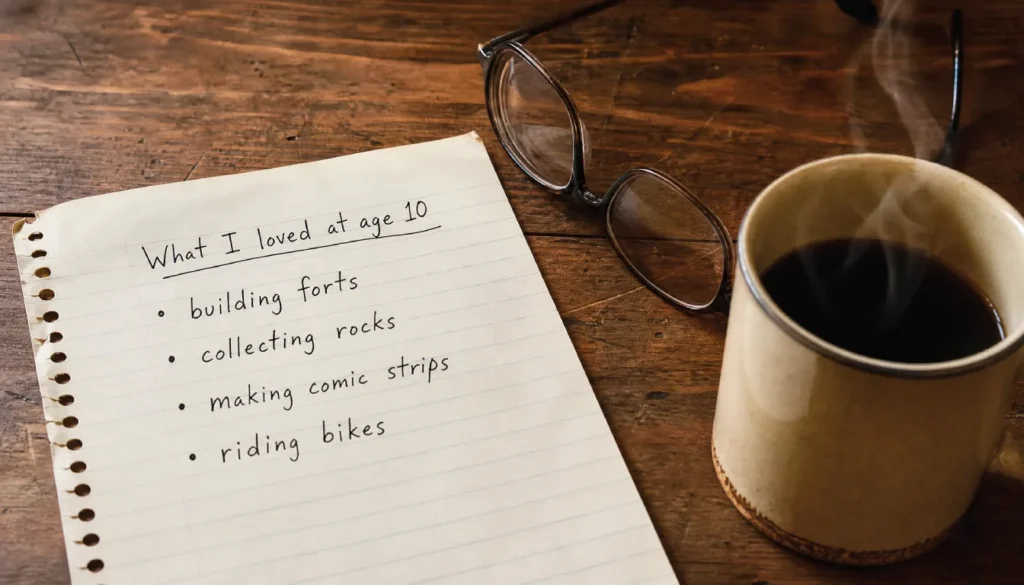
Step 1: Write a “What I Loved at Age 10” list.
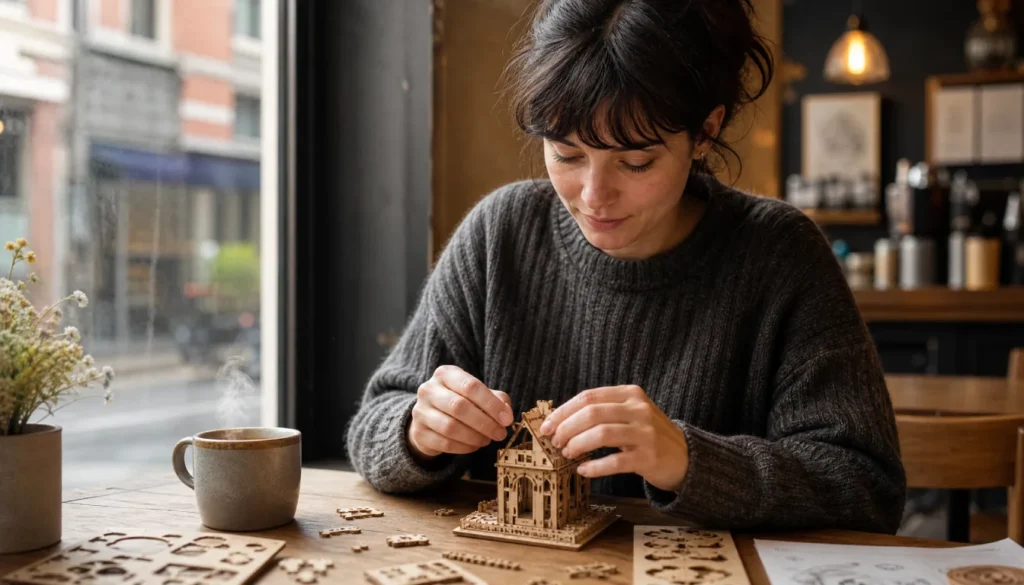
Grab paper and a pen. Set a five-minute timer. Write down everything you remember doing for fun between the ages of 8 and 14. Do not filter. Some starting prompts:
- What did you do on long summer days?
- What sections of the library or bookshop pulled you in?
- What did you collect, build, draw, or make?
- What activities made you lose track of time?
Common answers people write: building model kits, writing terrible comics, climbing things, keeping a nature notebook, learning magic tricks, rearranging furniture.
Step 2: Look for the underlying theme.
You are not going to go back to every childhood hobby — you are mining for the type of engagement that worked for you. Did you like working with your hands? Making things from scratch? Organising and categorising? Observing quietly?
This theme is your first real clue. How to rediscover old hobbies often begins right here — not with the exact activity, but with what that activity gave you.
Week 2: Try 5-Minute Micro-Hobbies (Zero Commitment)
Micro hobbies for people with no attention span are not a watered-down consolation prize. They are the right starting point for a depleted nervous system.
The rule is: five minutes only. You are not allowed to continue past five minutes on the first try. This removes the pressure of needing to “get into it” — you just show up for five minutes and observe how it feels afterwards.
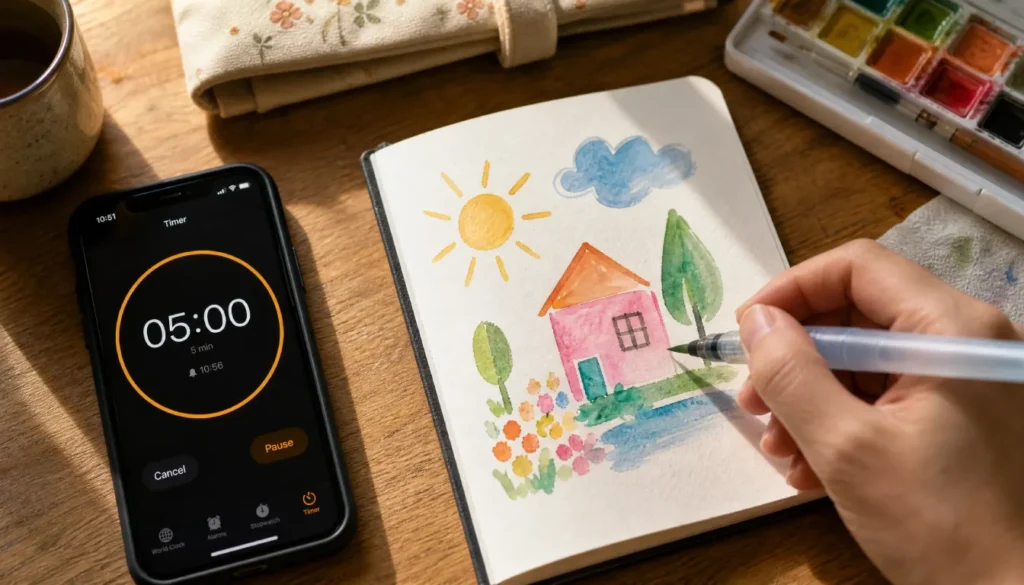
A starter list of 5-minute micro-hobbies:
- Doodle one thing on a notepad with a single coloured pencil
- Step outside and identify one bird, tree, or cloud shape using a free app
- Write three sentences of a story with no plan to continue
- Arrange five objects on your desk by colour or size
- Read one page of a book you have never opened
- Hum or tap out a rhythm to a song you like
- Fold one piece of paper into any shape
- Photograph one interesting texture around your home
How to track it (simply):
After each five-minute attempt, rate it on a scale of 0–3:
- 0 = Nothing. Flat.
- 1 = Neutral. Not unpleasant.
- 2 = A small flicker. I might try this again.
- 3 = I actually wanted to keep going.
You are not looking for 3s in week two. A 1 is a pass. A 2 is exciting. Keep your notes — they matter in week four.
Week 3: Low-Stakes Solo and Social Experiments
By week three, you have a short list of things that rated at least a 1. Now you take one of them slightly further — in two ways.
Experiment A: The Solo Outing
Take your highest-rated micro-hobby out of the house. Find a quiet café, a park bench, or a library corner. Spend twenty minutes on it there.
The change of setting does something important. It separates the activity from the home environment (where your brain often defaults to “task mode”) and gives it a small sense of occasion — without the pressure of doing it with anyone.
Experiment B: The Social Sample
Pick a low-commitment group activity related to one of your interests — a free drop-in class, a beginner craft night, a community birdwatching walk. One session. No obligation to return.
The point is not to find a community. The point is to observe whether being around others doing the same thing adds anything to the experience for you. Some people find it amplifying. Others discover they prefer solitude. Both are useful data.
Low-effort hobbies for adults with no motivation work best when the logistics stay simple. One bag. One short trip. Nothing to prepare in advance.
Week 4: Notice the Glimmers and Make a Gentle Choice
At the end of week three, you have four weeks of observations. Now you read them like a quiet detective.
Step 1: Find the glimmers.
A glimmer is not excitement. It is a moment where your attention did not immediately want to leave. Where you thought “hm” rather than “no.” Scan your notes for anything that scored a 2 or 3, or any session where you noticed time passing without resentment.
Step 2: Pick one thing to revisit — just once more.
Not to commit. Not to buy equipment. Just to try the highest-glimmer activity one more time, slightly longer — maybe fifteen to twenty minutes.
Step 3: Make a no-pressure decision.
After that second session, ask yourself: would I do this again next week, given almost no effort? If yes, that is your starting point. If no, that is fine too — go back to week two and try five new micro-hobbies.
This is not the end of the search. It is just the first checkpoint.
What If Nothing Worked? Next Steps and When to Get Help
First, this is more common than people admit.
If four weeks of gentle experiments produced nothing above a flat zero, that is worth paying attention to — not as a failure of the process, but as a signal worth taking seriously.
Persistent inability to find pleasure in anything can be a sign of clinical depression, burnout, or other conditions that genuinely benefit from professional support. Talking to a doctor or therapist is not a last resort — it is often the most efficient first step.
Some practical next directions if you want to keep trying on your own:
- Extend the micro-hobby list. Hobbies for adults who are bad at everything often appear in unexpected places — puzzle apps, community gardens, amateur astronomy, voice journaling, jigsaw puzzles, sourdough baking.
- Lower the bar even further. Try two-minute activities instead of five.
- Investigate sleep and movement first. Both have an outsized impact on dopamine sensitivity.
- Consider whether the environment — not just the activities — needs to change.
You are not running out of options. You are just at an earlier stage of the experiment than you expected.
Conclusion
How to find a hobby when nothing seems fun is rarely a motivation problem. It is usually a nervous system problem — one that responds to patience, small experiments, and zero pressure.
The 4-week plan in this article is designed to work with a depleted brain, not against it. Start with childhood clues. Try five-minute micro-hobbies. Run one solo and one social experiment. Then look for the quiet glimmers — those small moments where your attention stayed voluntarily.
You do not need a passion. You do not need enthusiasm. You just need one tiny experiment at a time.
What has your experience been? Drop it in the comments — even a “nothing worked yet” is worth sharing.
And if someone you know is in this same stuck place, share this with them. Sometimes just knowing the feeling has a name — and a plan — is enough to take the first step.