
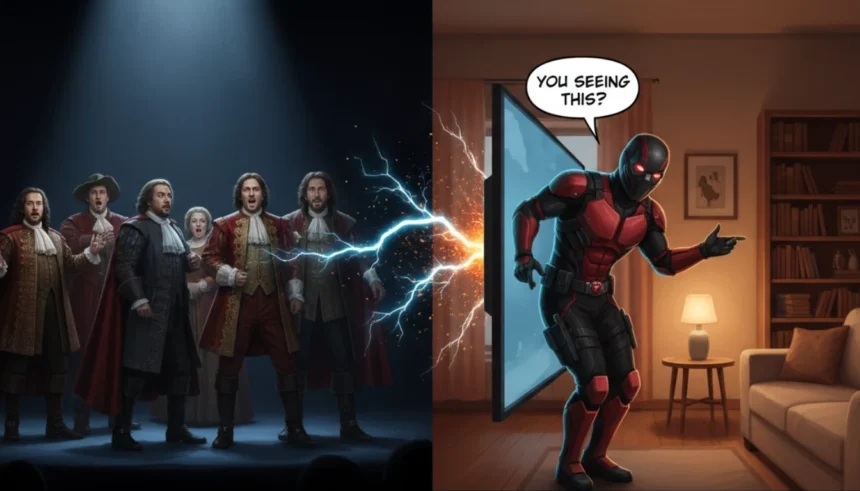
You’re watching Deadpool or Fleabag, and suddenly the main character turns to you and says something. You laugh, but a question pops up: “Wait, what’s that technique called? And why does it feel so weirdly personal?”
That’s breaking the fourth wall, and this guide will show you exactly what it is, where it started, why writers love it, and how you can try it yourself. No film-school jargon required.
What Is Breaking the Fourth Wall?
The fourth wall is the invisible barrier between the characters in a story and the audience watching them. In a theatre, three walls form the set. The fourth wall is the open side facing the crowd. Normally, actors pretend it’s solid. They ignore you completely.
Breaking the fourth wall means a character suddenly acknowledges that barrier and steps through it. They look directly at you. They speak to you. They wink, they sigh, they explain. For a moment, the fiction stops pretending it’s real.
You’ve seen it in superhero films, prestige TV, and classic comedies. It’s one of the most recognizable storytelling tools out there, and once you know its name, you’ll spot it everywhere.
Where Does the Term “Fourth Wall” Come From?
The phrase traces back to the 18th century. The French philosopher Denis Diderot wrote about the idea that actors should perform as if a wall separated them from the audience. He believed that great drama required performers to be fully absorbed in the scene, not performing for the crowd.
The term “fourth wall” itself became widely used in the 19th century, especially in realistic theatre. Playwrights wanted audiences to feel like they were watching real life through a window, not sitting in a theatre watching actors do their job.
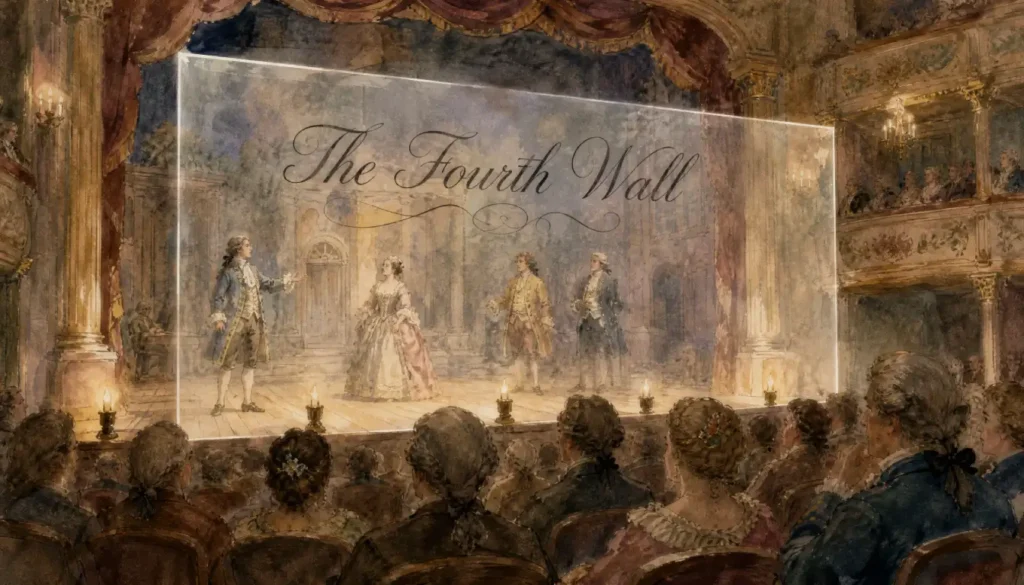
The moment a performer turned and spoke to the audience directly, they broke that agreed-upon fiction. It was considered jarring, even scandalous in some circles. Today, it’s a deliberate choice that writers and directors make for very specific reasons.
Why Do Shows and Movies Use This Technique?
Breaking the fourth wall is never accidental. Writers reach for it when they want something specific from the audience. There are three main reasons it shows up so often.
To Create Intimacy and Connection
When a character looks at you and speaks, your brain reacts differently than it does during a normal scene. You feel seen. You feel like you’re in on a secret that the other characters aren’t.
I first noticed this effect properly when I rewatched Fleabag for the second time. During a particularly emotional moment, she turns to the camera, and I felt a jolt. It wasn’t just clever writing. It genuinely made me feel like she was trusting me with her pain. That’s hard to create any other way.
This technique builds a one-on-one relationship between the character and every individual viewer. It’s personal in a way that standard dialogue simply isn’t.
To Get a Laugh (Comedy Loves It)
Comedy writers use fourth wall breaks constantly because the contrast between the in-world drama and the knowing aside is funny almost by default. When something absurd happens on screen, and the character shoots a look directly at you, it’s the visual equivalent of a raised eyebrow.
Deadpool built an entire franchise personality around this. His fourth-wall breaks work because the jokes land on multiple levels. He’s commenting on superhero conventions, on his own story, and on your expectations as a viewer, all at the same time.
To Make a Point or Comment on Society
Sometimes a character breaking the fourth wall is less about laughs and more about making you uncomfortable. Ferris Bueller’s Day Off uses it to position Ferris as a philosopher of freedom, speaking directly to teenagers who feel trapped by rules. He’s not just talking to the camera. He’s recruiting you.
More recently, shows such as Fleabag and House of Cards use it to put the audience in a morally complicated position. You become a confidant to characters who are unreliable, manipulative, or self-deceived. You’re implicated in what they do.
Famous Examples of Fourth Wall Breaking in Movies and TV
This technique shows up across every genre. Here are the most studied examples and what each one actually does.
Deadpool (2016 onward): Ryan Reynolds’ character talks to the audience constantly, often commenting on the plot itself. It works because Deadpool is already aware he’s a comic book character. The fourth wall breaks aren’t a gimmick. They’re built into his personality.
Fleabag (BBC, 2016-2019): Writer and star Phoebe Waller-Bridge uses the camera as a silent best friend. Her character confides in the audience, shares jokes, and hides things from us too. By series two, the breaks become emotionally devastating rather than comedic.
Ferris Bueller’s Day Off (1986): John Hughes had Ferris deliver life lessons straight to camera throughout the film. It’s warm and conspiratorial, making the audience feel like teenage co-conspirators rather than passive viewers.
Zack Morris in Saved by the Bell: He’d freeze time and explain his plan to the viewer. It made a chaotic sitcom feel personal, and kids watching felt like they had a friend letting them into a secret.
Frank Underwood in House of Cards (US): Kevin Spacey’s character would turn mid-scene and address the audience with cold, calculating commentary. It made viewers feel complicit in his schemes.
Deadpool & Wolverine (2024): The fourth wall breaking went even further, with meta-commentary on the Marvel universe itself. It’s a good example of how the technique can become the central comedic engine of an entire film.
What Is the Effect of Breaking the Fourth Wall on the Viewer?
Psychologically, direct address triggers what researchers call “para-social interaction.” You feel a connection to someone who cannot actually know you exist. When a character looks at the lens, your brain treats it similarly to eye contact in real life.
That’s why the technique carries weight. It’s not just a stylistic choice. It physically changes how your brain processes the story.
The key effects:
- You feel included and trusted, which raises your emotional investment.
- The story’s grip on you briefly loosens, creating a space for comedy, irony, or reflection.
- You become complicit in the character’s choices, which writers use to great ethical effect.
- The break signals that this character is self-aware, which adds a layer of complexity to their personality.
The risk is that it can also break immersion badly if used carelessly. One poorly timed aside and the audience is reminded they’re watching a show, which can undermine genuine dramatic tension.
How to Write a Fourth Wall Break (Tips for Beginners)
I’ve worked through this myself in short scripts and found that most beginner writers either overuse fourth wall breaks until they lose meaning, or they avoid them entirely because they seem too risky. The truth is, they’re not complicated to write. You just need a clear reason to use one.
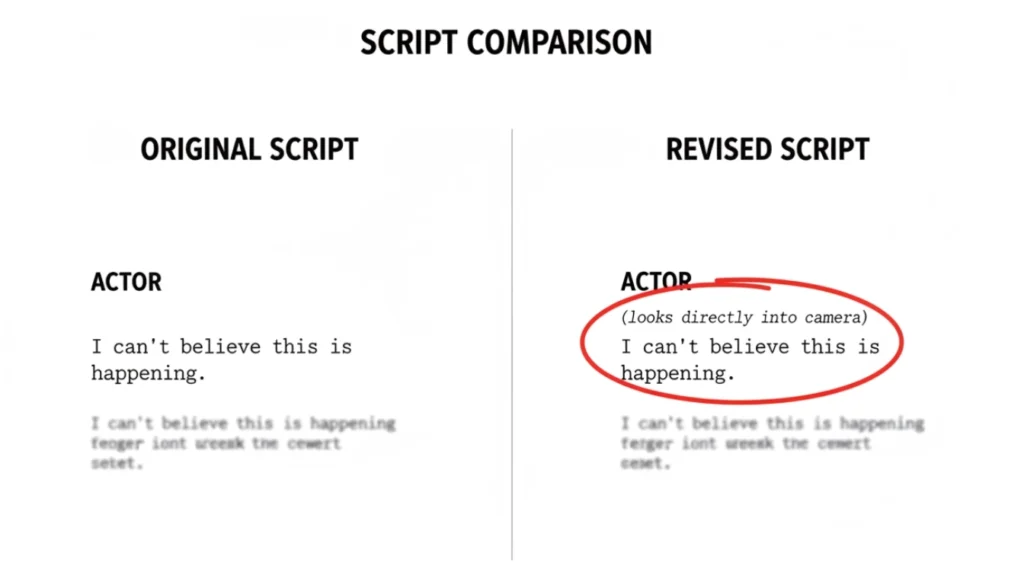
Follow these three steps when writing your first fourth wall break.
Step 1: Decide why your character is speaking to the audience.
Before you write a single word, know the purpose. Is it to share a secret? To make a joke at another character’s expense? To comment on something absurd? To tell the audience something they need to know before the next scene?
If you can’t answer that in one sentence, don’t write the break yet. Purpose comes first.
Step 2: Keep it short and get back to the story.
One or two lines. Three at most. A fourth wall break that goes on too long becomes a monologue, and the technique loses its punch. The power comes from the speed of the pivot: one moment the character is in the story, the next they’re talking to you, then they’re back before the other characters notice.
Think of it like a quick aside to a friend you’re sitting next to. You don’t pause the whole evening. You lean over, say something, and return.
Step 3: Read it out loud before keeping it.
This is the test I use every time. If the break sounds natural, adds something the scene didn’t have without it, and doesn’t slow the story down, keep it. If it feels like a trick or a gimmick, or if you can remove it without losing anything, cut it.
The best fourth wall breaks feel inevitable. Like the character had to say that to you, right then, and there was no other way.
Frequently Asked Questions
Is breaking the fourth wall the same as an aside?
An aside is a theatrical predecessor. The actor speaks to the audience while other characters pretend not to hear. Breaking the fourth wall in modern usage is broader: it includes direct camera address, characters acknowledging they’re in a story, and meta-commentary on the genre itself.
What is breaking the fourth wall in TV shows specifically?
In TV, the fourth wall meaning works the same way, but the format creates different opportunities. A sitcom character can break it once per episode for maximum impact. A drama series might save it for a pivotal moment. Some shows, like Fleabag, built their entire identity around regular, rhythmic breaks.
Can breaking the fourth wall ruin a story?
Yes, if used carelessly. It works when it fits the character’s voice and serves the story’s goals. It falls apart when it’s used as a shortcut for exposition or when it contradicts the tone the show has established.
Does breaking the fourth wall mean the character knows they’re fictional?
Not always. Some characters, like Deadpool, explicitly know they’re in a story. Others, like Ferris Bueller, seem to sense the audience is there. The level of meta-awareness varies by character and by writer intent.
Can you break the fourth wall in writing, not just film?
Absolutely. Novels have used it for centuries. Laurence Sterne’s Tristram Shandy (1759) is a famous early example. The narrator addresses the reader directly, anticipates objections, and acknowledges the act of writing. It’s the same technique, just on the page.
Wrapping Up
Breaking the fourth wall is one of the most versatile tools in a writer’s kit. At its best, it creates genuine emotional connection, sharp comedy, and moral complexity all at once. At its worst, it’s a lazy shortcut. The difference is almost always intent.
Now that you understand what breaking the fourth wall means, where it came from, and what it actually does to viewers, you’ll see it differently every time it happens. Watch how long the break lasts. Notice whether it makes you laugh or makes you uncomfortable. Ask yourself what the writer was trying to put in your hands by making you the character’s confidant.
If you’re a writer, try it once in your next short script or story. Start small. One moment, one purpose, one line. Then read it aloud.
You’ll know immediately whether it earns its place.