
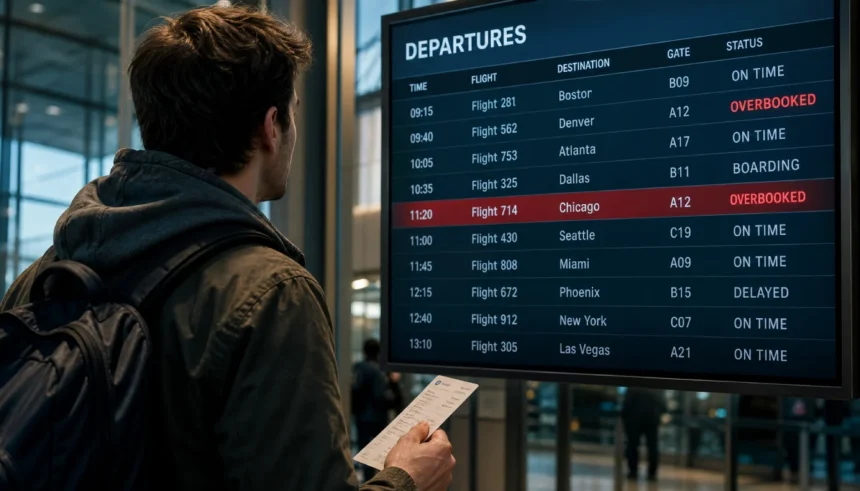
You checked in. Your bags are tagged. Then the gate agent announces the flight is overbooked.
Your stomach drops. Why does this even happen? Can they really bump you off a flight you paid for?
Take a breath. There’s a surprisingly simple business reason behind it, and it’s not a scam. Here’s the simple explanation for why flights get overbooked, what it means for you, and how to come out ahead if it happens.
What Does “Overbooked” Mean, Plain and Simple?
What does it mean when a flight is overbooked? It means the airline sold more tickets than there are seats on the plane.
That sounds reckless. It isn’t. Airlines run this play on purpose, and they’ve done the math on it for decades.
Every flight has a few passengers who never show up. Sick days, missed connections, last-minute changes. Airlines call this the no-show rate. They use it to predict how many extra seats they can safely sell.
Most of the time, the math works out. Every seat fills, and nobody notices a thing. Sometimes it doesn’t, and that’s when you hear your name at the gate.
Why Do Airlines Overbook Flights? The 2-Minute Explanation
Here’s the business case in plain terms.
An empty seat earns the airline nothing. A no-show costs the airline real money. So airlines sell a small buffer of extra tickets on routes where no-shows are common, usually business routes and early morning flights.
Think of it like a restaurant taking more reservations than tables. They know a few parties will cancel. If everyone shows up at once, someone waits at the bar.
Key takeaway: overbooking isn’t a mistake. It’s a calculated bet, and airlines win that bet on the vast majority of flights.
I’ve flown over 40 domestic routes in the past three years. I’ve been offered a voucher for volunteering exactly twice. That matches what the data shows: DOT records around a 0.06% involuntary bump rate for major US carriers, so it’s rare, but it does happen.
Is Overbooking Even Legal? (Spoiler: Yes, With Rules)
Is overbooking flights legal? Yes. It’s a standard, legal industry practice in the US and across most of the world.
What isn’t legal is handling it badly. Airlines must follow strict rules once a flight is oversold.
In the US, the Department of Transportation’s Rule 250 sets out what airlines owe passengers who get bumped. In the EU, EU261/2004 does the same job with its own compensation scale.
Both rules exist for one reason: to stop airlines from treating overbooking as a free pass to strand paying customers.
What Happens When a Flight Is Overbooked: The Gate Drama Explained
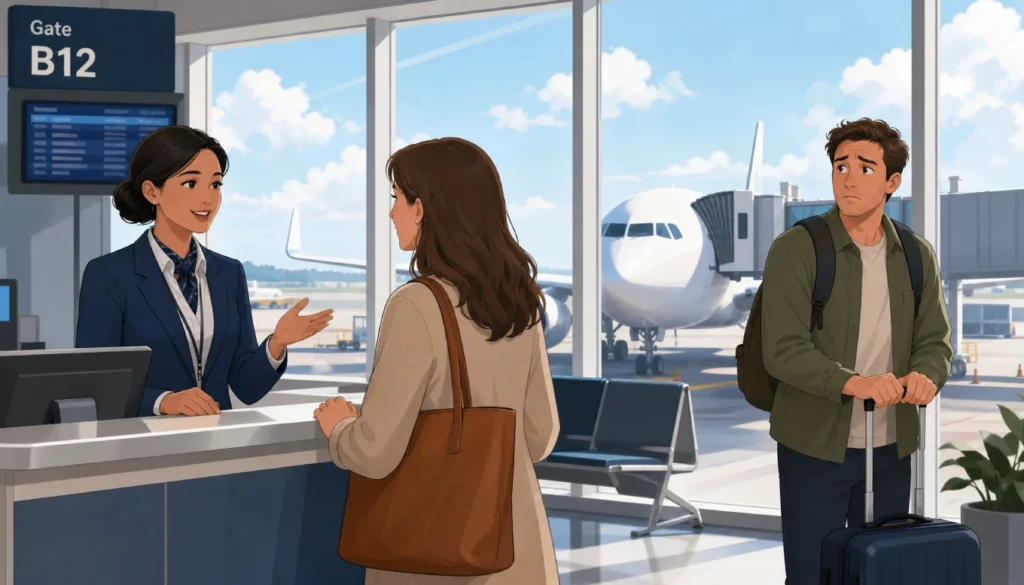
Here’s the order of events, almost every time.
- The gate agent counts confirmed passengers against seats.
- If there’s a shortfall, they ask for volunteers over the intercom or through the app.
- They offer compensation, usually a travel voucher, sometimes cash, plus a seat on a later flight.
- If not enough people volunteer, the airline picks passengers to bump involuntarily, based on factors like check-in time, fare class, and loyalty status.
I once showed up at the gate 45 minutes early, boarding pass in hand, and heard my name called for volunteers. I listened to the offer before saying anything. It was a $300 voucher and a seat two hours later. I didn’t have to take it, but knowing my rights meant I could weigh the offer instead of panicking. That voucher paid for most of my next flight.
That’s the move. Listen first. Decide second.
Your Overbooked Flight Rights and Compensation You Can Get
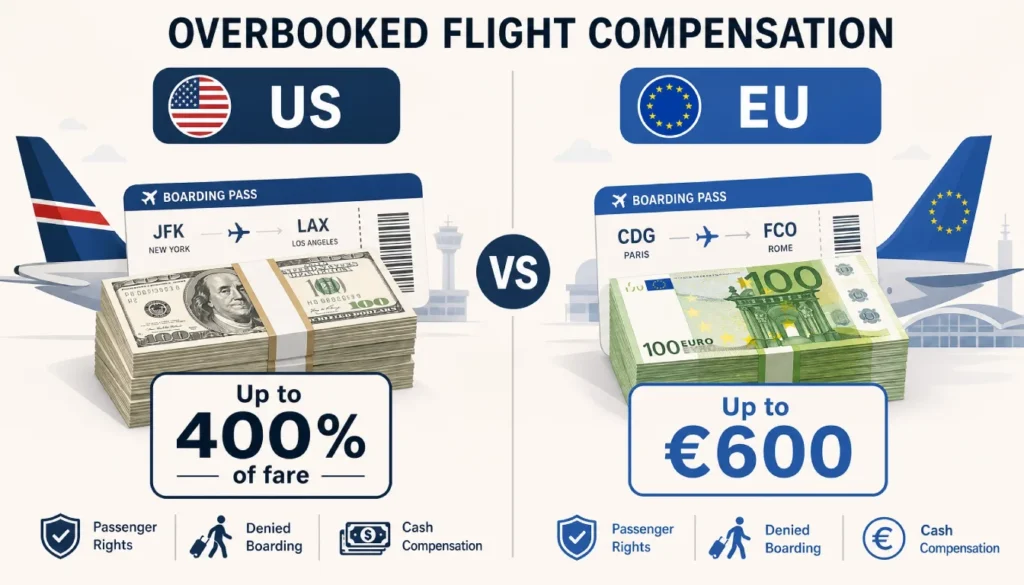
Your overbooked flight rights kick in the moment you’re denied boarding involuntarily. Here’s what the rules actually say.
In the US (DOT Rule 250):
- Under a 1-hour delay to your arrival: no compensation required.
- 1 to 2 hours delay (1 to 4 hours for international flights): 200% of your one-way fare, capped at $775.
- Over 2 hours delay (over 4 hours international): 400% of your one-way fare, capped at $1,550.
- You must also get a written statement explaining your rights.
In the EU (EU261/2004):
- Short flights under 1,500 km: up to €250.
- Medium flights within the EU over 1,500 km: up to €400.
- Long-haul flights over 3,500 km: up to €600.
- Airlines must also offer a choice of rerouting or a full refund.
Bottom line: if you’re bumped against your will, you’re entitled to real money, not just an apology and a snack voucher. Ask for the written notice at the gate. Don’t let anyone tell you compensation is optional if you’ve been involuntarily denied boarding.
If You’re Facing an Overbooked Flight Right Now, Do This
- Step 1: Don’t panic. Overbooking is legal, and the airline must follow set rules.
- Step 2: Decide if you want to volunteer. Hear the compensation offer before you say no.
- Step 3: If you’re bumped involuntarily, ask for the written notice of your rights immediately, and confirm your compensation amount before you leave the counter.
How to Avoid Getting Bumped (7 Simple Pre-Flight Habits)
You can’t stop an airline from overbooking a flight. You can lower your odds of being the one who gets bumped.
- Check in early. Airlines often bump the last people who checked in first.
- Choose a seat at booking. Passengers without an assigned seat get flagged more often.
- Fly early in the day. Morning flights have fewer no-shows, so airlines overbook them less.
- Join the airline’s loyalty program. Status holders are usually the last picked for involuntary bumps.
- Avoid the cheapest fare class on popular routes. Basic economy tickets are the first ones airlines bump.
- Get to the gate on time, not just the airport. A late arrival at the gate looks like a possible no-show.
- Set a fare alert for oversold-prone routes. Holiday weekends and Friday evening flights overbook the most.
I’ve helped friends rebook after a bump more than a dozen times, and the pattern is always the same. The people picked are almost always the last to check in and the cheapest fare on the ticket. Check in the second the window opens, and you cut your risk significantly.
FAQs
Does overbooking mean my flight is cancelled?
No. Overbooking only affects boarding, not the flight itself. The plane still flies as scheduled.
Can I refuse to give up my seat?
Yes. Volunteering is optional. If you refuse and the airline still needs seats, they can bump you involuntarily, but you’re then owed compensation under the rules above.
Do I get compensation if I volunteer?
Yes, but the amount is whatever you negotiate with the gate agent. It isn’t fixed by law like involuntary bumping compensation.
How common is getting bumped?
Rare. DOT data puts involuntary bumping at a fraction of 1% of passengers on major US carriers each year.
Can budget airlines overbook too?
Yes. The same DOT and EU rules apply to budget carriers, though enforcement and customer service response can vary.
Final Thought
So, why do flights get overbooked? Airlines oversell seats because a predictable number of passengers never show up, and an empty seat is lost revenue they can’t get back.
It’s legal, it’s common, and it’s manageable if you know your overbooked flight rights before you get to the gate. Check in early, pick your seat, and if you’re ever asked to give up your spot, listen to the offer before you decide.
Have you ever been bumped from a flight? Drop your story in the comments. It might help the next reader spot the same situation coming.