
Last month I asked an AI tool to summarize a research paper. It gave me a clean, confident answer, complete with a quote and a page number. One problem. The quote didn’t exist. Neither did the page.
That was my first real run-in with an AI hallucination. It felt strange. The tool sounded so sure of itself. No hesitation, no hedging, just a wrong answer delivered with total confidence.
If you use ChatGPT, Claude, or any other AI tool, you’ve probably hit this too. Maybe it invented a source. Maybe it gave you a fact that turned out to be false. That mix of trust and confusion is exactly why this topic matters.
In this article, I’ll explain what AI hallucination is in plain terms, why AI hallucinates, and walk through real-life examples of AI hallucinations from ChatGPT, Bard, and even a chatbot that got a company sued. By the end, you’ll know how to spot one and how to protect yourself from being misled.
What Is AI Hallucination in Simple Terms
An AI hallucination happens when an AI model generates information that sounds true but isn’t. The AI hallucination definition boils down to this: the tool produces false content, made up, or not backed by real data, and it presents that content as fact.
This isn’t the AI trying to trick you. Large language models work by predicting the next word based on patterns in their training data. They don’t actually “know” things the way a person does. So when they don’t have the right answer, they still generate one anyway.
Think of it less like lying and more like guessing with confidence. That difference matters, and we’ll get into AI hallucination vs lying a bit later.
Why Does AI Hallucinate
Understanding the causes of AI hallucination helps you know when to be extra careful. Here are the main reasons this happens.
Gaps in training data. Every AI model has a knowledge cutoff. If you ask about something recent or something obscure, the model may fill in the blanks with a guess instead of admitting it doesn’t know.
Pattern matching over fact checking. AI models are built to predict likely word sequences, not to verify facts. A confident-sounding sentence can be completely wrong.
Ambiguous or vague prompts. If your question is unclear, the AI has to make assumptions. Those assumptions can turn into fabricated details.
Overconfidence in output. Most models are trained to sound helpful and certain. That tone doesn’t change even when the underlying facts are shaky.
Complex or niche topics. The more specialized the subject, whether it’s medical, legal, or scientific, the higher the chance of hallucination in large language models.
Types of AI Hallucinations
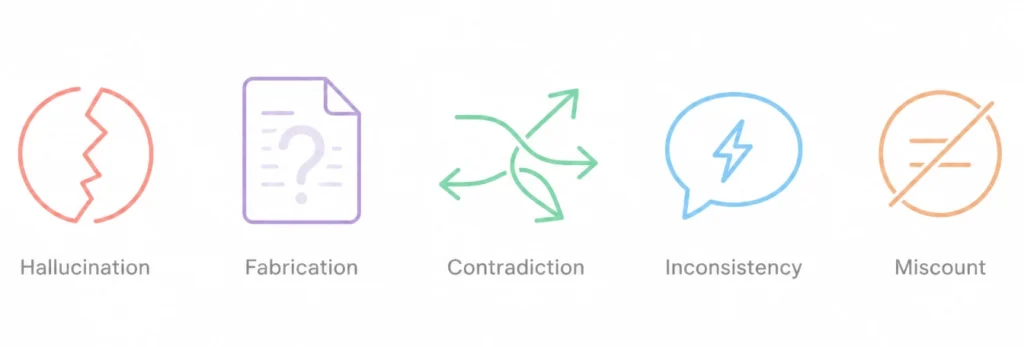
Not all hallucinations look the same. Knowing the different types helps you catch them faster.
- Factual hallucination. The AI states something false as if it were true, like the wrong date for a historical event.
- Fabricated sources. The AI invents a study, article, or quote that doesn’t exist. This is common when you ask for citations.
- Logical hallucination. The response contradicts itself or doesn’t follow from the question you asked.
- Context hallucination. The AI mixes up details from earlier in the conversation and applies them incorrectly.
- Numerical hallucination. The tool gives you a statistic or calculation that’s simply wrong.
Real Life Examples of AI Hallucinations

Reading about hallucinations in theory is one thing. Seeing real cases makes the risk click.
ChatGPT hallucinations in legal filings. A lawyer used ChatGPT to research case law and submitted a brief with fake court cases. The AI had invented them, complete with case numbers. The judge caught it, and the story became one of the most talked about AI hallucination lawsuit cases.
Google Bard’s factual mistake. During a public demo, Google’s Bard chatbot gave an incorrect answer about a space telescope discovery. The error was small but happened in front of a huge audience, and it cost the company a noticeable stock drop.
Air Canada chatbot hallucination case. A customer asked Air Canada’s support chatbot about bereavement fares. The bot gave incorrect policy information. When the airline refused to honor it, a tribunal ruled the company had to, since the chatbot’s words counted as official information from the company.
Medical chatbot hallucination example. Some health related AI tools have suggested treatments or drug interactions that aren’t supported by real medical guidance. This is exactly why hallucination in healthcare settings needs extra caution and human review.
AI-generated fake medical literature. Researchers have found AI tools citing medical studies that were never published. That’s a serious problem for anyone using AI for health research.
AI Hallucination vs Lying: What’s the Difference
This trips people up a lot. Lying requires intent. A person lies because they know the truth and choose to say something else.
AI doesn’t have intent. It doesn’t know it’s wrong. The difference between AI hallucination and bias matters here too. Bias comes from patterns baked into training data, like favoring certain viewpoints. A hallucination is simply made-up content, regardless of any bias.
So when an AI hallucinates, it’s not being dishonest. It’s producing a statistically likely response that happens to be false.
How to Spot an AI Hallucination in Text
Here are some quick signs a response might be hallucinated.
| Warning Sign | What to Do |
|---|---|
| Very specific numbers or dates with no source | Ask for the source directly |
| Citations you can’t find online | Search the exact title or author name |
| Overly confident tone on a niche topic | Cross-check with a trusted site |
| Contradicts something said earlier in chat | Ask the AI to clarify or restate |
| Sounds too perfect or too convenient | Slow down and verify |
How to Prevent AI Hallucinations

You can’t eliminate hallucinations, but you can reduce your risk with a few habits.
- Ask for sources. Request links or citations, then check if they’re real.
- Use retrieval-augmented generation tools when possible. RAG systems pull from real documents instead of relying only on memory, which lowers hallucination rates.
- Break big questions into smaller ones. Specific, clear prompts reduce guessing.
- Fact-check anything important. For health, legal, or financial topics, always verify with a real professional or source.
- Watch for AI hallucination detection tools. Some platforms now flag low-confidence answers automatically.
Mistakes to Avoid
- Don’t trust AI output blindly for high-stakes decisions like medical or legal advice.
- Don’t assume a confident tone means accurate information.
- Don’t skip fact-checking citations, even ones that look legitimate.
- Don’t use AI as your only source for anything time-sensitive or niche.
FAQs About AI Hallucination
What is an example of an AI hallucination in ChatGPT?
A common example is when ChatGPT generates a book title, study, or quote that sounds real but doesn’t actually exist anywhere.
How often does ChatGPT hallucinate?
Rates vary by version and topic, but studies have shown hallucination rates ranging from a few percent to over 20 percent on complex or niche questions.
Can AI hallucinations be fixed?
They can be reduced through better training, retrieval-augmented generation, and human review, but they haven’t been fully eliminated in any major AI model yet.
Is an AI hallucination the same as a bug?
No. A bug is a coding error. A hallucination is the model generating false content that sounds correct, which is a different kind of problem tied to how language models predict text.
Why do AI models generate false information so confidently?
Because they’re trained to produce fluent, natural-sounding language, not to express uncertainty. That fluency can make wrong answers sound just as convincing as right ones.
Final Thoughts
AI hallucinations aren’t going away anytime soon, but that doesn’t mean you’re powerless. Once you know what to look for, you can use AI tools with more confidence and less worry.
I still use AI every day. I just don’t take its word as final anymore. A quick fact check takes thirty seconds and can save you from a wrong citation, a bad decision, or worse.
Have you run into an AI hallucination yourself? Drop your story in the comments. I’d love to hear what you caught and how you handled it.