

You’ve heard the term AI a thousand times. The news says it will steal jobs. Your phone uses it. Your kids talk about it. And you’re quietly thinking: what even is it, and should I be scared?
Most explanations are full of jargon or sci-fi hype. They leave normal people more confused than before.
In this guide, I’ll explain artificial intelligence in simple words. You’ll learn what it really is, how it works without a single line of code, and when you actually need to worry. No tech background needed, just ten minutes of your time.
What Is Artificial Intelligence in Simple Words?
Artificial intelligence is a computer program that learns from examples instead of following a fixed set of rules. You show it a lot of information, and it finds patterns on its own.
That’s it. No robots, no consciousness, no secret plan. Just a program that gets better at a task the more examples it sees.
A Plain-English Definition You Can Use Today
Here’s a definition you can repeat at dinner parties: AI is software that spots patterns in data and uses those patterns to make a guess.
Netflix guesses what you’ll want to watch next. Your email guesses which messages are spam. Your phone camera guesses where the faces are in a photo. Every one of those is AI, and none of them involve anything scary.
The Difference Between AI and Machine Learning (60-Second Version)
People use these terms like they mean the same thing. They don’t, quite.
AI is the big idea: machines doing tasks that normally need human thinking. Machine learning is one way to build AI. Instead of a programmer writing every rule by hand, the machine learns the rules itself from data.
Think of it this way. AI is the goal. Machine learning is the method most modern AI tools actually use to get there.
How Does AI Work for Beginners? (The Super-Simple Explanation)
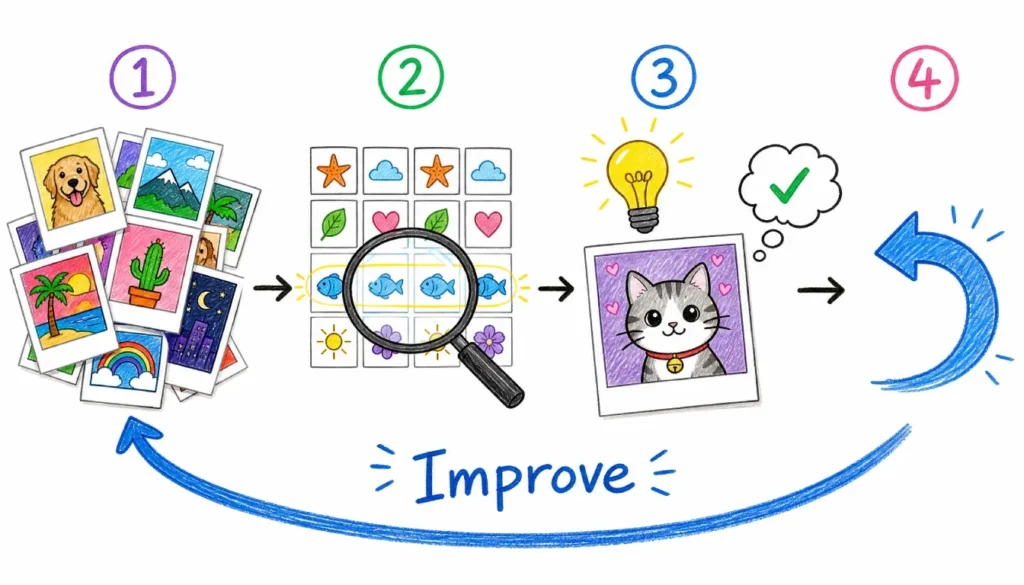
Here’s how AI works for beginners, stripped of all the technical noise. A program looks at thousands or millions of examples. It notices which patterns lead to which outcomes. Then it uses that pattern to predict the next example.
Learning from Examples, Like Teaching a Child
Imagine teaching a toddler what a dog looks like. You don’t hand them a rulebook. You point at real dogs. Big ones, small ones, fluffy ones, until they can spot a dog on their own.
AI learns the same way. Show it thousands of labeled photos, and it starts recognizing the pattern that makes a dog a dog. No instructions required, just repetition and correction.
I remember when I first tried to understand this. I assumed AI had to be coded rule by rule, like a giant flowchart. It clicked once I saw it as teaching by example instead of teaching by instruction. That single shift made the whole topic click for me, and I think it’ll do the same for you.
Algorithms Are Just Recipes
The word “algorithm” sounds intimidating. It shouldn’t.
An algorithm is a set of steps a computer follows, the same way a recipe is a set of steps a cook follows. Add flour, mix, bake at 350. An AI algorithm just has steps for spotting patterns instead of baking bread.
Once you see algorithms as recipes, the mystery drops away fast.
AI for Everyday Life: You Already Use It More Than You Think
You don’t need a lab coat to interact with AI. You’ve used it today already.
Here are everyday AI examples you probably ran into this week:
- Your email’s spam filter, sorting junk from real mail
- Netflix or Spotify recommendations based on what you’ve watched or heard
- Google Maps predicting your fastest route
- Your phone’s autocorrect and predictive text
- Voice assistants like Siri or Alexa understanding your speech
- Your bank flagging a suspicious charge
- Face unlock on your phone
- Online shopping sites suggesting “you might also like”
- Photo apps sorting pictures by the people in them
- Customer service chatbots answering basic questions
None of these are dramatic. That’s the point. AI for everyday life mostly looks like small, quiet conveniences, not headline-grabbing robots.
When to Worry About Artificial Intelligence (and When to Relax)
This is the section most people actually came here for. So let’s answer it directly.
Real Concerns: Jobs, Bias, and Your Privacy
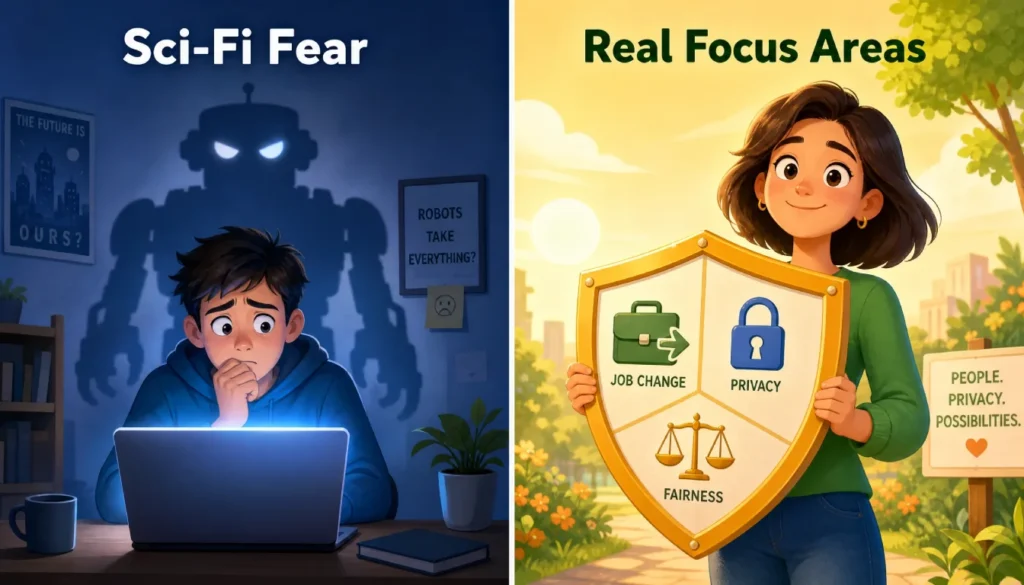
Some worries about AI are worth your attention. Job displacement is real. Certain tasks, especially repetitive data work, are shifting to AI tools. That doesn’t mean every job disappears, but some roles will change shape.
Bias is another genuine issue. If an AI learns from biased data, it repeats that bias. This has shown up in hiring tools and lending decisions. It’s a real problem that companies and regulators are actively working on.
Privacy deserves your attention too. AI tools often run on your personal data. Knowing what a company collects and how it’s used is a smart habit, AI or not.
AI Fears and Myths Explained: What’s Actually Science Fiction
Now let’s clear up the AI fears and myths that get all the attention but don’t hold up.
Myth: AI is secretly conscious. No current AI system thinks, feels, or wants anything. It predicts patterns. That’s the whole trick.
Myth: AI will suddenly take over everything. Today’s AI tools are narrow. A tool built to recommend movies can’t drive a car or run a country. Each system does one job.
Myth: AI is always right. It isn’t. AI makes confident mistakes constantly. Treat its answers as a first draft, not a final word.
The truth sits somewhere in the middle. You don’t need to panic, but it’s smart to pay attention to the real issues: jobs, bias, and privacy, not the movie-style ones.
I’ve walked a lot of friends through this exact conversation, and the pattern is always the same. Once they separate the sci-fi fear from the practical concern, the anxiety drops fast and the curiosity kicks in.
Simple Terms to Know: Your AI Cheat Sheet
Keep this list handy next time AI comes up in conversation.
- Algorithm: A set of steps a computer follows, like a recipe
- Machine learning: A way for computers to learn patterns from data instead of fixed rules
- Training data: The examples an AI studies to learn a task
- Model: The finished program after it has learned from the data
- Chatbot: A program built to hold a text conversation, like ChatGPT
- Bias: When an AI’s output unfairly favors or disfavors a group, usually from skewed training data
- Prediction: The AI’s best guess based on patterns it has learned
What Should You Do Next? Staying Smart, Not Scared
If you’re feeling overwhelmed by AI, here’s a simple three-step plan.
Step 1: Learn the basics. You just did. With today’s plain-English definitions, you already know more than most people.
Step 2: Spot AI in your daily life. Start noticing when you use Netflix recommendations, spam filters, or voice assistants. It turns fear into familiarity fast.
Step 3: Stay aware, not anxious. Pick one trustworthy source that explains AI in plain language and check in once a month. That’s enough to stay current without drowning in headlines.
That’s it. You don’t need to code. You don’t need to be a tech expert. You just need to stay curious.
Frequently Asked Questions
What is artificial intelligence in simple words?
AI is software that learns patterns from examples and uses those patterns to make predictions or decisions, without a person writing every rule by hand.
Is AI the same as machine learning?
Not exactly. AI is the broad goal of machines performing tasks that normally need human thinking. Machine learning is the most common method used to build that AI today.
Should I be worried about AI taking my job?
Some tasks will shift, especially repetitive ones. Full job disappearance is rare. Learning to work alongside AI tools is a stronger strategy than avoiding them.
Is AI dangerous?
Today’s AI systems are narrow and don’t think or want anything. The real risks are practical: bias in decisions, data privacy, and job shifts, not robots taking over.
How can I start learning about AI without getting overwhelmed?
Start small. Notice the AI tools you already use, read one plain-English source a month, and skip the panic headlines.
Final Thoughts
Artificial intelligence in simple words comes down to this: it’s software that learns from examples instead of following rigid rules. You already use it every day through your email, your maps app, and your streaming service.
The real conversation isn’t about robots taking over the world. It’s about jobs shifting, data privacy, and fairness, and those are things you can actually track and prepare for.
You don’t need a computer science degree to understand what artificial intelligence is in simple words. You just need someone to explain it without the noise. Now you have that.
Your turn: drop a comment with the AI tool you use most without even thinking about it. It’s a great way to see how normal this technology already is in your life.