You just spilled water on your brand new phone. The box said IP68, but now you’re checking for damage anyway. You’re not alone. Most people don’t know what the ip68 meaning waterproof rating actually covers.
Here’s the truth. IP68 does protect your phone from water. But it has limits most brands never explain. This guide breaks down exactly what IP68 allows, what it blocks, and where it fails you.
What Does IP68 Actually Mean?
IP stands for Ingress Protection. It’s an international standard that measures how well a device seals out solids and liquids.
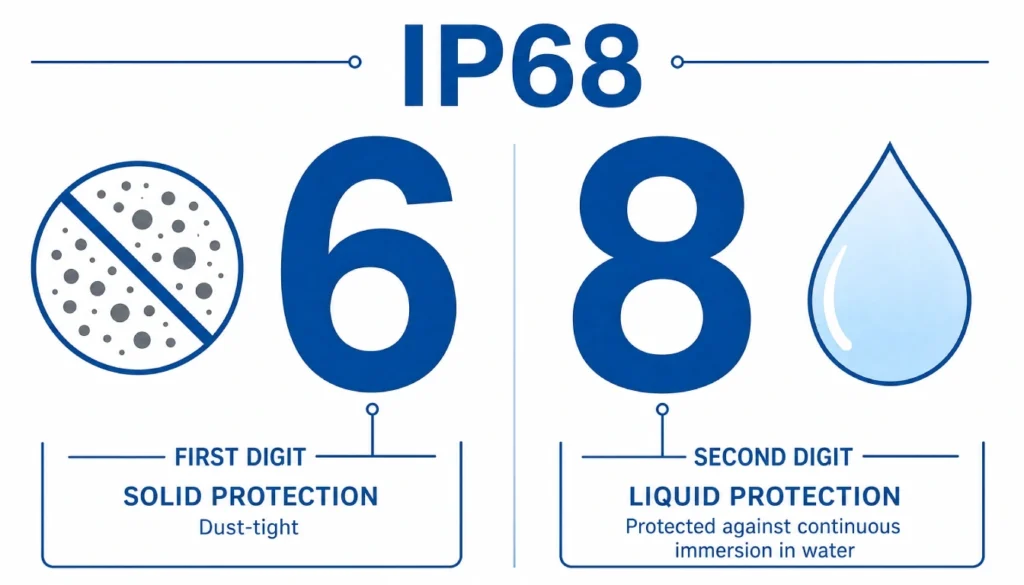
The two digits after “IP” aren’t random. Each one tells you something specific. The first digit covers dust and particles. The second covers water.
So when you see IP68, you’re looking at two separate test results stacked into one rating. Neither digit tells the full story on its own.
Breaking Down the Digits: Dust-Tight “6” and Water-Immersion “8”
The “6” means the device is completely dust-tight. No dust gets inside, period. This is the highest score on the dust scale, which runs from 0 to 6.
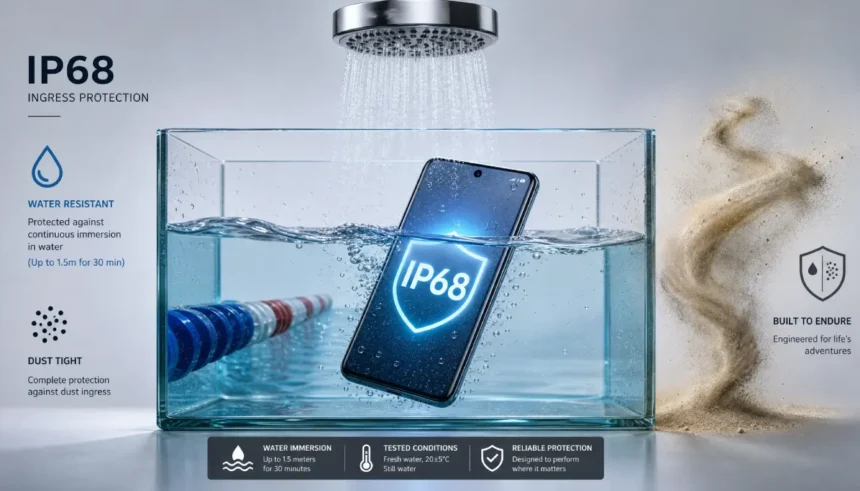
The “8” means the device can handle continuous submersion in water beyond 1 meter. The exact depth and time get set by the manufacturer, not a fixed universal number.
This is where most people get confused. IP68 doesn’t guarantee a specific depth. Samsung might test at 1.5 meters for 30 minutes. Apple might test at different conditions entirely. The “8” just means the device passed submersion testing past the 1 meter mark.
I once dropped an IP68-rated phone into a swimming pool. It survived, but the speaker sounded muffled for two days. That’s when I started digging into how this rating actually works. I realized how many “waterproof” assumptions lead to expensive repairs.
IP68 Testing: The Simple Truth About Depth and Time
Labs test IP68 in still, clean, fresh water. Not chlorinated pool water. Not salt water. Not a running shower.
The test happens under controlled conditions in a lab tank. A technician submerges the device to a set depth for a set duration, then checks for water damage.
Here’s what that means for you: your real-world conditions rarely match the lab. Pool chemicals, ocean salt, and moving water all behave differently than still tap water. The IP68 badge on your box reflects a lab result, not a real-world guarantee.
IP68 vs IP67, IPX8 and 5 ATM: Key Differences That Matter
These ratings look similar, but they aren’t interchangeable. Here’s what actually separates them.
IP67 protects against temporary submersion, usually up to 1 meter for 30 minutes. It skips the deeper water test that IP68 requires.
IPX8 skips the dust test entirely. The “X” means that category wasn’t tested or rated. You get water protection but no confirmed dust protection.
5 ATM is a watch rating, not a phone rating. It means the watch can handle pressure equal to 50 meters underwater, which makes it fit for swimming and snorkeling.
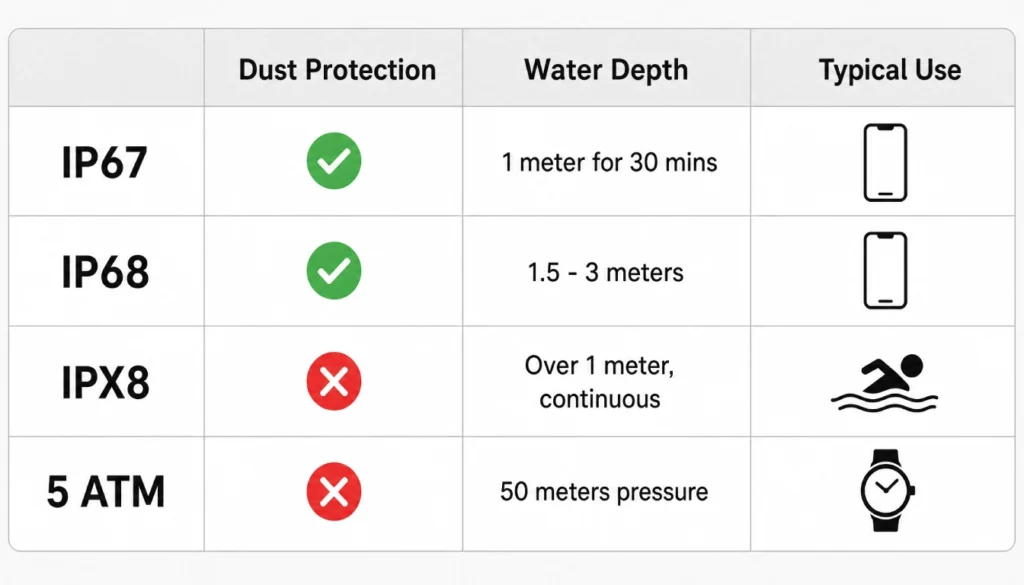
If you’re comparing devices, check both digits and the specific depth the manufacturer lists. Don’t assume two IP68 devices handle water the same way.
Real-World Use: Shower, Swimming, Rain and Tap Water
This is the section most people actually came here for. Let’s go through each situation.
Can You Take an IP68 Phone Into the Shower?
Technically, brief exposure to shower splashes probably won’t kill your phone. But steam, soap, and shampoo residue are different threats entirely.
Soap breaks down the oils and seals that keep water out. Steam can seep into small gaps that liquid water can’t reach. Neither of these gets tested in the IP68 lab process.
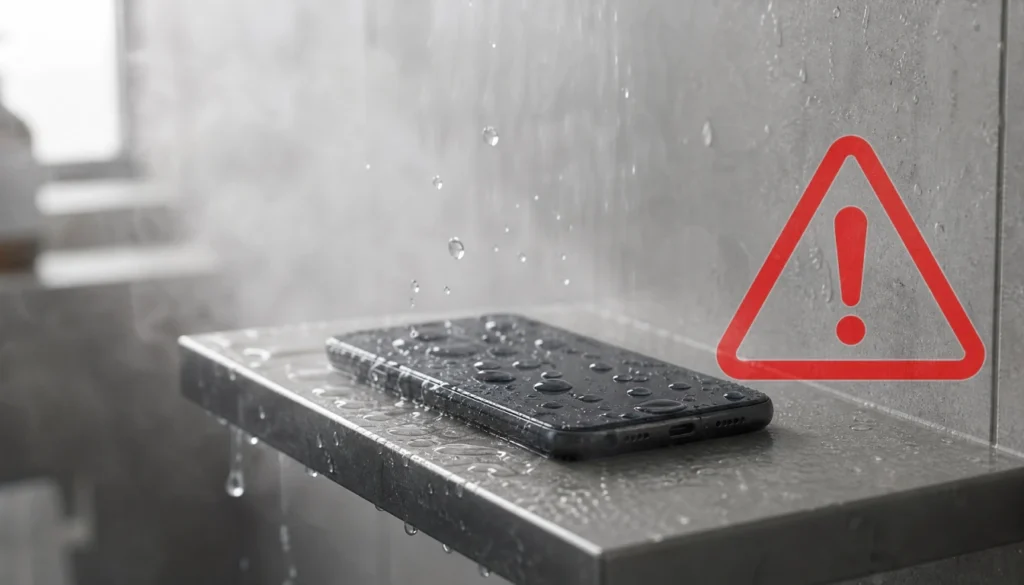
I’ve talked to dozens of readers who kept phones in the shower for months with no issues, then suddenly had a dead microphone. Soap residue building up over time is usually the cause.
Is IP68 Safe for Swimming?
Only if the manufacturer specifically lists swimming as a supported use case. Chlorine and salt water are more corrosive than the fresh water used in lab testing. Even a device rated for swimming can degrade faster in a saltwater ocean than in a chlorinated pool.
What About Rain and Tap Water Splashes?
This is the safest scenario. Rain and light tap water splashes match the lab test conditions closely. Your phone should handle this without any real risk.
What IP68 Doesn’t Protect Against (And Why Your Warranty Won’t Help)
IP68 doesn’t cover hot water, pressurized water jets, or water at high velocity. It also skips saltwater, chlorinated water, and soapy water entirely.
Here’s the part manufacturers rarely advertise clearly: most brands exclude water damage from their warranty, even on IP68-rated devices. Apple’s warranty, for example, doesn’t cover liquid damage even though iPhones carry an IP68 rating.
This isn’t a loophole. It’s the standard approach across the industry. The rating tells you the device passed a specific lab test. It doesn’t promise you a repair if something goes wrong.
Does IP68 Wear Off Over Time?
Yes. Water resistance depends on physical seals, gaskets, and adhesives. These wear down with drops, temperature changes, and general use.
A phone that was IP68 rated on day one might not hold that same protection after two years. Screen repairs and battery replacements often break the seal too, especially if done by a non-authorized shop.
If your phone is water resistant, treat that protection as something that fades, not something permanent.
What To Do If Your IP68 Phone Gets Wet
If your phone falls into water, salt water, pool water, or gets soaked in something other than plain tap water, follow these steps right away.
- Rinse with fresh water if it touched salt water, pool water, or a soapy liquid.
- Dry the exterior with a soft cloth. Gently shake out the charging port to clear trapped moisture.
- Leave it in a dry, airy spot for at least 5 hours before charging. Skip the rice trick. It doesn’t pull moisture out effectively and can leave dust in your ports.
Frequently Asked Questions
Does IP68 mean 100% waterproof?
No. IP68 means water resistant under specific lab conditions, not fully waterproof in every situation.
Can I use my IP68 phone at the beach?
Sand and salt water both pose risks the rating doesn’t fully cover. Rinse your phone with fresh water immediately if it touches salt water.
How deep can an IP68 phone go underwater?
It depends on the manufacturer’s specific claim, usually listed in the product specs. Most phones are rated for 1.5 to 6 meters for 30 minutes.
Can IP68 water damage void my warranty?
Water damage often isn’t covered even with an IP68 rating. Check your specific manufacturer’s policy before assuming you’re protected.
Is IP68 better than IP67?
Yes, for water resistance specifically. IP68 handles deeper, longer submersion than IP67.
Will soap damage an IP68-rated phone?
Yes. Soap can break down seals over time. Wipe your phone dry after any contact with soap or shampoo.
Can I charge my phone right after it gets wet?
No. Wait several hours and make sure the charging port is fully dry first.
Does cold water affect the rating differently than warm water?
The lab tests use room-temperature fresh water. Hot water and rapid temperature shifts aren’t part of the standard test and can affect seals differently.
Do all IP68 phones have the same depth rating?
No. Depth and duration vary by manufacturer. Always check the specific product listing.
Can I take underwater photos with an IP68 phone?
Some phones support this feature specifically, but check the manufacturer’s guidance first. Not every IP68 device is built for active underwater use.
Final Verdict: Is IP68 Enough for You?
IP68 gives you real protection against dust, rain, and accidental splashes. That covers most daily situations without any extra thought.
But the ip68 meaning waterproof confusion trips up a lot of people. This rating isn’t a guarantee against pool chemicals, ocean salt, hot water, or soap. Treat it as strong protection with clear limits, not a free pass to ignore water entirely.
If you want the safest approach, keep your phone away from soap, salt water, and steam whenever you can. Your seals will last longer, and you’ll avoid the kind of slow damage that shows up months later.
Got a specific situation you’re not sure about? Drop a comment below, and I’ll help you figure out if it’s safe.