
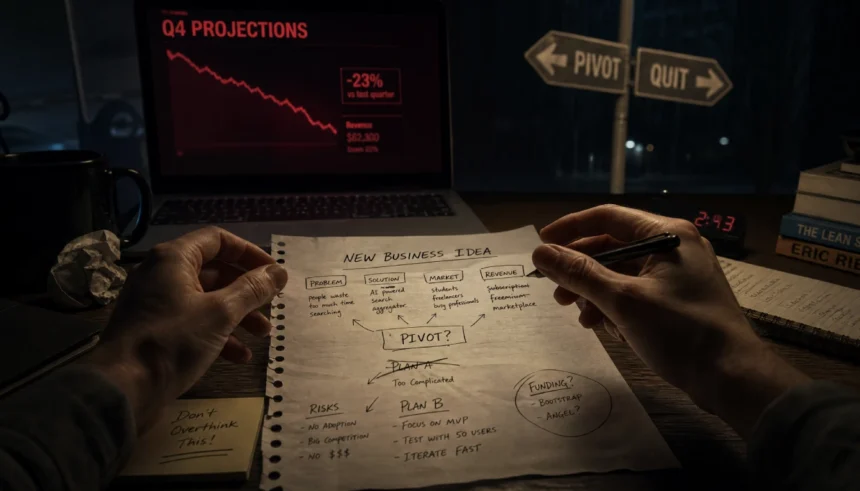
You have an idea that keeps you up at night—but you’re terrified it might be a money pit. You’ve told your friends, mapped out a rough plan, maybe even spent a little money. Now you’re second-guessing everything.
You’re not alone.
Knowing the signs you should quit your business idea before it drains your savings is one of the most valuable skills a first-time founder can build. This post gives you five honest, specific warning signs—no sugarcoating, no vague advice. By the end, you’ll know exactly where you stand.
Why Most “Good” Business Ideas Turn Into Costly Mistakes
Most people don’t fail because they’re lazy or untalented. They fail because they fall in love with their idea before they test it.
When I first tried to launch a subscription box for productivity tools, I spent $1,200 on samples. But when I actually asked five people to pre-order, zero said yes. I ignored that red flag for months because I’d already put money into it. That’s when I learned: if nobody pays for a pilot, the full launch won’t magically work.
The mistake isn’t having a bad idea. It’s staying in one too long.
Here’s what the research says: CB Insights found that 35% of startups fail because there’s no market need for their product. That’s not a product problem. That’s a validation problem. You can build a great product for a problem nobody actually wants solved.
The five signs below are your early warning system. Take them seriously.
Sign 1: You Can’t Find a Single Person Ready to Pay
This is the most reliable red flag that your business idea will fail: you can’t get anyone to hand over real money, even a small amount.
Notice the word “real.” Compliments don’t count. “That’s such a cool idea” is not market validation. Neither is a long list of email signups or 500 Instagram followers. What counts is someone pulling out their wallet.
If you’ve pitched your idea to 20 people and nobody has offered to pay, that’s data. It tells you one of three things: the problem isn’t painful enough, your solution doesn’t fit the problem, or the price doesn’t match what people think it’s worth.
The honest question to ask yourself: Have you actually asked people to buy, or have you only asked what they think of the idea? These are very different conversations.
The $20 Coffee Test for Real Demand
Here’s a simple test. Find five people who match your target customer. Tell them: “I’m working on [brief description of your solution]. Would you pay $20 right now to get early access?”
Track the responses. Not what they say about the idea; only whether they pay.
- 0 out of 5 pay: The idea needs major rethinking.
- 1 out of 5 pay: You have one signal, not a business.
- 3 or more out of 5 pay: You have something worth continuing.
The dollar amount doesn’t matter much. The willingness to commit money, even a small amount, is the signal.
Sign 2: The Math Simply Doesn’t Add Up (Even on Paper)
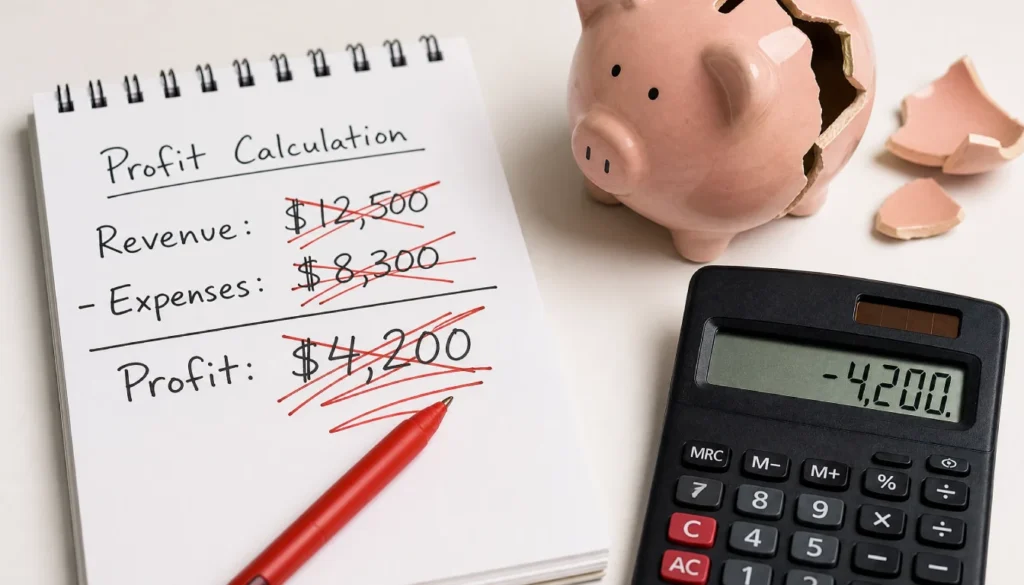
This is one of the clearest signs your business idea won’t make money: when you run the basic numbers honestly, you can’t find a path to profit.
Many first-time founders skip this step because math feels intimidating or premature. But you don’t need a spreadsheet. You need a napkin.
Ask yourself three questions. What does it cost you to deliver your product or service once? What will you charge? How many sales do you need each month to cover your basic costs?
If the numbers don’t work on paper, they won’t work in the real world either. Hustle and volume don’t fix broken unit economics.
A 5-Minute Profit Margin Gut Check
Grab a pen. Fill in these numbers:
- Cost to deliver one unit or one client: $_____
- Your planned price: $_____
- Gross margin per sale (price minus cost): $_____
- Fixed monthly costs (your time, software, rent if any): $_____
- Sales you need to break even (fixed costs divided by gross margin): _____
If step 5 feels impossible in year one, that’s a red flag. If your margin per sale is less than 30%, you’ll have almost no room to run ads, handle refunds, or grow.
This isn’t about perfection. It’s about whether a realistic path exists at all.
Sign 3: You’re Dreading the Work Every Single Day
Passion alone doesn’t run a business. But if you genuinely dread the core work of your idea, that matters.
There’s a difference between normal stress and chronic dread. Normal stress comes from uncertainty, learning curves, and hard decisions. Chronic dread is when you wake up and feel a weight in your chest every time you think about working on this thing.
Ask yourself: what does this business actually require you to do every day? Writing, selling, client calls, logistics, content creation, customer support? If the daily work of the business feels like a punishment, sustainability becomes nearly impossible, especially when revenue is still low.
I’ve seen this trap clearly: people who love the idea of a business but hate the actual work it requires. A person who loves cooking might hate running a catering business because the reality is inventory management, early mornings, and difficult clients, not creative cooking.
The test: Imagine doing the core daily task of this business for free, for six months. Does that feel manageable or unbearable? Your gut answer tells you something real.
Sign 4: You’re Only Staying Because You Already Invested Time or Money
This is the sunk cost fallacy in action, and it tricks some of the smartest people you’ll meet.
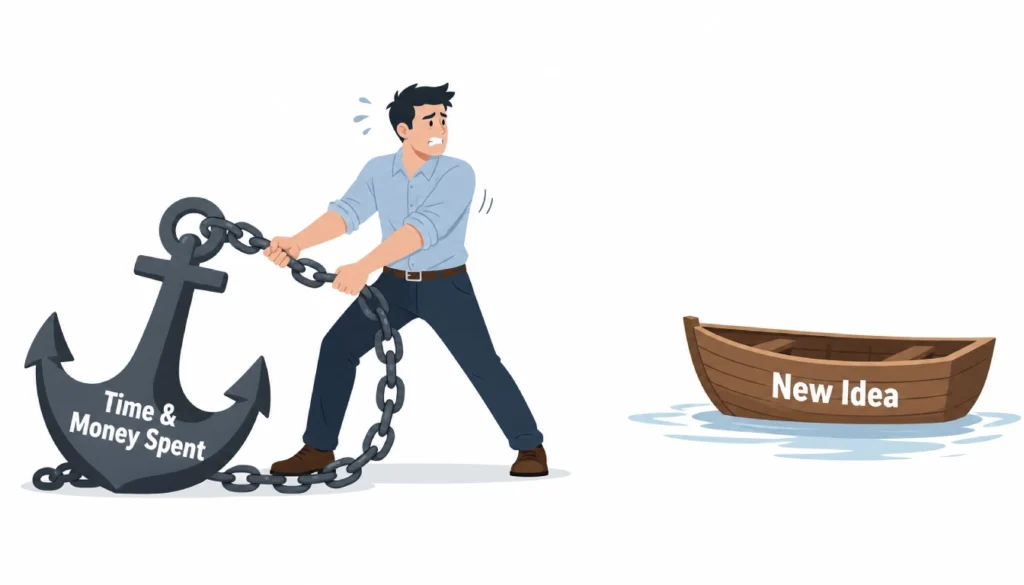
The sunk cost fallacy is the tendency to keep going with something because you’ve already invested in it, even when the evidence says stop. The time you’ve spent, the money you’ve put in, the identity you’ve built around this idea—none of that changes whether the idea has a future.
What’s already spent is gone. The real question is: given what you know right now, would you start this today?
If the honest answer is no, that’s a sign to stop.
How the Sunk Cost Fallacy Tricks Smart People
The more you invest, the more painful quitting feels. That’s the trap. Your brain starts treating past investment as a reason to continue, rather than looking clearly at future prospects.
Watch for these phrases in your own thinking:
- “I’ve already put six months into this.”
- “I can’t stop now after spending $3,000.”
- “People expect me to launch this.”
Each of these is a reason to look backward, not forward. They’re not business reasons. They’re emotional anchors.
The founders who recover fastest from bad ideas are the ones who recognize this trap early and act despite it. Quitting a losing idea isn’t failure. Staying in one past the evidence is.
Sign 5: People You Trust Are Quietly Telling You to Let Go
Not everyone who tells you an idea is bad is a hater. Sometimes, the people closest to you see what you can’t.
There’s a difference between unsupportive people and people with legitimate concerns. Your aunt, who dismisses every idea, is not a useful data point. But a trusted friend who knows business, a potential customer who explained clearly why they wouldn’t buy, or a mentor who keeps asking hard questions you can’t answer—these voices deserve real consideration.
I’ve worked with early-stage founders on idea validation, and the most common pattern I see is this: the founder has already heard the feedback. Someone smart said something specific and uncomfortable, and the founder talked themselves out of taking it seriously.
One step to take: Write down every concern a trusted person has raised about your idea. For each one, ask: have I genuinely addressed this, or have I explained it away?
If your list is long and your answers feel forced, that’s worth sitting with.
I See the Signs—Should I Pivot or Quit Completely?
Seeing these signs doesn’t automatically mean you quit. It means you make a clear decision with clear criteria.
Pivot if:
- The core problem you’re solving is real and validated.
- Your current approach is the issue, not the problem itself.
- A different customer segment, price point, or format could work.
- You still feel genuine interest in the problem.
Quit if:
- Nobody has shown real willingness to pay, even at a very low price.
- The unit economics are fundamentally broken and can’t be fixed with a tweak.
- The daily work feels unsustainable.
- You’re only staying because of what you’ve already put in.
Give yourself a 48-hour window to decide. Write down the most honest version of where your idea stands. Then make the call and commit to it.
Your 5-Minute Final Decision Checklist
Go through this list honestly. Mark each one yes or no.
Market demand:
- Have at least 3 people paid real money for a pilot or pre-order? Y / N
- Have at least 10 qualified prospects confirmed that the problem is urgent? Y / N
Financial viability:
- Does your gross margin exceed 30%? Y / N
- Can you reach break-even within 12 months with realistic sales? Y / N
Personal fit:
- Can you do the daily core work sustainably for 1 to 2 years? Y / N
- Does the idea still excite you when you strip away the fantasy of success? Y / N
Outside feedback:
- Have you addressed every serious objection from trusted advisors? Y / N
- Are you staying because the future looks promising, not because of past investment? Y / N
Your score: Count your “yes” answers.
- 7 to 8 yes: Keep going. You have a real signal.
- 4 to 6 yes: Pivot. You have something, but the current form isn’t working.
- 0 to 3 yes: Quit this version. Return to the drawing board.
Frequently Asked Questions
When to give up on a business idea?
Give up when you have no paying customers after genuine effort, the economics don’t work on paper, and you’re staying only because you’ve already invested. Emotional attachment is not a reason to continue.
Is seeing one or two of these signs enough to quit?
Not necessarily. One sign might point to a fixable problem. Two or more signs in combination, especially no paying customers plus broken math, is a much stronger signal to stop or pivot.
What if I’ve already told everyone about my idea?
The embarrassment of quitting is temporary. The cost of continuing a failing idea for another year is much higher. Nobody respects the years you lost more than the clean decision you made.
Can a bad idea turn into a good one?
Yes, through pivoting. Instagram started as a check-in app. YouTube started as a video dating site. The pivot works when you keep the validated insight (someone has a real problem) but change your solution. The pivot fails when you change nothing and just hope harder.
How do I know if I’m being too hasty?
You’re being too hasty if you haven’t actually asked for payment yet, haven’t run the basic financial math, and haven’t had at least two or three honest conversations with potential customers. If you’ve done all three and the signals are bad, you’re not being hasty. You’re being clear.
The five signs you should quit your business idea are real, specific, and measurable. No paying customers. Broken unit economics. Dread of the daily work. The sunk cost trap. And trusted voices raising concerns you can’t genuinely answer.
Seeing these signs early is an advantage, not a defeat. The founders who build durable businesses are the ones who get honest with themselves fast, pivot or stop when the evidence demands it, and move toward something that actually works.
Run your idea through the checklist above. Be brutally honest. Then make your decision and act on it.