

You’re making decent money on the side, but your family still calls it a little project. Deep down, you wonder if you’re just playing around or if this is something real. That confusion keeps you stuck.
Here’s the truth. When does a side hustle become a real business? It’s not about how many hours you put in. It comes down to specific signs, legal shifts, and a change in how you think. In this guide, you’ll find out exactly when a side hustle becomes a real business and what to do next.
What Really Separates a Side Hustle from a Real Business?
A side hustle is something you do around a job, a family, or a full schedule. You treat it as extra income. You don’t think about it much when you’re not working on it.
A real business runs differently. It has structure. It has a plan. It shows up on your taxes as its own entity, not a hobby you mention once a year.
The line between the two isn’t about revenue alone. A business earning $500 a month can be more “real” than one earning $5,000 a month, if the first one has systems and the second one is chaos. Structure, consistency, and legal standing separate the two. Money is just one piece of the puzzle.
5 Clear Signs Your Side Hustle Is Already a Real Business
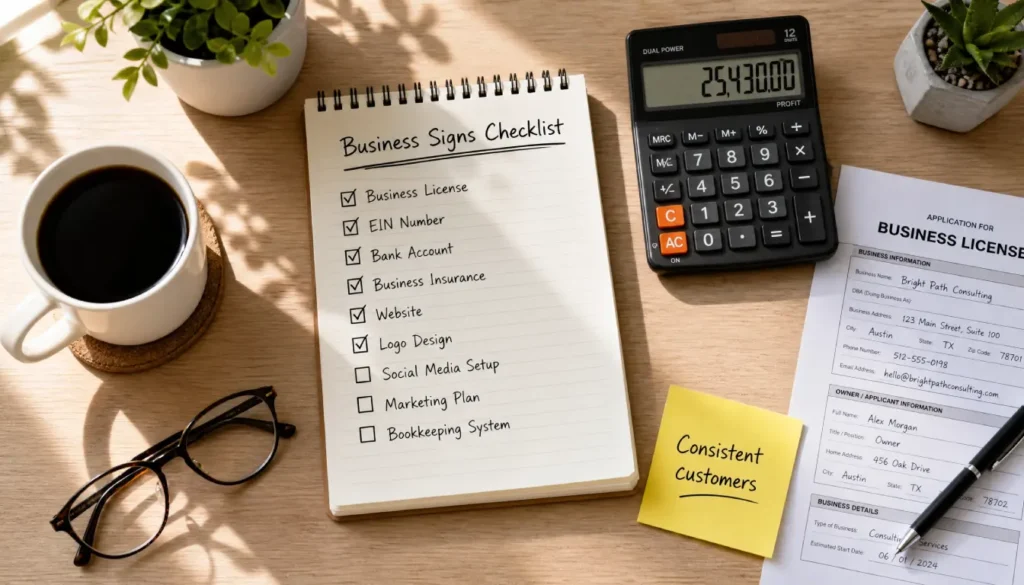
Most people don’t realize they’ve already crossed the line until someone points it out. Here are the signs your side hustle is a real business, even if you haven’t admitted it yet.
- You have repeat customers. One-off sales feel like a hobby. A client who comes back three times feels like a business.
- You’ve turned down other work because of it. If you’re prioritizing this over other opportunities, your mindset has already shifted.
- You track income and expenses somewhere other than your head. A spreadsheet, an app, anything counts.
- People refer you to others. Word of mouth is a business signal. Nobody refers a hobby.
- You’ve thought about raising your prices. That thought alone means you see value in what you offer.
If two or more of these sound familiar, you’re likely already past the side hustle stage.
The Legal & Tax Differences Nobody Tells You
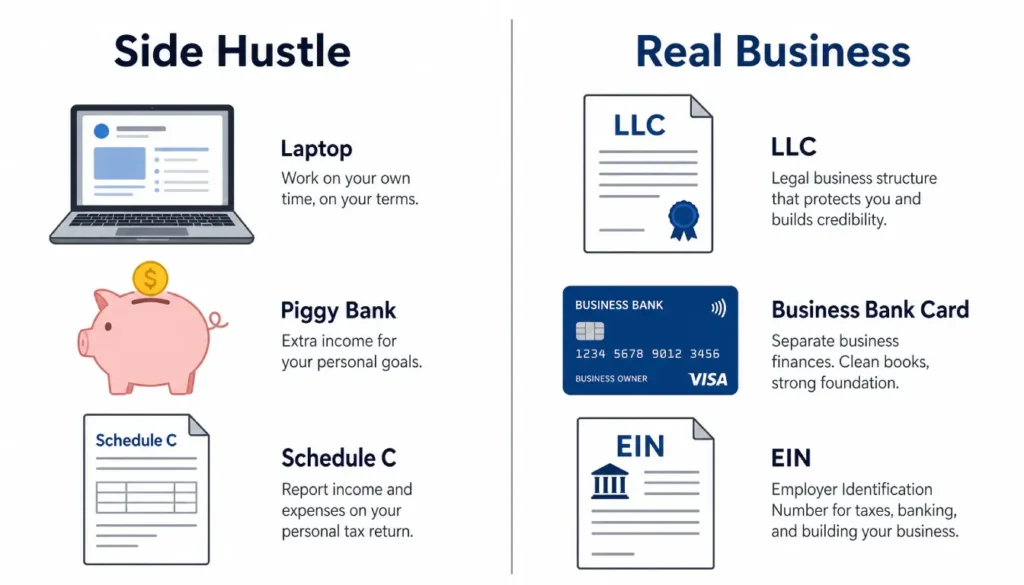
This is where the side-hustle-vs-business legal differences get real. On paper, the IRS doesn’t care what you call your work. It cares about how you report it.
If you’re filing a Schedule C as a sole proprietor, you’re still legally a side hustle in the eyes of most banks and lenders, even if you’re earning full-time income. A real business usually means:
- An LLC or other registered business structure
- An Employer Identification Number (EIN) instead of just your Social Security number
- A separate business bank account
- Estimated quarterly tax payments, since nobody is withholding for you
The side hustle vs small business IRS distinction mostly comes down to intent and structure. If you’re operating with the intent to profit consistently and you’ve set up formal systems, the IRS treats you as a business, not a hobby. That distinction matters, because hobby losses aren’t deductible the same way business losses are.
The Mindset Shift: Thinking Like a CEO, Not a Side Hustler
I personally faced this exact confusion with my freelance writing work. I couldn’t tell if it was a business or just something I did on weekends. After I treated it like a business for 90 days, opening a separate bank account, registering an LLC, and writing a one-page business plan, everything changed. Clients started taking me seriously. My income doubled within that quarter.
The shift wasn’t about working more hours. It was about making decisions the way a business owner does. That means:
- Pricing based on value, not guilt
- Saying no to work that doesn’t fit your goals
- Reinvesting profit instead of spending all of it immediately
- Treating client relationships as long-term, not transactional
Once you start making decisions this way, the legal paperwork just catches up to what’s already true.
How to Transition Your Side Hustle Into a Business (Step-by-Step)
If you’re facing the uncertainty of when to make your side hustle official, follow these steps.
Step 1: Check the legal triggers. Look at your income consistency, your repeat customer count, and how much you’re already reinvesting. If you’ve hit steady monthly income for three months straight, that’s a strong signal.
Step 2: Separate your finances. Open a business bank account. Get a business debit or credit card. Stop mixing personal and business money, since this alone will save you hours during tax season.

Step 3: Pick a business structure. For most people starting, an LLC offers a good balance of protection and simplicity. Talk to an accountant before you file, since state fees and rules vary.
Step 4: Get your EIN and register your business name. This step is usually free and takes less than 30 minutes online through the IRS website.
Step 5: Announce your new status and adjust your pricing. Tell your existing clients. Update your invoices. Raise your rates if you haven’t in a while, since a registered business justifies professional pricing.
I’ve walked several freelance clients through this exact checklist, and the biggest mistake I see is skipping Step 2. Mixing finances creates a mess that takes weeks to untangle later.
Common Mistakes That Keep You Stuck in “Side Hustle” Mode
Some people stay stuck for years, not because they lack income, but because of avoidable habits.
- Waiting for permission. Nobody is going to hand you a certificate that says “real business now.” You decide.
- Underpricing out of fear. If you’re afraid to charge what you’re worth, clients treat you like a hobbyist too.
- Skipping bookkeeping. Without clean records, you can’t prove growth, apply for a loan, or file taxes accurately.
- Avoiding the legal paperwork. Filing an LLC feels intimidating, but most states process it online in under an hour.
- Not setting boundaries. If you’ll drop everything for any client at any time, you’re still operating like a hobbyist, not a business owner.
Fixing even two of these shifts your entire trajectory within a few months.
FAQs
How much money do I need to make before it’s a real business?
There’s no fixed number. Consistency matters more than the amount. Steady income for three to six months is a stronger signal than one big month followed by silence.
Do I need an LLC to be a real business?
No, but it helps. You can operate as a sole proprietor and still be a legitimate business. An LLC adds legal protection and can make you appear more credible to clients and lenders.
What’s the side hustle to business checklist I should follow?
Track income and expenses, separate your bank accounts, register your business name, get an EIN, and set up quarterly tax payments if your income is significant.
Can I switch back from a business to a side hustle?
Yes. Plenty of people scale down. The label matters less than whether your setup matches your actual activity and income.
Is a business license required?
It depends on your location and industry. Check your city and state requirements, since some services require specific licenses even for solo operators.
The Bottom Line
So, when does a side hustle become a real business? It happens the moment you have repeat customers, separate finances, and a mindset that treats the work as permanent rather than temporary. The legal paperwork just formalizes what’s already true.
You don’t need to wait for a perfect moment. Start with Step 1 from the checklist above, check your triggers, and take it from there. If this guide helped you see your own progress more clearly, leave a comment with where you’re at, or share it with someone else stuck asking the same question.