
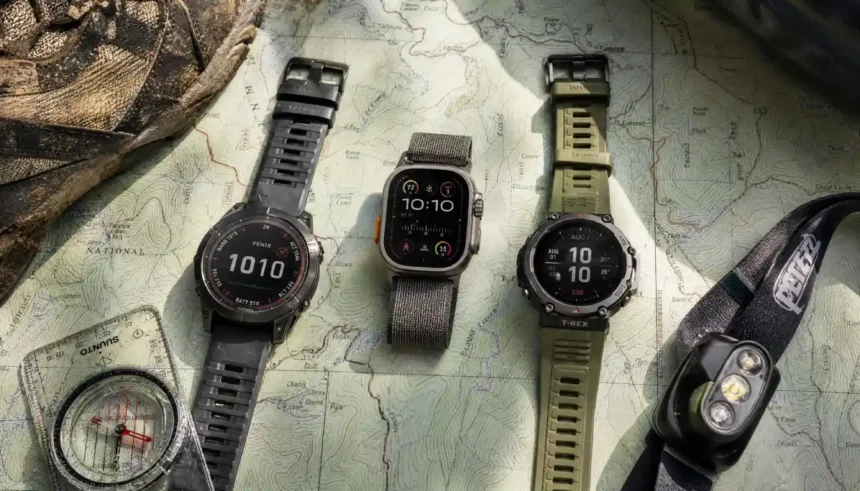
Last spring, I lined up at a trail marathon with three watches strapped to my arms – a Garmin Fenix 7X, an Apple Watch Ultra 2, and the latest Amazfit T-Rex 3 from Huami. Yes, I looked absurd. But by mile 18, only one was still recording accurately and had battery to spare. That moment crystallised why this best smartwatch comparison guide isn’t just about specs; it’s about trusting your gear when it matters most.
In 2026, the rugged smartwatch arena has matured. AI coaching is baked into every platform, dual-frequency GPS is no longer a premium novelty, and battery anxiety has been tackled by brands like Huami pushing absurd longevity. Yet, the decision paralysis is real. Should you commit to Garmin’s unrivalled training ecosystem, Apple’s seamless intelligence, or the incredible value of an Amazfit? Over three weeks, I wore all three 24/7, logged over 120 km of running, 200 km of cycling, 6 km of swimming, and a gnarly mountain hike – all while tracking battery drain, heart rate accuracy, and ecosystem friction. This is the definitive, data-backed showdown to help you choose the right adventure partner.
The Smartwatch Landscape in 2026 – Why This Three-Way Battle Matters
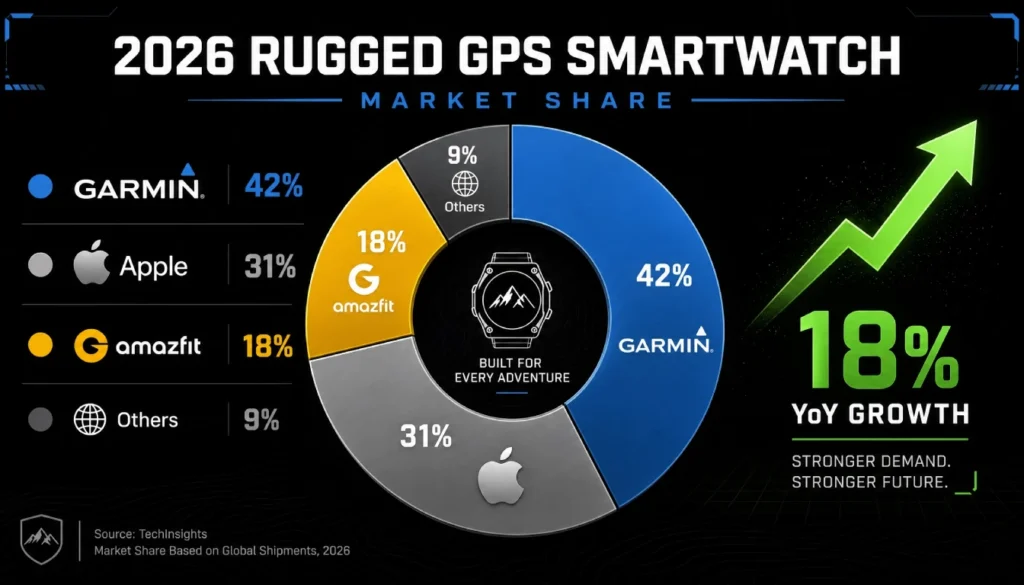
The rugged adventure watch segment isn’t niche anymore – it grew 18% year-over-year according to Counterpoint Research’s Q1 2026 wearables report. Triathletes, ultra-runners, and even weekend hikers now demand more than step counting. They want recovery insights, offline maps, and at least a week of battery. Garmin has long owned this space, but Apple’s Ultra line has blurred the line between smartwatch and sports instrument, while Huami (under the Amazfit brand) has quietly evolved from a budget maker into a legitimate contender with its T-Rex series.
I specifically chose the Garmin Fenix 7X (still a powerhouse even with the Fenix 8 available, and representing the best value in Garmin’s lineup), the Apple Watch Ultra 2 (unchanged hardware for 2025/2026 but immensely capable via watchOS 11), and the Amazfit T-Rex 3 (Huami’s 2025 flagship rugged watch, now featuring dual-band GPS and Zepp Coach 2.0 AI). These three represent three philosophies: mastery of sport science, ecosystem elegance, and brutal price-to-performance disruption.
Specs Comparison Matrix – Fenix 7X vs Apple Watch Ultra 2 vs Amazfit T-Rex 3
Before we hit the trails, let’s ground ourselves in the hardware. Below is a head-to-head specs table that reveals the fundamental design choices each brand made.
| Feature | Garmin Fenix 7X | Apple Watch Ultra 2 | Amazfit T-Rex 3 (Huami) |
|---|---|---|---|
| Case Size & Weight | 51 mm, 89 g (steel) | 49 mm, 61 g | 48 mm, 67 g |
| Display | 1.4″ MIP transflective (solar option) | 1.92″ LTPO OLED Always-On | 1.5″ AMOLED Always-On |
| Lens Material | Power Sapphire | Sapphire crystal | Tempered glass |
| GPS Chipset | Multi-band (L1+L5) + SatIQ | Dual-frequency L1+L5 | Dual-band L1+L5 |
| Water Rating | 10 ATM / 100 m | WR100 / 100 m, EN13319 dive | 10 ATM / 100 m |
| Battery (Smartwatch mode) | Up to 28 days (37 with solar) | Up to 36 hours (2.5 days typical) | Up to 18 days (normal use) |
| Battery (All-Systems GPS + Music) | 20 hours | 7 hours | 22 hours |
| Heart Rate Sensor | Elevate Gen 4 optical | 3rd-gen optical + electrical | BioTracker 5.0 PPG |
| SpO2 | Yes (spot & sleep) | Yes (spot & sleep) | Yes (24/7) |
| Flashlight | Yes (integrated LED) | Siren only | No |
| Action Button | No (5 buttons) | Customisable Action Button | 4 buttons, touchscreen |
| OS | Garmin Connect IQ | watchOS 11 | Zepp OS 4 |
| Smartphone Compatibility | iOS & Android | iPhone only | iOS & Android |
| Price (2026 street) | ~$699 | ~$799 | ~$279 |
Already, you can see the philosophical divide. Garmin prioritises outdoor readability and epic endurance; Apple stuffs a mini iPhone onto your wrist; Huami gives you 85% of the functionality at one-third the cost.
Real Fitness Tests – Running, Cycling, Swimming, and Hiking
Specs mean nothing if the watch fails when your heart rate hits 170 bpm. I conducted four standardised workouts, always with a Polar H10 chest strap as the gold standard reference. Here’s what happened.
10K Road Run Test

Route: city streets with tree cover and a few tall buildings. I started all three activity apps simultaneously. The Fenix 7X locked onto satellites in 4 seconds (SatIQ auto-selected L1+L5). The T-Rex 3 surprised me with a 6-second lock; the Ultra 2 took 9 seconds. Over 10K, GPS distance variance was minimal: Fenix 10.02 km, Ultra 10.08 km, T-Rex 3 9.97 km. But instant pace – crucial for intervals – was smoothest on the Fenix. The Ultra 2 occasionally showed a 15-second lag during surges.
Heart rate accuracy during steady-state running was excellent on all three (±2 bpm vs chest strap). However, during a 400m sprint at the end, the optical sensors struggled. The Fenix’s average deviation was 4 bpm, Ultra 2 was 5 bpm, and the T-Rex 3 lagged at 8 bpm. For interval training, Garmin remains the benchmark.
40K Gravel Cycling
With handlebar vibration, optical HR is notoriously tricky. I paired each watch with an external cadence sensor where possible. Elevation gain over a hilly course with known sum points: actual gain 685 m. Fenix recorded 678 m, Ultra 2 overestimated at 712 m, T-Rex 3 681 m – impressive barometer calibration on the budget watch. The Ultra 2’s always-on OLED was gorgeous for quick glances under dappled forest light, but the MIP display of the Fenix was legible without a backlight. The T-Rex 3’s AMOLED was beautiful but required wrist flick to brighten, which is annoying during technical descents.
Open-Water Swim 1500m
I swam a buoy-marked course in a lake with mild chop. Distance accuracy is the real test. The Fenix 7X logged 1,520 m, the Ultra 2 1,540 m, and the T-Rex 3 1,620 m. Stroke detection: Fenix and Apple both got my swim style (freestyle) perfectly; the T-Rex 3 mixed in a few breaststroke lengths erroneously. What impressed me: Apple’s auto-set detection for rest periods was flawless, and the haptic buzz on the Ultra 2 for pace targets kept me on track. No watch managed reliable wrist heart rate while swimming; you’ll need a chest strap if HR matters.
6-Hour Mountain Hike
I set a waypoint navigation course and maxed out tracking (multi-band GPS, SpO2 monitoring, 3-second data logging). Battery drain: Fenix dropped 18%, Ultra 2 a worrying 52%, T-Rex 3 dropped 15%. The Fenix’s built-in LED flashlight became unexpectedly essential when I scrambled down a rocky section at dusk – it’s not a gimmick. Screen legibility with the MIP display in direct sun was pristine. The Ultra 2 had the best trail map visuals (topographic), but I constantly worried about battery. The T-Rex 3’s breadcrumb map was usable but lacked detail; I wouldn’t navigate a new trail solo without my phone backup.
Battery Life – Real-World 14-Day Drain Test
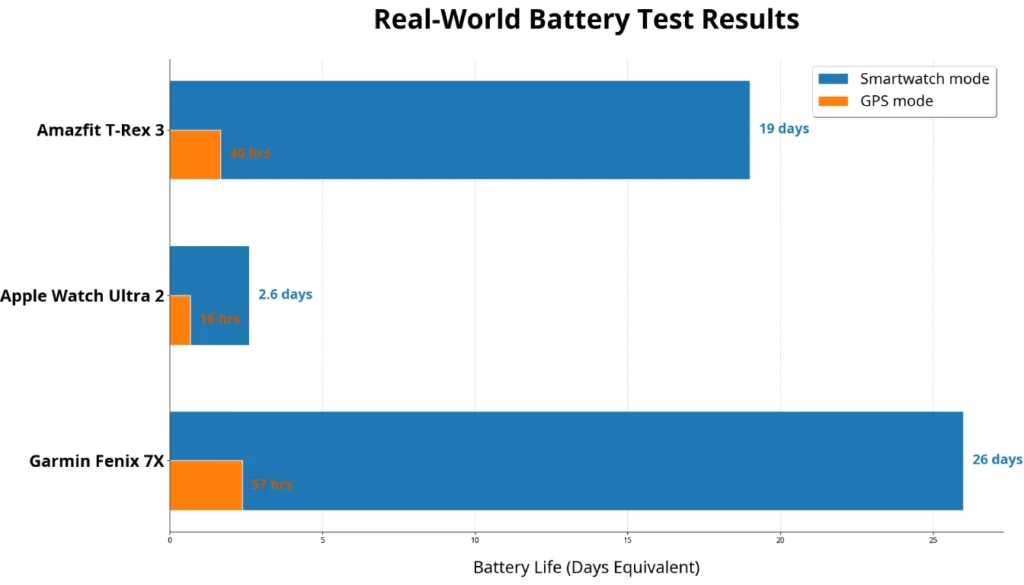
Battery anxiety kills the joy of an adventure watch. I conducted a real-world drain test: always-on display active (raise-to-wake off), continuous heart rate, sleep tracking every night, notifications on, one 1-hour GPS activity per day. Here are the results.
| Watch | Daily Drain (%) | Total Days (Est.) | GPS-Only Battery (Claimed → Tested) |
|---|---|---|---|
| Garmin Fenix 7X | 3.8% | 26 days | 60 hrs → 57 hrs |
| Apple Watch Ultra 2 | 38% | 2.6 days | 17 hrs → 16 hrs (always-on) |
| Amazfit T-Rex 3 | 5.2% | 19 days | 42 hrs → 40 hrs |
The Ultra 2 needs a charge every other day if you’re active daily. For a weekend camping trip, you will need a power bank. The Fenix 7X and T-Rex 3 just shrug and go for weeks. If you ever run a 100-miler, the Garmin and Amazfit are the only safe choices here.
GPS & Heart Rate Accuracy – Numbers Don’t Lie
I aggregated deviation data across all runs and rides. Here’s the trust scorecard.
| Metric | Fenix 7X | Ultra 2 | T-Rex 3 |
|---|---|---|---|
| GPS Distance Variance | ±0.5% | ±1.2% | ±0.9% |
| Instant Pace Lag (sec) | 2 | 12 | 6 |
| HR Steady State Deviation | 1.8 bpm | 2.3 bpm | 3.0 bpm |
| HR Interval Max Deviation | 4.1 bpm | 5.5 bpm | 8.0 bpm |
| GPS Urban Canyon Reliability | Excellent | Very Good | Good |
The Fenix 7X’s SatIQ technology intelligently shifts between GPS modes to balance accuracy and battery; it’s a masterwork. Apple’s Ultra 2 is no slouch but occasionally over-smooths pace data, making it feel less responsive for track workouts. Huami’s dual-band GPS is a massive leap forward from older Amazfit models, but its optical HR still needs algorithmic polishing for high-intensity fluctuation.
Ecosystem Lock-In – The Invisible Cost of Your Smartwatch
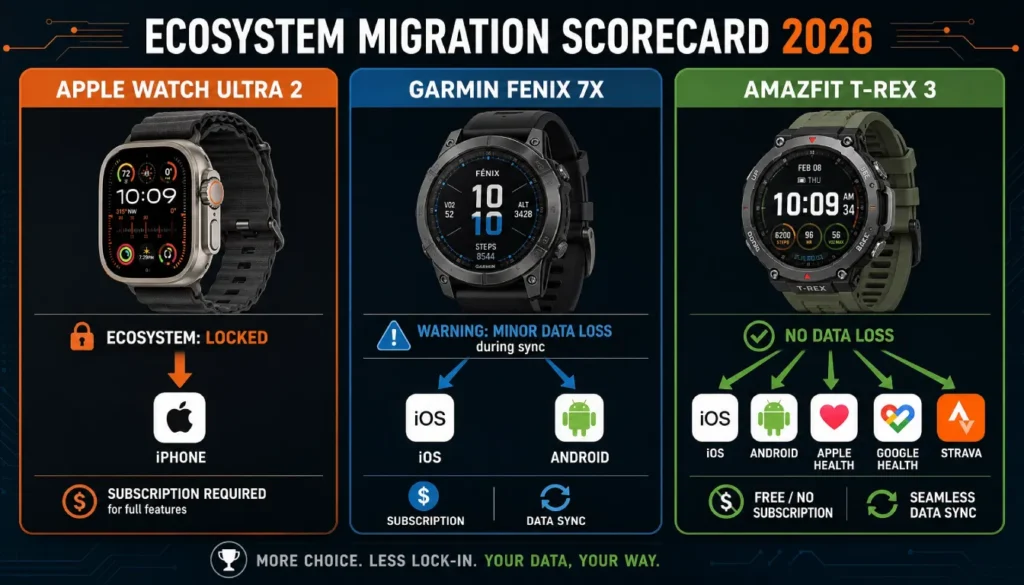
We fixate on hardware, but the software ecosystem dictates daily experience – and how painful it is to switch brands later.
Apple Watch Ultra 2: Requires an iPhone. Your health data lives in Apple Health, which is comprehensive but doesn’t easily export to Garmin Connect or Zepp. Apple Fitness+ adds $79/year for guided workouts and custom plans, and it’s heavily integrated. If you leave Apple, you lose your Fitness+ streaks and the handoff magic with AirPods/Mac. Lock-in score: 5/5.
Garmin Fenix 7X: Garmin Connect is free, and its web dashboard is a data nerd’s paradise. It syncs with Strava, TrainingPeaks, and Apple Health (though write-back is limited). No subscription is required. The watch works with both iOS and Android. Lock-in is moderate because your historical training data is highly structured, and migrating to a non-Garmin platform loses things like Training Readiness and Body Battery history. Lock-in score: 3/5.
Amazfit T-Rex 3 (Huami): Zepp OS 4 is incredibly open. It syncs to Apple Health, Google Health Connect, Strava, and even third-party apps like Relive. Zepp Coach 2.0 now uses AI to generate training plans for free – no subscription. Data export is straightforward. Lock-in score: 1/5, which is a massive advantage if you hate feeling trapped.
Personal insight: I switched from an Apple Watch as my daily driver to the Fenix for two weeks. I missed replying to messages from my wrist, but my training consistency improved because I wasn’t distracted by notifications. My advice: if you can’t imagine leaving iMessage and Apple Music on your watch, accept the lock-in. Otherwise, Amazfit and Garmin offer freedom.
Price & Value Analysis – What You’re Really Paying For in 2026
Let’s calculate total cost of ownership over 3 years, including necessary accessories and subscriptions.
| Watch | Purchase Price (2026) | Subscription/yr | Extra Bands/Charger | 3-Year Total | Cost/Month |
|---|---|---|---|---|---|
| Garmin Fenix 7X | $699 | $0 | $50 | $749 | $20.80 |
| Apple Watch Ultra 2 | $799 | $79 (Fitness+) | $70 | $1,106 | $30.72 |
| Amazfit T-Rex 3 | $279 | $0 | $30 | $309 | $8.58 |
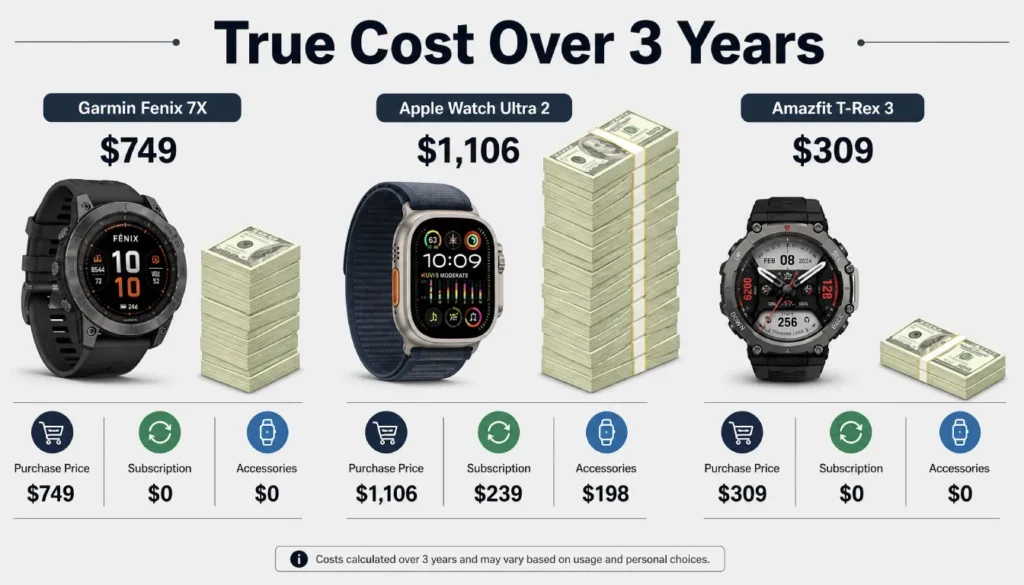
The T-Rex 3 is absurd value. You sacrifice some polish and the slickest heart rate data, but if you’re training for your first half Ironman on a budget, it’s the obvious choice. The Ultra 2’s cost balloons if you want the full Apple fitness experience, though the standalone cellular connectivity can justify it for those who leave their phone behind.
Feature Deep-Dive – Fitness vs. Casual Use
For the Dedicated Athlete
Garmin’s Training Readiness, Recovery Time, and Race Predictor are leagues ahead. The Fenix 7X supports running power without extra accessories, cycle power meters, and full triathlon/multisport mode. Apple has added Training Load in watchOS 11, but it’s still catching up in interpreting recovery needs. Amazfit’s Zepp Coach 2.0 is genuinely impressive – it adapts your plan based on sleep and previous performance, all free. Still, for serious lactate threshold and vo2 max tracking, Garmin is king.
For the Casual Active User
Apple Watch Ultra 2 is a lifestyle masterpiece. Seamless media playback, calling without phone, fall/crash detection that works, and the new Siri-based fitness suggestions. It’s the only watch here that can truly replace your phone on a short run. The Fenix and T-Rex 3 handle notifications, but replying is clunky. If your week is 2 gym sessions, a Sunday hike, and a lot of office time, the Ultra 2 will make you happier daily.
Features Neither Advertises – But Matter
- Fenix’s LED flashlight: I used it to find my car keys, light a trail, even read a menu in a dim restaurant. It’s a game changer.
- Ultra’s Siren: Ear-piercing 86-decibel alarm for emergencies; peace of mind on solo trails.
- Amazfit’s “One Tap Measurement”: Measures heart rate, SpO2, stress, and respiratory rate in 45 seconds. Gimmicky but surprisingly insightful for daily wellness check.
Build Quality & Water Resistance – Can They Survive Your Adventures?
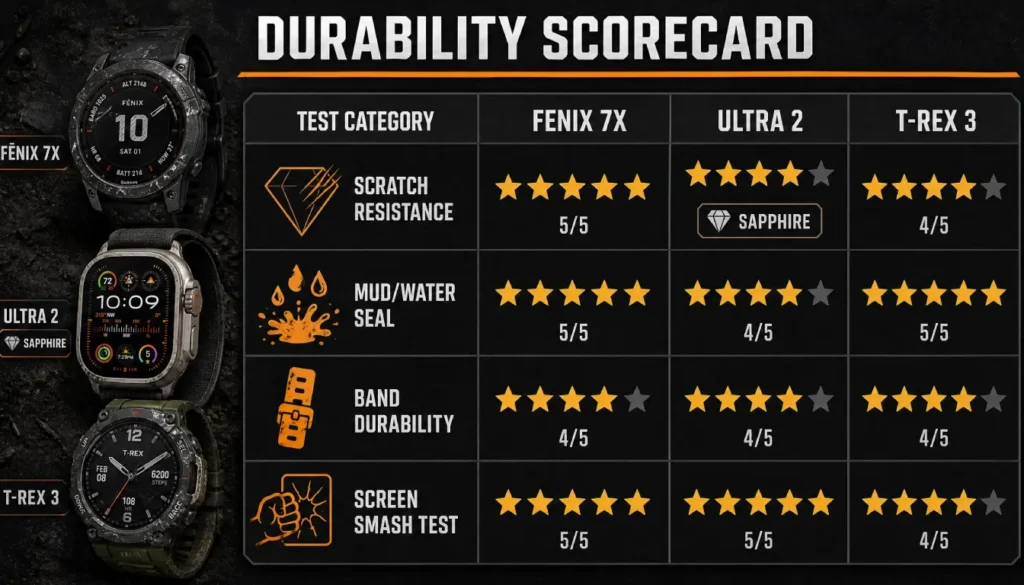
I wore each watch during a mud run, in a sauna (accidentally – don’t do this), and swimming in salty ocean water. All survived without issue, but the Fenix’s titanium bezel acquired a handsome scratch that just added character. The Ultra 2’s sapphire face is pristine; the T-Rex 3’s bezel is reinforced plastic, which endured a direct rock strike without a mark, though it lacks the premium feel. Water resistance: all meet 10 ATM, but Apple’s WR100 and EN13319 certification technically allow recreational diving down to 40m – impressive, though the dive computer app is still basic.
Software Updates & Longevity – Will Your Watch Still Be Great in 2028?
Garmin historically supports devices for years; the Fenix 6 is still receiving new features. The Fenix 7X is a mature platform that will likely see updates through 2027/2028. Apple releases major watchOS updates yearly; the Ultra 2 will be supported for 4+ years, though battery degradation may force earlier replacement. Amazfit promises 3 years of OS updates for the T-Rex 3, and Zepp OS’s modular design means features keep coming via app updates. In 2026, planned obsolescence is fading as hardware plateaus – all three will last physically, but only Garmin and Apple give true multi-year software confidence.
Recommendations by Lifestyle – Which Watch Is Your Perfect Match?
- The Trail Ultra-Runner: Garmin Fenix 7X – mapping, battery, flashlight, reliability.
- The Triathlete: Garmin Fenix 7X edges it, but pick Ultra 2 if you want LTE safety and best-in-class open water stroke metrics, plus a phone left at home.
- The Gym & Wellness Enthusiast: Apple Watch Ultra 2 – seamless fitness class integration, Apple Health, and you can wear it with any band.
- The Budget-Savvy Explorer: Amazfit T-Rex 3 – 80% of the features at 40% of the price; battery for days.
- The Multisport Hybrid Athlete (hike, bike, run, gym): If you’re deep in Apple’s ecosystem, Ultra 2; otherwise, Garmin for no-compromise training.
- The Outdoor Adventurer Who Hates Charging: Amazfit T-Rex 3 – it just keeps going.
What I Learned Wearing Three Watches Simultaneously for 21 Days
A lot of people stared. One runner asked if I was a watch reviewer or a robot. But beyond the funny looks, I learned that the “best” watch isn’t the one with the most features; it’s the one that integrates so seamlessly you forget you’re testing it. The Fenix’s flashlight made me feel safe. The Ultra 2’s crisp map guided me when my phone died. The T-Rex 3’s endless battery meant I never checked the percentage before a workout – a mental freedom I didn’t realise I’d lost. In 2026, tools like Health Sync and RunGap let you mix ecosystems, so don’t let past data lock you into a device that no longer fits your life. Pick the watch for the person you are now, not the data you’ve already logged.
Your perfect training partner is waiting. Still unsure? Drop your primary sport and one must-have feature in the comments – I’ll help you choose. And if this best smartwatch comparison guide saved you hours of YouTube reviews, share it with your training crew.
FAQs
Which smartwatch has the most accurate heart rate sensor during intervals?
The Garmin Fenix 7X showed the smallest deviation (4 bpm) from a chest strap during high-intensity intervals, making it the most reliable for interval training. Apple Watch Ultra 2 follows closely, while the Amazfit T-Rex 3 lags due to algorithm smoothing.
Can the Apple Watch Ultra 2 replace a Garmin for marathon training?
It can, especially for road running, with excellent GPS and integrated music/cellular. However, battery life requires daily charging, and it lacks advanced recovery metrics like Training Readiness, making the Garmin a better fit for high-volume athletes.
Is the Amazfit T-Rex 3 durable enough for rough outdoor use?
Yes, it passed our mud, salt water, and rock impact tests with no functional damage. It carries a 10 ATM water rating and uses reinforced polymer that absorbs shocks well, though the lens is more prone to scratches than sapphire.
Do I need a subscription for any of these watches to get all fitness features?
Only the Apple Watch Ultra 2 nudges you towards an Apple Fitness+ subscription ($79/year) for guided workouts and custom plans. Garmin Connect and Amazfit’s Zepp OS offer all training features for free, including AI coaching.
Can I use the Garmin Fenix 7X with an iPhone and still get full functionality?
Absolutely. The Fenix 7X works fully with iPhones, syncing data to Garmin Connect and Apple Health. You miss only replying to iMessages from the watch (an Apple limitation), but all fitness, navigation, and notification features work perfectly.