
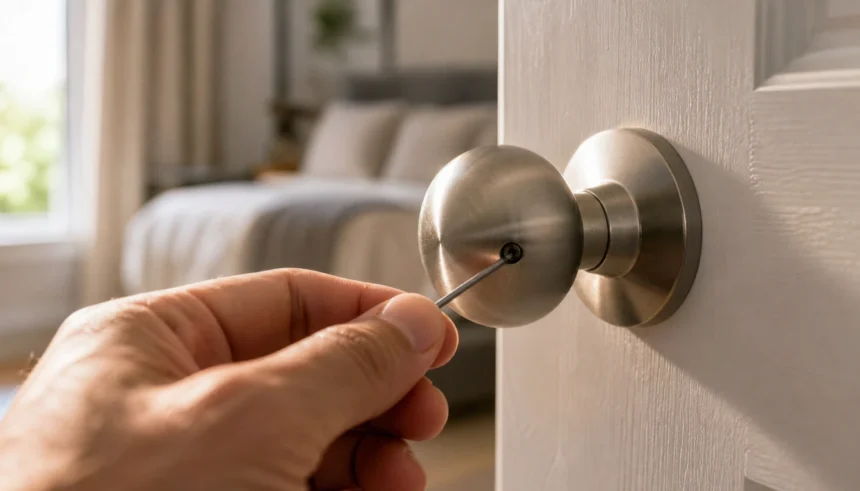
Last month, my bedroom doorknob started spinning like a slot machine. You’d turn it, hear a click, and the door still wouldn’t open. I stood there at 11 p.m., locked out of my own room, feeling ridiculous.
Sound familiar? A loose doorknob is one of those small annoyances that grows into a daily headache. It rattles when you walk by. It won’t latch. Sometimes it just spins uselessly in your hand.
The good news: you don’t need a handyman or a toolbox full of gear. I fixed mine with two tools I already had in a kitchen drawer, and it took less than five minutes. This guide walks you through exactly how to do the same, no matter what kind of doorknob you have.
Why Doorknobs Get Loose in the First Place
Every time you turn a doorknob, tiny screws inside get a little looser. Over months and years, that adds up. This is normal wear, not a sign your door is falling apart.
Most doorknobs use a small set screw hidden somewhere on the knob or the base plate. That screw holds everything in place. When it loosens, the whole knob starts to wobble or spin.
Other causes include humidity swelling the wood frame, kids yanking the handle, or a knob that was never installed tightly to begin with. Whatever the reason, the fix is usually the same.
The Only 2 Tools You Need
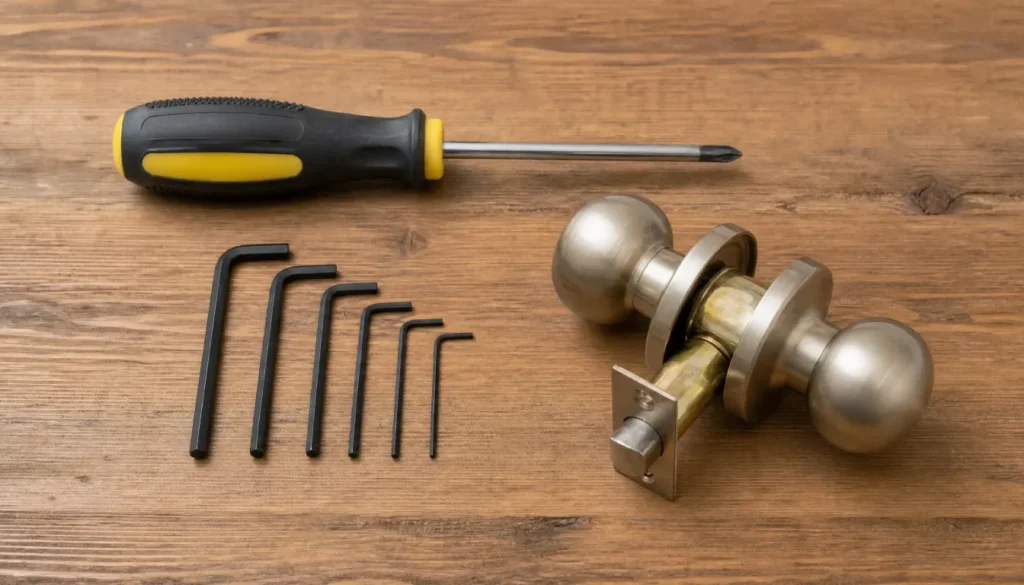
You do not need a full toolbox for this job. Here’s what actually works.
| Tool | What It Does | Where to Find It |
|---|---|---|
| Phillips or flathead screwdriver | Tightens visible mounting screws | Kitchen drawer, junk drawer |
| Small Allen wrench (hex key) | Tightens the hidden set screw on the knob shank | Often comes with furniture, IKEA boxes |
That’s it. Some doorknobs use only a screwdriver. Others hide their screw and need the Allen wrench. Either way, you likely already own both.
Step-by-Step: How to Tighten a Loose Doorknob
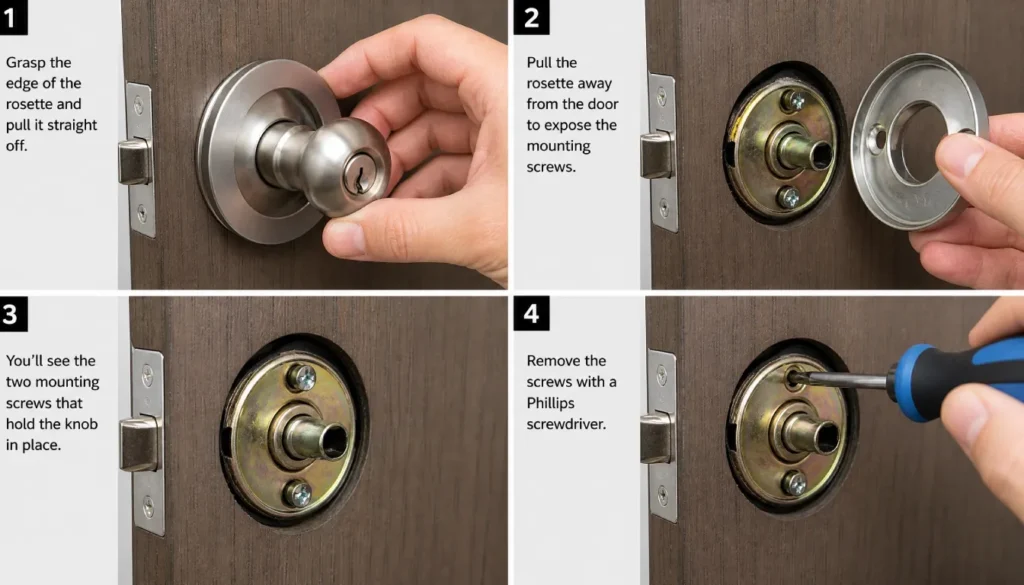
Follow these steps in order. Most people finish in under five minutes.
1. Find the doorknob type. Look at your knob closely. If you see two screws on the inside plate, it’s a standard setup. If the knob spins freely with no visible screws, it likely has a hidden set screw on the neck of the knob.
2. Locate the set screw. Check the small metal shank right behind the knob. Look for a tiny slot or hex-shaped hole. This is the set screw that holds the knob onto the spindle.
3. Tighten with the right tool. Use your Allen wrench for a hex-shaped hole, or a small flathead for a slotted screw. Turn clockwise until snug. Do not overtighten, since that can strip the threads.
4. Check the base plate screws. On the inside of the door, you’ll see the rosette or backplate held by two screws. Give both a firm turn clockwise with your screwdriver.
5. Test the knob. Turn it a few times. It should feel firm, not wobbly. Open and close the door to make sure the latch clicks properly into the strike plate.
If your knob still wobbles after this, the screw threads may be stripped. That’s a sign you need a replacement part, not a bigger screwdriver.
Fixing Different Types of Doorknobs
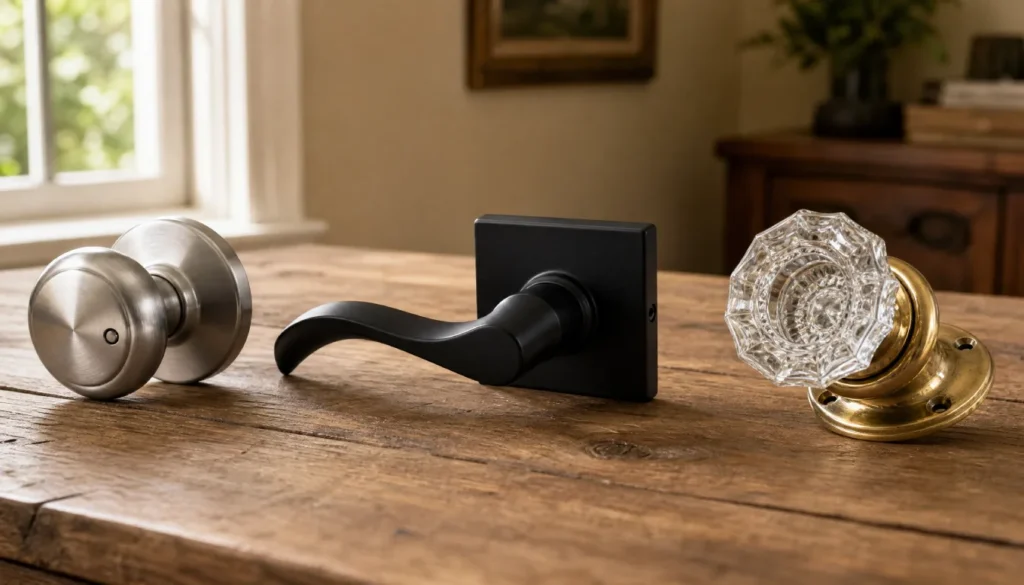
Not every doorknob is built the same way. Here’s how the fix changes by type.
Bedroom and bathroom privacy knobs: These often have a small push-button lock. The set screw sits on the underside of the knob. A quick turn with your Allen wrench usually solves the wobble.
Passage and hallway knobs: These have no lock at all. They’re the simplest to fix since you’re only dealing with the base plate screws and the set screw.
Exterior and keyed entry knobs: These matter for your home’s security. A loose exterior knob can be a real risk, so check it every few months and tighten it the moment it starts to feel loose.
Vintage and antique doorknobs: Older knobs sometimes use a different screw type or have a worn-out spindle. If the set screw is missing entirely, a hardware store can match a replacement for a few dollars.
Lever handles: Levers work almost the same way, but the set screw sits underneath the lever arm instead of the round knob. Everything else about the fix stays the same.
Common Mistakes to Avoid
A few small errors can turn a five-minute fix into a bigger problem.
- Overtightening the set screw, which strips the threads and makes future tightening impossible
- Using the wrong size Allen wrench, which rounds out the hex hole
- Ignoring a loose exterior knob, which weakens your home’s security over time
- Skipping the base plate screws and only tightening the set screw
- Forcing a stuck knob instead of checking the latch mechanism first
If you hit resistance that feels wrong, stop. A gentle turn is all you need.
When to Call a Professional
Most loose doorknobs are a simple DIY fix. But call a locksmith or handyman if the spindle is bent, the latch mechanism is broken, or the knob is on a security door and the lock itself feels unreliable. Your home’s safety is worth the extra ten dollars.
Frequently Asked Questions
Why is my doorknob loose even after tightening the screws?
The set screw threads may be stripped. Try a slightly larger screw, or replace the knob entirely.
Do I need a professional to fix a loose doorknob?
No. Most fixes only need a screwdriver and an Allen wrench. Save the professional call for broken latches or security concerns.
What size screwdriver do I need for a loose doorknob?
A standard Phillips head works for most base plates. For the hidden set screw, a small hex key set covers nearly every doorknob brand.
Can a loose doorknob damage my door over time?
Yes. A wobbling knob puts extra stress on the latch and strike plate, which can eventually misalign the door.
How often should I check my door hardware?
Give your knobs a quick wiggle test every few months, especially on exterior doors you use daily.
Final Thoughts
A loose doorknob feels like a small thing until it’s the reason you’re stuck outside your own room. The fix really is this simple: grab a screwdriver, grab an Allen wrench, and give those screws a firm turn.
You don’t need special skills for this one. Just five minutes and the right two tools. If you try this fix, I’d love to hear how it went for you. Drop a comment below and let me know which doorknob type you tackled.