

You’re booking a place to stay, and you keep seeing “hotel” and “motel” on the results page. You’re not sure what actually separates them. You just want a clean, safe, affordable bed without any surprises when you pull up.
Here’s the hotel vs motel difference for dummies, explained in plain English. By the end of this guide, you’ll know exactly which one fits your trip, your budget, and your comfort level. No guessing at the front desk.
What Is a Hotel? (A Super Simple Definition)
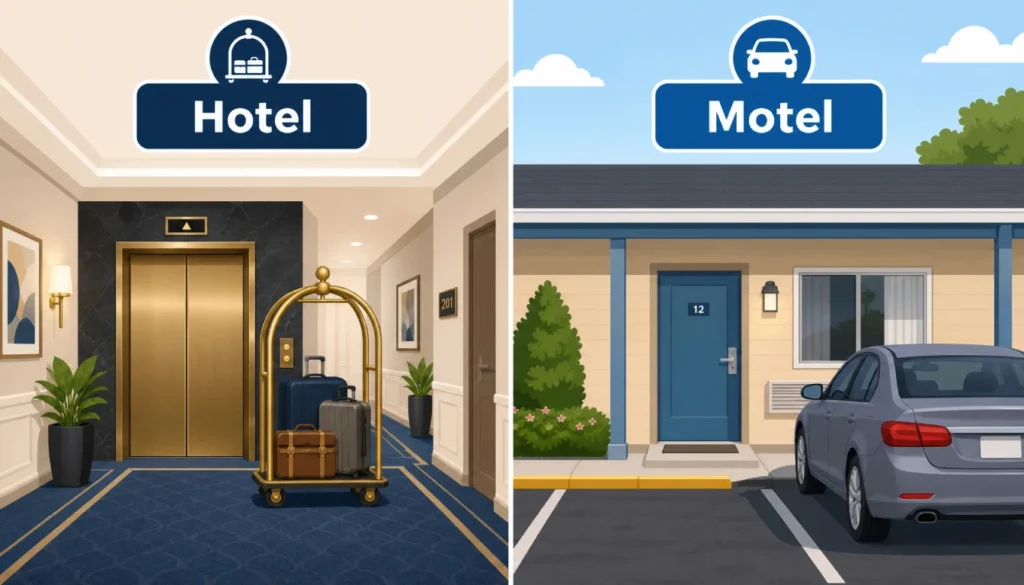
A hotel is a multi-story building with rooms that open onto indoor hallways. You walk through a lobby, take an elevator or stairs, and reach your room from inside the building.
Hotels usually come with extra staff. Think bellhops, room service, a front desk that’s staffed around the clock, and sometimes a restaurant or bar downstairs.
Most hotels also charge more. You’re paying for the building, the staff, and the amenities packed inside it.
What Is a Motel? (And Where the Name Actually Comes From)
The word “motel” is a mashup of “motor” and “hotel.” It was built for road trippers in the 1920s and 1930s, back when driving cross-country became popular in the US.
A motel is usually a single story, or maybe two. Each room opens directly to the outside, right next to a parking spot. You pull up, grab your bag, and walk straight into your room.
There’s no long hallway to navigate. No elevator wait. Just you, your car, and your door.
I’ll never forget my first motel booking. I rolled up tired after a ten-hour drive, walked to my room, and realized the door opened straight onto the parking lot. It wasn’t unsafe, but I definitely wasn’t expecting it. That’s when I learned: if you’re picturing a hotel lobby, a motel will surprise you. So let me show you what to actually expect.
Hotel vs Motel: 5 Key Differences at a Glance
Here’s the difference between hotel and motel stays, broken into the five things that matter most.
| Feature | Hotel | Motel |
|---|---|---|
| Entrance | Indoor hallway | Exterior door, near parking |
| Staff | Front desk, bellhops, often 24/7 | Small front office, sometimes limited hours |
| Price | Higher, plus possible fees | Lower, usually flat rate |
| Size | Often multiple floors | Usually one or two floors |
| Ideal for | City stays, business trips, longer visits | Road trips, quick overnight stops |
Motel vs Hotel Amenities List: What You’ll Actually Get
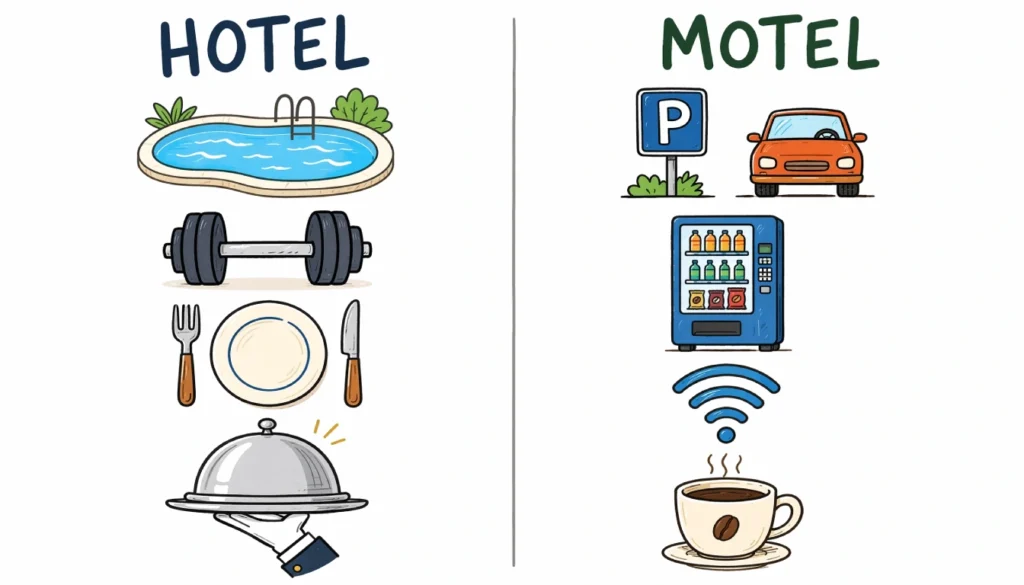
This is where the motel vs hotel amenities list gets real. Hotels pack in the extras. Motels stick to the basics.
What hotels usually offer:
- A swimming pool or fitness center
- An on-site restaurant or bar
- Room service
- A concierge or 24-hour front desk
- Daily housekeeping
What motels usually offer:
- Free parking right by your door
- Basic Wi-Fi
- A simple continental breakfast, or none at all
- A vending machine or small snack area
- Fewer common spaces, since most of the property is just rooms
Neither list is better on its own. It depends on what you need. If you’re driving twelve hours and just need six hours of sleep, a motel gives you exactly that, minus the extras you won’t use anyway.
Which Feels Safer? A Real-World Safety Comparison
This is the question I get asked most, especially by solo travelers. Here’s the hotel vs motel safety comparison, without the scare tactics.
Hotels tend to feel safer by default. You walk through a staffed lobby before reaching your floor. Indoor hallways mean strangers can’t just walk up to your door from a parking lot.
Motels aren’t automatically unsafe. Most are perfectly fine. But the exterior layout means your door faces the parking lot, so it’s worth taking a few extra precautions.
On a solo trip through Oregon, I used a three-step safety check before booking motels along the route. It turned a sketchy-looking listing into a completely fine night, every single time.
Quick safety checklist for motels:
- Check recent reviews for mentions of lighting and security cameras
- Pick a room near the front office, not at the far end of the lot
- Use the deadbolt and door chain the moment you’re inside
- Park directly in front of your room, where you can see your car

Cost Showdown: Why Motels Are Almost Always Cheaper
The motel vs hotel cost difference usually comes down to overhead. Hotels have more staff, more common areas, and more square footage to maintain. That cost gets passed to you.
Motels run leaner. Fewer staff, fewer shared spaces, lower nightly rates. On a typical US road trip, you might pay $60 to $90 for a motel room, compared to $120 to $200 for a mid-range hotel in the same area.
Hotels also tend to add extra fees. Resort fees, parking charges, and “amenity fees” can quietly add $20 to $40 a night. Motels usually skip these entirely and just charge one flat rate that includes parking.
A quick example from a recent trip: I booked a motel for $68 a night with free parking included. A hotel two miles away quoted $145, plus a $25 daily parking fee. That’s a $102 difference for one night, just for a place to sleep between drives.
How to Choose for Road Trips, Families, and Solo Stays
If you’re stuck choosing, follow these three steps.
Step 1: List your non-negotiables. A pool and a gym mean you probably want a hotel. Parking right outside your door and a budget under $80 means motel territory.
Step 2: Check the entrance type. Exterior doors mean it’s a motel. Interior corridors mean it’s a hotel. This one detail predicts almost everything else about the stay.
Step 3: Compare the all-in price. Add up parking fees and resort charges for hotels. Motels usually fold parking and Wi-Fi into the base rate. Multiply the total by your number of nights before you decide.
For road trippers: motels win almost every time. You’re only there to sleep, and parking right by your door saves time in the morning.
For families: hotels often make more sense if you want a pool or free breakfast to keep the kids occupied. But a clean, well-reviewed motel works fine for a single overnight stop.
For solo female travelers: either can work. Just run the safety checklist above before booking a motel, and choose a room near the office rather than a far corner.
FAQs
Is a motel cheaper than a hotel?
Yes, in almost every case. Motels typically run $30 to $70 less per night than a comparable hotel in the same area.
Do motels have room service?
Rarely. Most motels skip room service entirely. If that matters to you, book a hotel instead.
Are motels safe for solo travelers?
Most are. Check recent reviews, pick a room near the office, and use the deadbolt once you’re inside.
What is a motel vs hotel definition in one sentence?
A hotel has indoor hallways and more staff and amenities. A motel has exterior doors, direct parking access, and a simpler setup built for quick stops.
Can a motel be nicer than a budget hotel?
Yes. Some motels are recently renovated and spotless, while some budget hotels are dated. Always check photos and reviews before booking either one.
Final Take: The Simple Rule of Thumb
Here’s the hotel vs motel difference for dummies, boiled down to one line: if your room opens to an indoor hallway, it’s a hotel. If it opens straight to the parking lot, it’s a motel.
Hotels give you more staff, more amenities, and a higher price tag. Motels give you convenience, lower cost, and a faster path from your car to your bed. Neither one is the “right” choice. It depends on your trip.
Next time you’re comparing a hotel vs motel, run through the three-step check above. Look at the entrance, list your must-haves, and compare the full price, not just the nightly rate.
Have a motel or hotel story of your own, good or bad? Drop it in the comments. It might help the next traveler make a better call.