
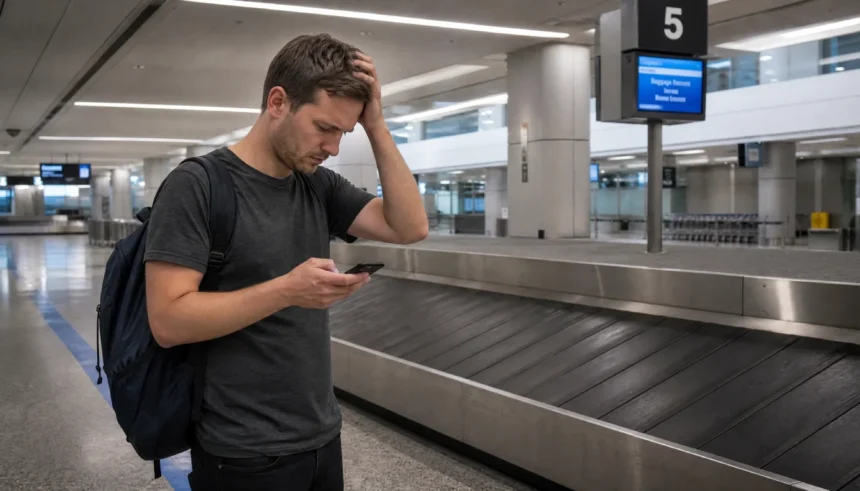
You’re standing at the baggage carousel. The crowd thins out. The belt stops. Your bag never shows up. Your stomach drops. What do you do if your luggage is lost at the airport?
I know that feeling. I’ve been there. But here’s the thing: if you follow the right steps, you can get your bag back or claim compensation without losing your mind. This guide walks you through exactly what to do, from the moment you realize your bag is missing to filing your final claim.
If you’re at the airport right now, here are your first three moves:
- Step 1: Check the oversize belt and surrounding carousel area before assuming the worst.
- Step 2: Go straight to the airline’s baggage service office and report the missing bag.
- Step 3: Get your Property Irregularity Report (PIR) with the reference number before you leave.
That’s your foundation. Now let’s go through every step in detail.
1. Stay Calm and Double-Check the Baggage Carousel
Before you panic, do a full scan of the area. Bags get misrouted to the wrong carousel more often than people think. Check the oversize and oversized luggage belt nearby. Some airports have a separate area for strollers, sports equipment, and large bags that gets overlooked.
Wait until the belt completely stops and the area clears. Then look around the carousel floor. Other passengers sometimes pull bags off and leave them nearby. Check the lost and found corner in the baggage hall, too.
If your bag truly isn’t there after a full check, don’t leave the airport yet. That’s the most important thing. Reporting inside the airport is faster and gives you more leverage than calling a hotline later.
2. Report Your Lost Luggage Immediately at the Airport
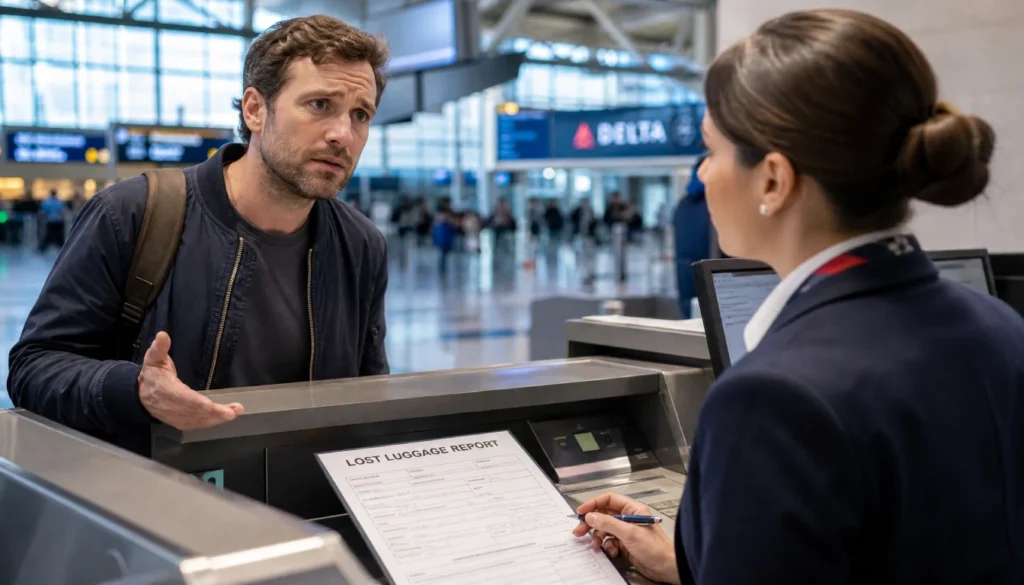
Go directly to the airline’s baggage service desk, which is usually located inside or just outside the baggage claim area. If your flight involved a connection, go to the operating carrier’s desk, meaning the airline that actually flew your last leg.
Tell them your bag didn’t arrive. Have these documents ready:
- Your boarding pass (all legs of the journey)
- Your baggage claim tag (the sticky stub attached to your boarding pass at check-in)
- Your passport or government-issued ID
- Your destination address or hotel name
The agent will search the system using your bag tag number. They’ll also check if the bag was left behind at a connecting airport or loaded on a later flight.
I personally faced this situation on a connecting flight through Frankfurt. My bag didn’t make the tight layover, and I stood there staring at an empty belt. The agent found it in the system within minutes. It had been held in Frankfurt and was on the next flight out. That only happened because I reported it immediately while the trail was still warm.
3. Get the Property Irregularity Report (PIR) — Your Most Important Document
The PIR is the official written record that your bag is missing. Without it, you have almost no standing to claim compensation or push for updates. Insist on one before you leave the desk.
The report will include:
- Your name and contact details
- Flight number and date
- Bag description (color, size, brand, distinguishing features)
- A unique file reference number (looks something like LHRAB12345)
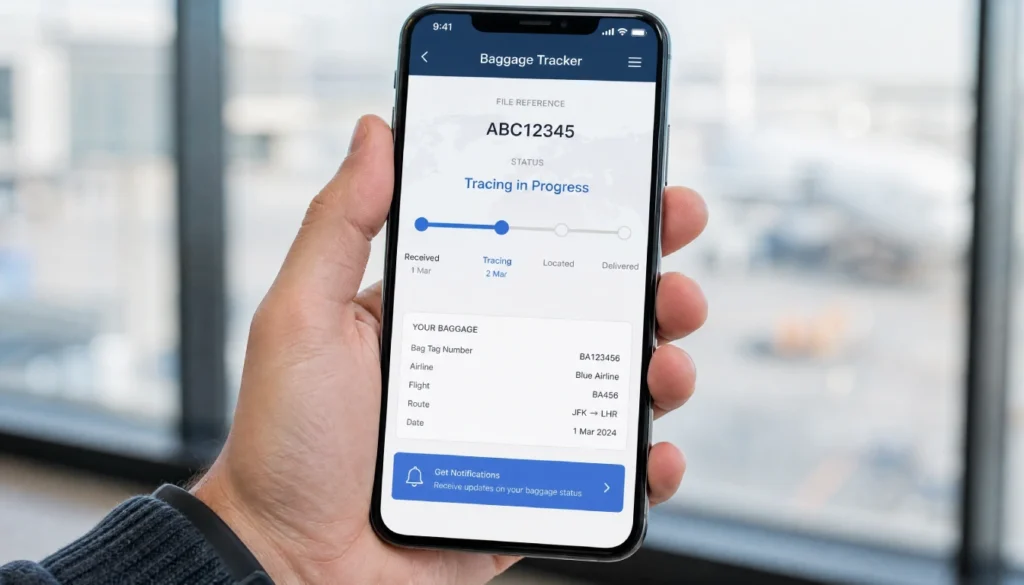
Keep a photo of this document on your phone. The reference number is what you’ll use to track your bag online, follow up by phone, and submit any expense claims later.
If the agent tries to send you a digital copy only, ask for a printed version as well. Some airline systems have delays pushing the email, and you want it in your hands before you leave.
4. Track Your Missing Bag Online (WorldTracer and Airline Apps)
Most major airlines use a system called WorldTracer to locate missing bags globally. Once your report is filed, you can check the status yourself.
Here’s how to track your lost luggage step by step:
- Go to your airline’s website or download their app.
- Find the baggage tracking or “delayed baggage” section.
- Enter your file reference number from the PIR.
- Enter your last name exactly as it appears on your ticket.
- Check the status. Common updates include “Tracing in Progress,” “Located,” and “On the Way.”
You can also go directly to the WorldTracer portal used by many carriers. The updates don’t always come in real time, so check back every 12 hours rather than refreshing constantly.
If 24 hours pass with no update, call the airline’s baggage tracing line. Use the file reference number every time you contact them. It keeps the conversation focused and puts the burden back on them.
5. What If My Bag Is Just Delayed, Not Lost?
Airlines treat delayed bags and lost bags differently, and the distinction matters for what you’re owed.
A bag is considered delayed when it fails to arrive on your flight but is still being traced. Most airlines reunite delayed bags within 24 to 72 hours. If your bag is found, the airline will typically deliver it to your address or hotel at no charge.
A bag is officially declared lost when the tracing process has gone on for around 21 days without a result. At that point, you move from delayed status to permanent loss, and your compensation rights change significantly.
If your bag is delayed, ask the airline two things right away:
- Will you deliver the bag to my address when found?
- What is your interim expense policy while I wait?
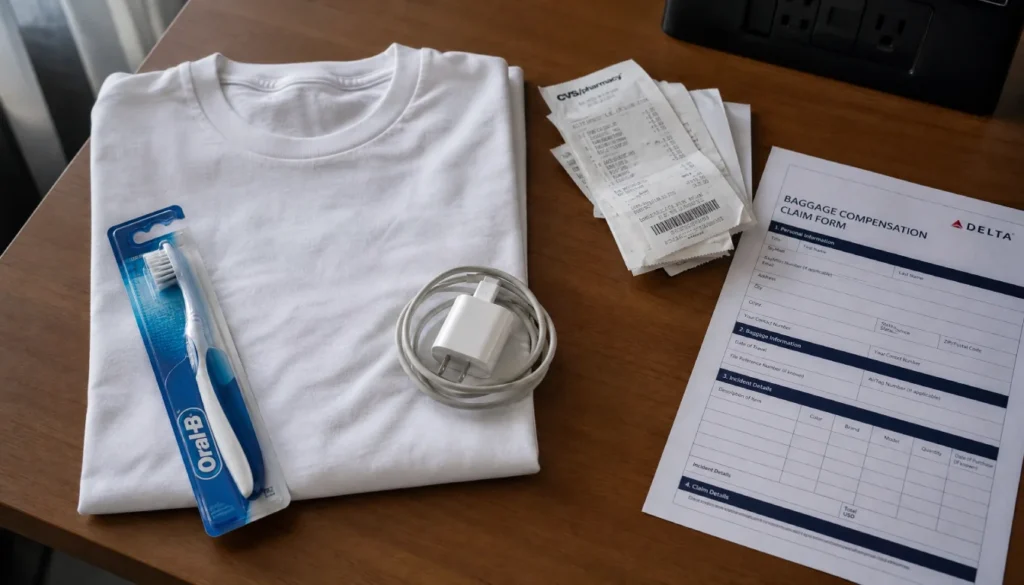
Most carriers will cover reasonable purchases you need to make in the meantime. Keep every receipt.
6. Your Compensation Rights and What the Airline Owes You
This is where most travelers lose money simply because they don’t know the rules. Understanding your rights is critical, and the timeline matters.
Interim expenses for delayed bags
If your bag is delayed, airlines are generally required to reimburse you for essential items: toiletries, a change of clothes, a phone charger, and similar necessities. “Reasonable” is the key word. A $300 jacket probably won’t get covered; a $30 t-shirt and $15 toiletry kit will.
US domestic flights
The US Department of Transportation (DOT) sets liability limits for domestic flights. Airlines are liable for up to $3,800 per passenger for lost, damaged, or delayed baggage as of the most recent federal guidelines.
International flights
For international travel, the Montreal Convention applies. It sets the liability limit at approximately 1,288 Special Drawing Rights (SDR), which converts to roughly $1,700 to $1,800 USD depending on the exchange rate.
Don’t miss the deadline: lost baggage claim time limit
This is where people get caught. The claim deadlines are strict:
- Delayed bags: Submit an expense claim as soon as possible, and no later than 21 days from when the bag was returned.
- Lost bags: File your written claim within 21 days of the bag being declared lost on international flights.
- US domestic flights: Check your airline’s specific terms; most require a claim within 30 days.
Missing these windows can void your right to compensation entirely, so don’t wait.
Lost luggage compensation on international flights also depends on whether you bought travel insurance, which can cover the gap between the Montreal Convention limits and the actual value of your belongings.
7. What to Do If Your Luggage Is Never Found
After 21 days with no result, it’s time to shift gears. Here’s your action plan for a permanently lost bag:
Step 1: File a formal written claim with the airline. Include your PIR number, a detailed list of contents with estimated values, and receipts or proof of purchase where you have them. Be specific. “Clothing” is not enough. List items individually.
Step 2: Submit a travel insurance claim. If you have travel insurance, contact your provider immediately. Many policies cover the full replacement value of lost luggage up to your policy limit, separate from what the airline pays.
Step 3: Check your credit card benefits. Several travel credit cards include lost baggage protection as a perk. Check your card’s benefits guide or call the benefits number on the back of your card.
Step 4: Document everything for your records. Keep all correspondence with the airline, your PIR copy, receipts, and any written confirmation of the bag being declared lost. You may need these if you escalate to a consumer protection body or small claims court.
One thing I learned from going through the Frankfurt delay myself: the airlines respond faster when you follow up in writing by email and keep a record of dates and times. A paper trail is your best tool.
A Quick Note on What to Pack in Your Carry-On Next Time
Once you’ve been through a missing bag, you never pack the same way again. Your carry-on should always hold your medications, one change of clothes, your phone charger, and any valuables. A separate post covers exactly what to pack in your carry-on in case your luggage is lost, including a printable checklist you can save before your next trip.
Wrapping Up
Knowing what to do if your luggage is lost at the airport turns a stressful situation into a manageable process. Report immediately, get your PIR, track your bag with the reference number, buy what you need and keep receipts, and know your compensation rights under the Montreal Convention or DOT rules.
Don’t leave the airport without that PIR. That single document is your proof, your tracking key, and your compensation claim starter.
Have you had a bag go missing? Drop a comment below and share what worked for you. It might help someone else who’s standing at an empty carousel right now.