
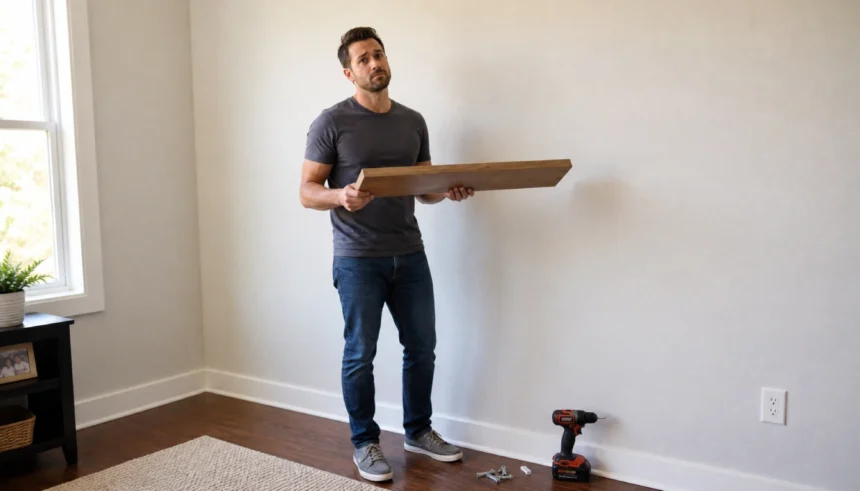
You’ve got a shelf ready to go. You check your toolbox, and there’s no stud finder. Now you’re standing there wondering if this whole project is dead in the water.
It’s not.
Knowing how to hang shelves without a stud finder is a real skill, and it’s more common than you’d think. Most beginners assume you need to hit a stud every time, but that’s simply not true. Four methods work well on drywall, whether you’re renting an apartment or just want to avoid buying another tool. I’ll walk you through each one, including which holds the most weight and where people go wrong.
Can You Really Hang a Shelf Without Hitting a Stud?
Yes. You can hang shelves without a stud finder, and plenty of them will hold more weight than you’d expect.
Studs give you a solid wood anchor behind the drywall. But drywall anchors and toggle bolts work differently. They grip the back of the drywall panel itself, or spread their load across a wider surface area. When you use the right hardware for the right weight, the result is just as solid.
The key question isn’t “did I hit a stud?” It’s “Did I choose the right anchor for this load?”
That’s exactly what this guide covers. You’ll know your options, their limits, and the steps to install each one correctly.
What You’ll Need (Tools & Materials Checklist)
Before you start, gather these. You won’t need all of them for every method, but it helps to know what’s involved.
- Power drill or hand drill
- Drill bits (matched to your anchor size)
- Pencil
- Level (a small one works fine)
- Tape measure
- Stud-free anchors: toggle bolts, molly bolts, or self-drilling anchors
- Adhesive strips (for the no-drill method)
- Screws (usually included with anchors)
- Screwdriver (flathead or Phillips, depending on your hardware)
If you’re a renter going for zero damage, skip the drill entirely and go straight to Method 3.
Method 1: Heavy-Duty Toggle Bolts (Best for Medium-Heavy Shelves)
Toggle bolts are the strongest drywall anchor you can buy without hitting a stud. I learned this the hard way.
The first floating shelf I ever hung used cheap plastic anchors from a dollar store. Two days later, it ripped clean out of the wall. I had a stack of cookbooks on it, and the whole thing came down at 2 a.m. That experience taught me that toggle bolts are non-negotiable for anything heavier than a picture frame.
I switched to metal wing toggles. That same shelf, in a different spot, has held my full cookbook collection for three years without moving.
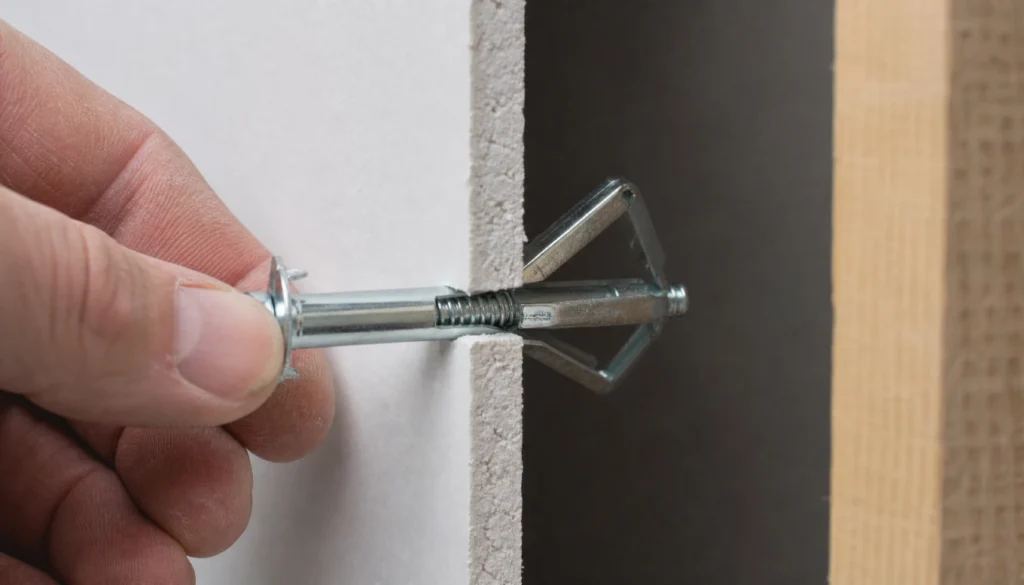
How toggle bolts work: You drill a hole, fold the metal wings flat, push the bolt through, and once it’s behind the drywall the wings spring open. When you tighten the screw, the wings press against the back of the drywall from inside the wall cavity. The load gets distributed across a wide surface.
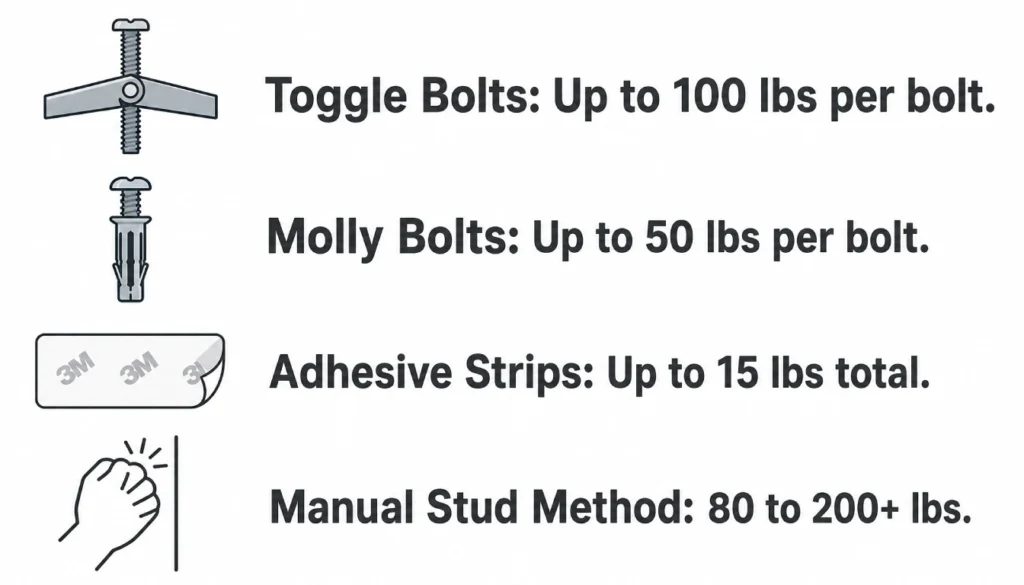
Toggle bolt weight limit: Most standard metal toggle bolts hold between 50 and 100 lbs per bolt when installed correctly in 1/2-inch drywall. Always check the packaging for the exact rating.
Steps to install toggle bolts:
- Mark your bracket hole positions with a pencil. Use a level to keep them even.
- Drill a hole slightly wider than the folded toggle wings.
- Thread the bolt through your shelf bracket, then through the folded toggle.
- Push the whole assembly into the hole until the wings pop open on the other side.
- Pull back gently on the bolt while you tighten the screw. This keeps the wings pressed against the interior wall.
- Tighten until snug. Don’t overtighten or you’ll crush the drywall.
- Mount the shelf, check the level, and do a firm tug test before loading.
One warning: If you ever remove a toggle bolt, the wings drop inside the wall. You can’t reuse them. Plan your placement before you drill.
Method 2: Self-Drilling Drywall Anchors and Molly Bolts
Self-drilling anchors, also called EZ anchors, are the go-to choice when you want something quick and you’re not dealing with heavy loads. They screw directly into drywall without a pre-drilled hole.
Drywall anchors for shelves work best for lighter setups: a small decorative shelf, a bathroom shelf with toiletries, or a bookshelf with paperbacks. They’re fast to install and widely available at any hardware store.
Molly bolts are the stronger version. You drill a small pilot hole, insert the bolt, and tighten the screw. As you tighten, the back of the bolt collapses and flares out against the inside wall surface, creating a firm grip. They hold more than plastic self-drillers and are easier to remove cleanly than toggle bolts.
Steps for self-drilling anchors:
- Mark your hole location and use a level to align both points.
- Push the tip of the self-drilling anchor against the wall and use a Phillips screwdriver or drill to screw it in flush with the wall surface.
- Insert the provided screw through your bracket and into the anchor.
- Tighten firmly, mount the shelf, and test before loading.
Steps for Molly Bolts:
- Drill a pilot hole the size specified on the Molly bolt packaging.
- Tap the Molly bolt into the hole with a hammer until the collar sits flush.
- Tighten the screw, which collapses the back of the bolt against the wall interior.
- Back out the screw, slip your bracket over it, and reinsert and tighten.
Weight limits: Self-drilling plastic anchors typically hold 25 to 50 lbs. Metal Molly bolts can hold 30 to 50 lbs per anchor, depending on size and drywall thickness.
Method 3: Adhesive Strips and No-Drill Hooks (Renter-Friendly)
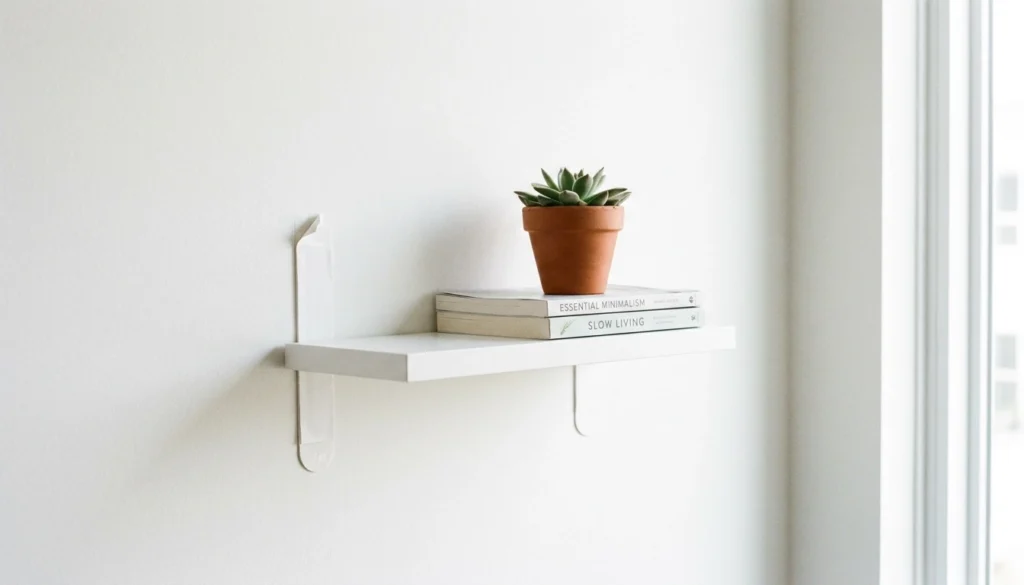
This is the method for renters who want to hang shelves without losing their security deposit. If you’re looking for a truly renter-friendly way to hang shelves, adhesive strips are your best option.
Command strips and similar heavy-duty adhesive products have improved significantly. For light shelves, they work. The keyword is light.
What works and what doesn’t:
- Good for: small floating shelves with plants, candles, a few books, or light decor
- Not good for: shelves holding anything over 15 lbs total, or shelves with uneven weight distribution
Steps to hang a shelf with adhesive strips:
- Clean the wall with rubbing alcohol and let it dry fully. Dust or oil will kill the adhesion.
- Read the strip packaging. Most require you to press and hold for 30 seconds per strip.
- Apply strips to the back of the shelf bracket or the shelf itself, following the pattern shown on the packaging.
- Press the shelf firmly against the wall for at least 60 seconds.
- Wait the full cure time before placing any weight on it. Most brands recommend 1 hour minimum, some say 24 hours for full strength.
- Load the shelf gradually. Don’t place everything on it at once.
One real-world tip: I’ve seen people use adhesive strips on textured walls and wonder why they fail within a week. Adhesive strips need a smooth, flat, clean surface. On textured or painted brick walls, they simply won’t grip correctly.
Method 4: Finding a Stud Manually (Without a Stud Finder)
Sometimes you want to hit a stud the traditional way, but you just don’t own the tool. Here’s how to find one without it.
Stud spacing is your starting point. In most homes built in North America, studs are spaced 16 inches apart, sometimes 24 inches in older homes. If you can find one stud, you can locate the rest by measuring outward.
How to find a stud without a stud finder:
- Use the outlet trick. Electrical outlets are almost always nailed to the side of a stud. Remove the cover plate and look inside the box. The stud will be on one side. Measure 16 inches from there to find the next one.
- Knock on the wall. Tap across the wall slowly. A hollow sound means no stud. A slightly duller, denser sound means you’re close. This takes practice but works.
- Look for nail pops or seams. Drywall sheets are screwed to studs. If you see slight bumps or vertical nail pops in the paint, those are often right over a stud.
- Use a strong magnet. Rare earth magnets can detect the drywall screws beneath paint. Drag it slowly across the wall. A pull means you found a screw head, which sits on a stud.
- Mark it and verify. Once you think you’ve found a stud, drive a thin finish nail at a low angle at that spot. If it hits wood after the drywall layer, you’ve found your stud. If it goes straight through with no resistance, adjust 1 inch left or right and try again.
When you’re drilling into a stud, you don’t need anchors at all. Standard wood screws go straight in, and the shelf is as solid as it gets.
Weight Limits and Comparison Table: Which Method Holds What?
Before you decide on a method, match it to your shelf’s expected load. Here’s a clear breakdown.
| Method | Hardware | Approx. Weight Limit | Best For |
|---|---|---|---|
| Toggle Bolts | Metal wing toggles | 50 to 100 lbs per bolt | Heavy shelves, kitchenware, books |
| Molly Bolts | Metal expansion bolts | 30 to 50 lbs per bolt | Mid-weight shelves, bathroom storage |
| Self-Drilling Anchors | Plastic or metal EZ anchors | 25 to 50 lbs per anchor | Light to mid shelves, decor |
| Adhesive Strips | Heavy-duty peel and stick | Up to 15 lbs total | Decorative shelves, plants, and frames |
| Manual Stud Finding | Wood screws into the stud | 80 to 200+ lbs per screw | Any shelf, heavy loads |
Always add up the total load, including the shelf itself. A 5-lb wooden shelf holding 20 lbs of books means a 25-lb total load. Choose your hardware accordingly, and always use at least two anchor points per shelf.
4 Common Shelf-Hanging Mistakes Beginners Make
I’ve seen these same errors come up over and over, whether from my own experience or from helping others fix their shelves.
Mistake 1: Buying the cheapest plastic anchors. White plastic ribbed anchors are everywhere. They’re also the most likely to strip out or pull free. Spend a few extra dollars on metal self-drillers or toggle bolts. The shelf you’re hanging is worth it.
Mistake 2: Skipping the level. Even a slight tilt becomes obvious after a week. Take 30 seconds to level your marks before drilling. It saves you from patching holes and starting over.
Mistake 3: Not accounting for total weight. People weigh the shelf, forget to count the items going on it, and install anchors rated for half the actual load. Always estimate high when calculating.
Mistake 4: Not doing a pull test before loading. Once the shelf is mounted, grip it firmly and give it a pull. If it shifts, the anchor isn’t fully set. Better to find out now than when it’s full of dishes at midnight.
FAQs
Can you hang shelves without a stud finder on any wall?
This guide covers standard drywall. If your walls are plaster, concrete, or tile, you’ll need different anchors, specifically masonry anchors or plaster-rated hardware.
How heavy a shelf can I hang without hitting a stud?
With two heavy-duty toggle bolts, you can safely support 100 to 200 lbs of total load. Always check the rating on the specific product you buy.
Will adhesive strips damage my walls when removed?
Most stretch-release adhesive strips, like Command strips, come off cleanly if you follow the removal instructions exactly. Pull slowly at a low angle parallel to the wall, not outward.
Do I need to patch the wall after toggle bolts?
Yes. Toggle bolts leave a hole wider than most anchors. Use lightweight spackle, let it dry, sand smooth, and touch up with paint.
What’s the easiest method if I’m a first-timer?
Self-drilling metal anchors. They go in fast, no pre-drilling needed, and they’re forgiving if your placement isn’t perfect. Start there for shelves under 30 lbs.
Ready to Hang Your Shelf?
You now have everything you need to hang shelves without a stud finder, safely and confidently. Here’s the short version:
- Use toggle bolts for anything heavy, including bookshelves and kitchen storage.
- Use Molly bolts or self-drilling anchors for mid-weight shelves.
- Use adhesive strips if you’re renting and want zero wall damage.
- Use the manual stud-finding method if you want a wood anchor without buying a tool.
The right anchor for the right load is all it takes. Pick your method, follow the steps, and do the pull test before loading your shelf. Knowing how to hang shelves without a stud finder is a skill you’ll use in every home you live in.
If this guide helped you, leave a comment below and tell me which method you used. And if you’re still deciding, drop your shelf’s weight in the comments, and I’ll point you to the right anchor.