

I remember sitting in a meeting that had already gone 20 minutes over, watching the clock, and thinking: there has to be another way.
Not because I hated my job. But because I had skills people kept asking me to use for free, a few solid ideas, and a quiet feeling that I was leaving money, purpose, and something bigger sitting on the table.
Maybe you know that feeling. You scroll past someone’s “I replaced my salary in six months” post and think, “Good for them,” then click away. Because you have rent. Health insurance. A manager who expects you to be online by 8 a.m.
The good news? You do not have to quit anything to get started. Thousands of people are building profitable service-based businesses right now, around their day jobs, on evenings and weekends, using skills they already have.
This guide breaks down exactly how to do that, step by step, without the burnout or the guesswork.
Why a Service-Based Business Makes Sense When You Have a Full-Time Job
When you are starting a business while working a 9-to-5, you want the fastest path to real income, not a two-year product development cycle.
Service businesses win here because your expertise is the product. No inventory. No manufacturing. No upfront capital. You get paid for what you already know how to do.
Consulting, copywriting, bookkeeping, cleaning, web design, virtual assistance, tutoring. These are all service business ideas that can start small and grow at your pace.
You also get to test the market before you risk your paycheck. That is a massive advantage most founders never have.
Step 1: Pick a Service That Fits Your Current Life
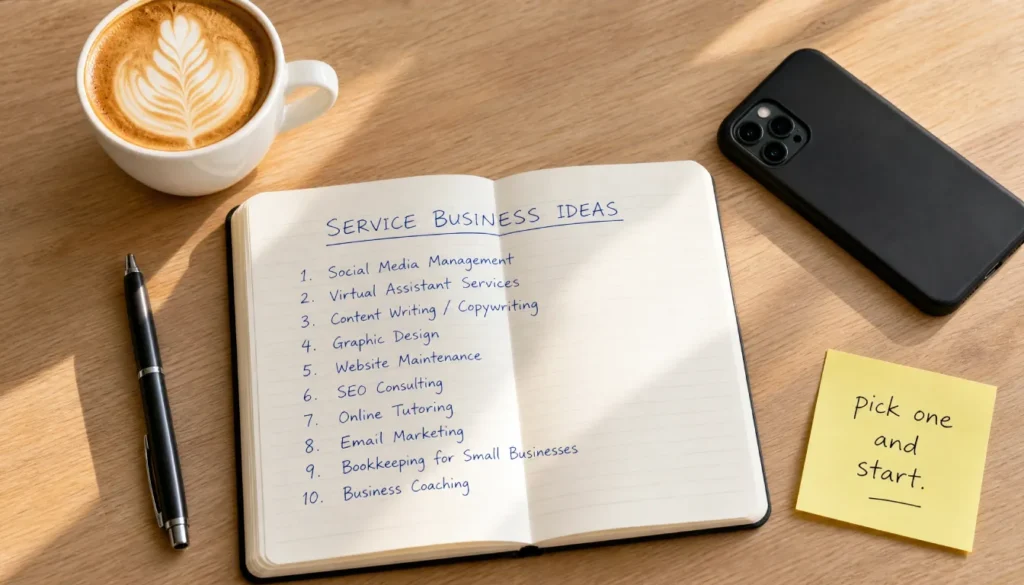
The best service business for you right now is not necessarily the most profitable one. It is the one you can actually run between 6 p.m. and 10 p.m., or on Saturday mornings, without it destroying your quality of life.
Ask yourself:
- What do people already ask me to help with?
- What can I do remotely, or in short time blocks?
- What requires minimal equipment or startup cost?
Practical service business ideas for working professionals:
- Freelance graphic design or copywriting
- Social media management for small businesses
- Bookkeeping or tax prep for freelancers
- Virtual assistant work for entrepreneurs
- Online tutoring or coaching
- Home services like cleaning, lawn care, or mobile car detailing
You do not need experience running a business. You need one marketable skill and one willing client.
Step 2: Check Your Employment Contract First
This is the part most people skip, and it matters.
Before you take a single paid client, read your employment agreement. Look for non-compete clauses, moonlighting policies, or conflict-of-interest language.
Most contracts restrict you from working for direct competitors, not from freelancing in an unrelated area. But you need to know what yours says.
If you are unsure, a quick 30-minute consultation with an employment attorney is worth every cent. It protects you before you build something worth protecting.
One more thing: use a separate email address, phone number, and bank account for your side business from day one. Keep it clean. Keep it professional. Keep it clearly separate.
Step 3: Register Your Business the Right Way
You do not need a fancy setup to get started, but you do need a legal structure.
For most people starting a service business part-time, a sole proprietorship works for day one. But forming an LLC is worth considering early. It protects your personal assets and adds credibility with clients.
The good news: you can register an LLC while employed full-time. It is legal in all 50 states. You can do it online in most states for under $150.
Quick legal and financial setup checklist:
- Choose a business name
- Register your business (sole prop or LLC)
- Open a dedicated business bank account
- Apply for an EIN (free from the IRS)
- Look into general or professional liability insurance
- Set up simple bookkeeping from day one
Affordable LLC formation services like ZenBusiness or Northwest Registered Agent make this easy, even if legal paperwork is not your thing.
Step 4: Price Your Services Confidently
A lot of first-time service business owners underprice because they feel like they are “just starting.”
Here is a reframe: your client is not paying for your years of experience. They are paying for a result. Price based on the value of that result, not your imposter syndrome.
How to price your services when you are just starting part-time:
- Research what established providers charge in your niche
- Start at 70 to 80 percent of the market rate
- Raise your rates after your first three to five clients
- Never price below your time cost, including admin, communication, and revisions
A simple formula: if a project takes 5 hours and your time is worth $50 an hour, your floor is $250. Add a buffer for communication and revisions. Charge $350 to $400.
Step 5: Get Your First Client Without a Big Marketing Budget

You do not need a website, an Instagram account, or a content strategy to land your first client. You need one conversation.
Start with your existing network. Tell three to five people what you are now offering. Be specific. “I help small businesses manage their social media so they can focus on running their company” is 10 times more effective than “I do social media stuff.”
Low-cost ways to find your first clients:
- Post on LinkedIn with a clear offer
- Join Facebook groups in your niche and be genuinely helpful
- Reach out to local small businesses directly
- Use platforms like Upwork, Fiverr, or Thumbtack to build early reviews
- Ask past colleagues if they know anyone who needs your service
One client leads to a referral. One referral leads to two more. That is how this starts.
Step 6: Manage Your Time Without Losing Your Mind
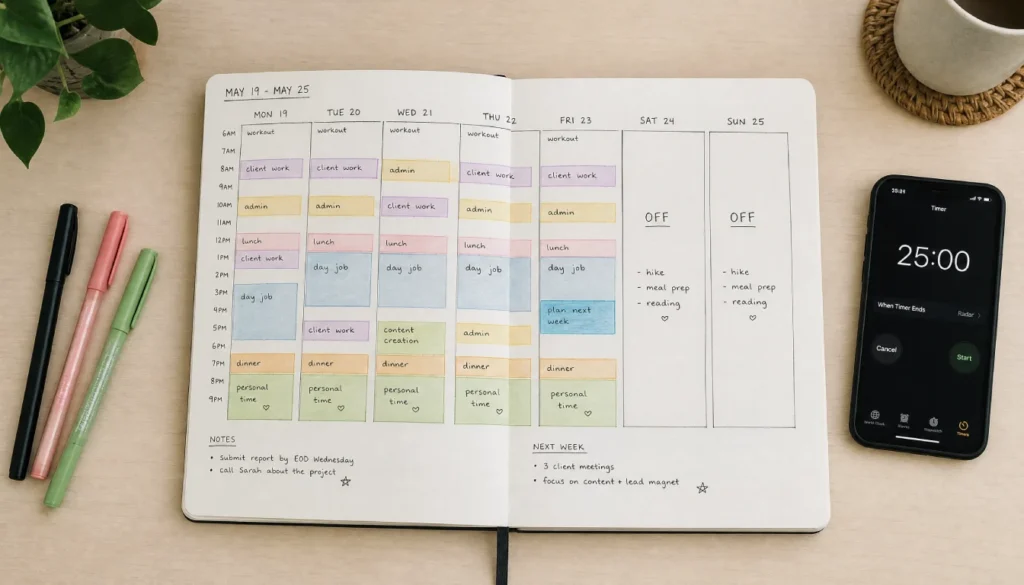
This is where most side business owners struggle. Not because they lack hustle, but because they do not design their schedule.
Time blocking is your best friend here. Pick two to three evening slots per week and one weekend block that are reserved for your business. Treat them like meetings you cannot cancel.
Time management tips for side business owners:
- Set a weekly hour limit and stick to it (10 to 15 hours is realistic to start)
- Use tools like Calendly to let clients book during your available windows only
- Batch similar tasks together (client calls one day, admin another)
- Automate what you can: invoices, follow-ups, appointment reminders
- Protect at least one full day off per week
Burnout is the biggest threat to a part-time business. Rest is not optional. It is part of your operating plan.
Step 7: Use Simple Tools to Run Your Business
You do not need expensive software. You need tools that save time and look professional to clients.
| What You Need | Affordable Options |
|---|---|
| Invoicing | Wave (free), FreshBooks |
| Contracts | HelloSign, AND.CO |
| Scheduling | Calendly, Acuity |
| Communication | Slack, Zoom |
| Simple website | Squarespace, Carrd |
| Accounting | Wave, QuickBooks Simple Start |
| CRM | HubSpot free tier, Notion |
Start free where you can. Upgrade when revenue justifies it.
Common Mistakes to Avoid
A few things will slow you down faster than anything else:
- Waiting until everything is perfect. Your website, your branding, your pricing, it is never fully ready. Start with what you have.
- Taking on clients you cannot serve well. One bad client relationship at this stage costs you time, energy, and confidence. Be selective early.
- Mixing business and personal finances. Open a separate bank account before you take your first payment.
- Ignoring taxes. As a self-employed person, you owe quarterly estimated taxes. Set aside 25 to 30 percent of every payment.
- Underestimating admin time. Client emails, proposals, and invoicing take real time. Factor it into your pricing.
Frequently Asked Questions
Can I legally start a service business while employed full-time?
Yes, in most cases. The key is to review your employment contract for any non-compete or conflict-of-interest clauses. As long as your side business does not compete directly with your employer, you are typically fine.
How do I find clients for my service business while working a 9-to-5?
Start with your existing network. Tell people specifically what you do and who you help. Use LinkedIn, local Facebook groups, and freelance platforms to expand your reach. Referrals from your first few clients will do most of the work.
How many hours a week should I dedicate to a side service business?
Most people start with 8 to 15 hours per week. Focus on client work first. Admin and marketing can be batched into shorter sessions. Protect your rest.
What is the best legal structure for a part-time service business?
A sole proprietorship is the simplest starting point. An LLC is worth forming early if you want liability protection and a more professional image. You can set up an LLC in most states for under $150.
How long does it take to replace a full-time income with a service business?
It varies widely. Most part-time service businesses take 12 to 24 months to reach income levels that make quitting a realistic option. Some do it faster. Focus on profitability first, not speed.
You Are Closer Than You Think
Starting a service-based business while working full-time is not about having the perfect plan. It is about taking one concrete step this week and then another next week.
You already have the skill. You just need the structure, the first client, and a schedule that does not wreck your life.
Pick one service. Tell someone about it. Send one email. That is the whole move.
The people who succeed at this are not more talented than you. They just started before they felt ready.
You can do this. And you do not have to blow up your life to find out.
If you are working on a service business right now or thinking about starting one, drop your biggest question in the comments. I would love to hear where you are in the process.