

I remember sitting at my kitchen table at 11 PM, staring at a blank spreadsheet, trying to figure out if my business idea was worth pursuing.
I had no team. No budget for a research firm. No MBA telling me what to do next.
Just me, a lukewarm coffee, and a whole lot of uncertainty.
If you’ve been there, you know how exhausting solo founder market research feels. You don’t know where to start. You’re not sure which questions matter. And hiring someone to do it for you costs more than your monthly revenue.
That’s exactly why I started using ChatGPT for market research. It changed the way I validated ideas, studied competitors, and understood customers.
In this article, I’ll show you exactly how to use ChatGPT for market research as a solo founder, step by step. No fluff, no vague advice. Just what actually works.
Why Solo Founder Market Research Is Harder Than People Think
You’re doing everything alone. Product, marketing, sales, support. Research keeps falling to the bottom of the list.
Traditional market research takes weeks and costs thousands. Surveys need distribution. Focus groups need coordination. Hiring a research analyst is out of the question when you’re bootstrapped.
The result? Most solo founders skip proper research and go straight to building. That’s a risky move.
ChatGPT doesn’t replace every research method, but it gives you a fast, affordable starting point. Think of it as a research assistant that never sleeps and never sends you an invoice.
Step 1: Use ChatGPT to Define Your Target Market
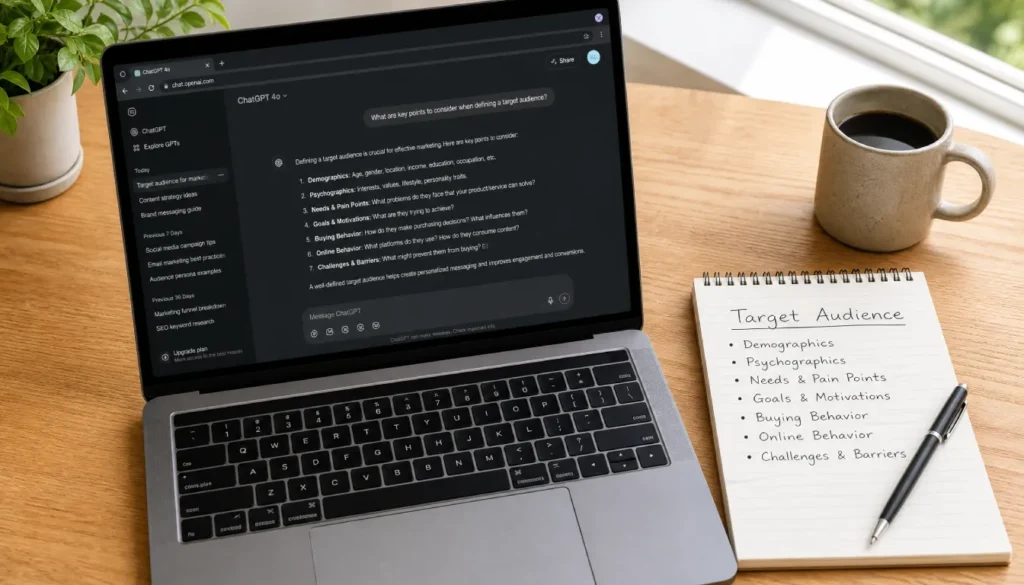
Before you research anything, you need to know who you’re researching.
Start with this prompt:
“I’m building [product/service] for [type of person]. Help me define my target audience, including demographics, goals, frustrations, and buying behavior.”
ChatGPT will give you a rough audience profile in seconds. It won’t be perfect, but it gets you moving. You can refine it as you learn more.
This is also where ChatGPT persona development shines. Ask it to create 2 to 3 buyer personas based on the audience you described. Each persona becomes a lens for every decision you make later.
Step 2: Validate Your Business Idea Before You Build Anything
One of the best uses of ChatGPT for startup validation is stress-testing your idea early.
Try this:
“Here’s my business idea: [describe it]. What are the most common reasons ideas like this fail? What assumptions am I making that could be wrong?”
This is the question most founders are afraid to ask. ChatGPT will surface risks you haven’t considered, gaps in your thinking, and market conditions worth checking.
It’s not pessimism. It’s preparation.
You can also ask it to do a quick ChatGPT SWOT analysis on your concept. List your strengths, weaknesses, opportunities, and threats in plain language. It takes about two minutes and saves you from chasing a dead end.
Step 3: Analyze Competitors Without Paying for Expensive Tools

ChatGPT competitive analysis works surprisingly well when you give it enough context.
Start by telling it about a competitor:
“Here’s what I know about [Competitor Name]: [paste website copy, pricing page, key features]. Analyze their positioning, target customer, strengths, and weaknesses.”
Then ask it to compare that competitor against your own offer. Where are the gaps? What are they doing well? What are customers likely complaining about that you could solve?
You can also ask ChatGPT to help you use ChatGPT to find market gaps by looking at what competitors are ignoring. Sometimes the best opportunity isn’t where everyone is fighting. It’s where no one is looking.
Quick tip: Pair ChatGPT with free tools like Google Trends, Reddit, and G2 reviews for real data. ChatGPT interprets and connects the dots. You supply the raw material.
Step 4: Generate Survey Questions and Customer Discovery Prompts
Customer discovery is where most solo founders get stuck. They don’t know what to ask. Or they ask leading questions that confirm their existing beliefs.
ChatGPT fixes this fast.
“I want to interview potential customers for [product]. Write 10 open-ended discovery questions that uncover their real frustrations, current solutions, and willingness to pay.”
You’ll get a solid list in under a minute. Edit the ones that don’t fit your context. Use the rest in actual conversations.
ChatGPT for conducting customer interviews is also useful for practicing. Ask it to role-play as a skeptical potential customer and push back on your pitch. It sounds strange, but it’s great prep for real conversations.
Step 5: Do a Quick ChatGPT Market Sizing Exercise
You don’t need a PhD in economics to estimate your market size. You need the right questions.
Ask ChatGPT this:
“Help me estimate the total addressable market for [product/service]. Walk me through a top-down and bottom-up approach.”
It will explain both methods and help you fill in the numbers with logic and assumptions. You can then verify those assumptions with public data from sources like Statista, IBISWorld free previews, or industry reports.
ChatGPT market sizing won’t give you a board-ready slide deck. But it will help you think clearly about whether the opportunity is worth your time.
Step 6: Build a Market Research Report You Can Actually Use
At some point, you’ll want to pull your findings together. ChatGPT makes this easy.
“Based on what I’ve shared, write a one-page market research summary that includes: target audience, problem statement, competitive landscape, key risks, and next steps.”
Feed it the notes, personas, and SWOT analysis you’ve already built. Ask it to synthesize everything into something clean and readable.
This market research report with ChatGPT won’t be a 60-page consultant document. It’ll be a tight, clear summary you can actually use to make decisions, not one that sits in a folder and collects dust.
ChatGPT Market Research vs. Hiring a Research Firm
| Factor | ChatGPT | Research Firm |
|---|---|---|
| Cost | Free or $20/month | $5,000 to $50,000+ |
| Speed | Minutes to hours | Weeks to months |
| Customization | High (you control the questions) | High (but expensive to change) |
| Data quality | Depends on your inputs | Usually primary research |
| Best for | Ideation, direction-setting, prep | Formal studies, investor decks |
For most solo founders, especially in the early stages, ChatGPT is more than enough to get started. Use it to set direction. Use real customer conversations to validate.
Common Mistakes to Avoid

Treating ChatGPT output as fact. ChatGPT draws on its training data, which has a cutoff date and can contain errors. Always verify key numbers and claims with a second source.
Asking vague questions. “Tell me about my market” will get you a vague answer. The more specific your prompt, the more specific the output.
Skipping real customer conversations. ChatGPT can simulate a customer, but it can’t replace an actual 30-minute call with someone in your target market. Use ChatGPT to prepare for those conversations, not to avoid them.
Using it once and moving on. The best solo founders build a market research workflow they return to regularly. Markets change. Competitors shift. What was true six months ago might not be true now.
Frequently Asked Questions
Can ChatGPT do market research for a startup?
Yes, and it’s particularly useful in the early stages. ChatGPT can help you define your audience, identify competitors, size your market, create survey questions, and build buyer personas. It works best when you give it detailed context and combine its output with real-world data.
What are the best ChatGPT prompts for market research?
Some of the most useful include: “What are the biggest frustrations faced by [target customer]?” “Compare [your product] to [competitor] based on these features,” and “Help me estimate the market size for [product] using a bottom-up approach.” Be specific and iterate from there.
Is ChatGPT reliable for market research?
It’s reliable as a thinking tool and a starting point. It’s not reliable as a sole source of truth. Use it to generate hypotheses, organize your thinking, and prepare research frameworks. Validate important claims with real data.
How do I use ChatGPT to understand my target market?
Start by describing your product and the type of person you think would buy it. Ask ChatGPT to identify its goals, frustrations, and buying behavior. Then ask it to create a detailed buyer persona. Use that persona to guide your messaging, features, and outreach.
Can I replace a market research analyst with ChatGPT?
For early-stage exploration, often yes. ChatGPT can handle a significant portion of what an analyst might do in the discovery phase, including competitive research, audience profiling, and report writing. For formal research with statistical significance or investor-grade findings, you’ll still want a professional.
You Don’t Need a Big Team to Do Good Research
Doing market research as a solo founder used to mean choosing between doing it badly or not doing it at all.
That’s no longer true.
ChatGPT gives you a practical, fast, and affordable way to understand your market, study your competitors, and talk to customers more effectively. It’s not magic. It won’t guarantee product-market fit. But it gives you a real head start.
Start small. Pick one section from this article. Run one prompt today. See what comes back.
You might be surprised how much clarity a single conversation can bring.
Have you tried using ChatGPT for market research? What worked for you, and what didn’t? Drop your thoughts in the comments. I’d love to hear what solo founders are actually finding useful out there.