

You set the alarm for 5 AM. You had the plan. You lasted three days before sleeping through it entirely. Now you feel like the problem is you. It isn’t. The real problem is the routine itself. Rigid, one-size-fits-all morning plans fail most people because they ignore how you actually live. This guide will show you exactly how to create a morning routine that actually sticks, without a punishing alarm, a 10-step checklist, or an ounce of guilt.
Why Most Morning Routines Fail (And It’s Not Your Fault)
Here is what nobody tells you: the popular “5 AM miracle” approach was designed by and for a very specific type of person. Early risers with flexible schedules, no young kids, and a personality that finds structure energizing.
For everyone else, forcing that model backfires. You fight your biology, exhaust your willpower, and quit by Thursday. Then you blame your discipline.
The research tells a different story. A 2019 study published in Nature Communications found that chronotype, meaning your natural sleep-wake preference, is largely genetic. Night owls are not lazy. Their bodies are wired differently. Forcing an early riser schedule on a night owl creates real cognitive stress and often worsens productivity rather than improving it.
The fix is not more willpower. It is a better design.
The Flexible Morning Routine Philosophy: No 5 AM Required
A morning routine that actually sticks has three qualities. It is short enough that you cannot fail. It starts at a time that fits your real life. And it builds on something you already do automatically.
This is the philosophy behind a realistic morning routine without waking up early. Your morning begins when your morning begins, whether that is 6 AM or 9 AM. What matters is consistency in sequence, not clock time.
I spent years feeling broken because I couldn’t maintain a 5 AM ritual. Journaling, cold showers, meditation, all of it abandoned within a week. The turning point came when I stopped trying to copy someone else’s schedule and asked a simpler question: what is the one thing I do every single morning without fail?
For me, it was making coffee. That became my anchor. Everything else grew from there.
Step 1: Anchor Your Routine with One Tiny Non-Negotiable
The biggest mistake people make is starting with too much. Ten habits, a packed schedule, a vision board. It collapses under its own weight.
Instead, identify one small behavior you can do in under two minutes. Something so easy it feels almost pointless. That is your anchor habit.
Good anchor habits include:
- Writing one sentence in a notebook
- Drinking a full glass of water before anything else
- Doing five slow stretches while your coffee brews
- Sitting quietly for 60 seconds before picking up your phone
The goal is not transformation on day one. The goal is showing up.
When I started with just one minute of stretching after pouring my coffee, it was the first morning habit I ever kept for six months straight. Not because stretching changed my life, but because it trained my brain to associate that morning trigger with intentional action. The routine grew from there naturally.

Step 2: Use Habit Stacking to Make It Automatic
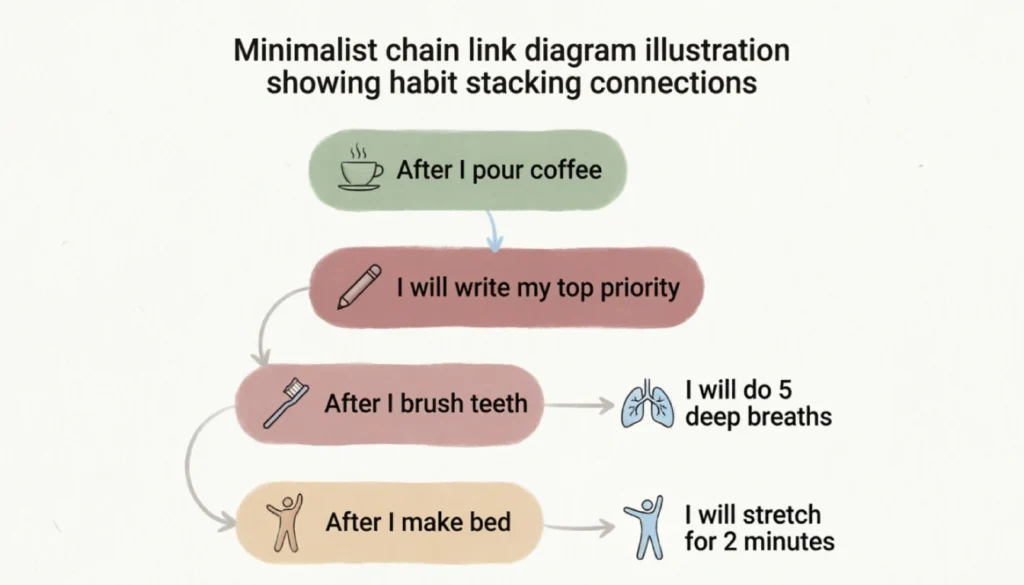
Once you have your anchor, use a technique called habit stacking. The idea, popularized by James Clear in Atomic Habits and rooted in BJ Fogg’s Tiny Habits research, is simple. You link a new behavior to an existing one using a formula:
“After I [current habit], I will [new habit].”
Your existing habits are already automatic. Brushing your teeth, pouring coffee, opening the front door. Stacking a new behavior onto one of these means you borrow its automaticity.
Habit Stacking Morning Routine Examples
Here are five examples you can use immediately:
- After I pour my coffee, I will write my top priority for the day.
- After I brush my teeth, I will take five deep breaths.
- After I turn off my alarm, I will drink a glass of water.
- After I sit up in bed, I will do ten shoulder rolls.
- After I step into the kitchen, I will open the blinds and stand in the light for 30 seconds.
Start with one stack. Add a second only after the first feels effortless, usually after two to three weeks.
Step 3: Shape Your Environment So Willpower Isn’t Required
Willpower is unreliable. Your environment is not. Design your space so the right choice is the easiest one.
Practical changes that work:
- Put your journal and a pen on your nightstand, not in a drawer.
- Set your water glass on the counter before you sleep.
- Lay out your workout clothes the night before, right where you will step on them.
- Keep your phone charger in another room so you don’t grab it first thing.
Each of these reduces friction. When the journal is already open, you write. When the clothes are on the floor, you put them on. You’re not relying on motivation. You’re just following the path of least resistance.
Step 4: Prepare the Night Before (The Real Secret to Consistency)
Most people think morning routines are built in the morning. They’re not. They’re built at night.
A two-minute evening prep session sets you up to succeed before the day even starts. Here’s what that looks like:
- Decide what time you’re getting up. Set one alarm, not five.
- Identify your one anchor habit for tomorrow.
- Set out any physical items you’ll need (water, notebook, shoes).
- Write tomorrow’s single top priority so your brain doesn’t have to figure it out at 7 AM.
That’s it. Two minutes. The next morning runs on autopilot.
Real-Life Morning Routine Examples for Different Lifestyles
There is no universal routine. Here are three that actually work for different lives.

The Night Owl Routine (Realistic Morning Without an Early Wake-Up)
If you’re wired to sleep late, a morning routine for night owls that works looks nothing like the 5 AM club. It might start at 8 AM or 9 AM. That is fine.
Sample routine (15 minutes total):
- 8:30 AM: Alarm goes off. Drink water immediately.
- 8:32 AM: Five minutes of light stretching or walking around the apartment.
- 8:37 AM: Make coffee. While it brews, write one sentence in a journal.
- 8:40 AM: Sit by a window for natural light exposure for five minutes.
No productivity pressure, no phone for the first 20 minutes. Just a slow, consistent start.
The Busy Parent Routine (Simple Morning for Moms and Dads)
A simple morning routine for busy moms and dads has to be honest about the chaos. Kids don’t care about your journaling practice. Build around that reality.
Sample routine (10 minutes before anyone else wakes up):
- Wake up 10 minutes before the kids.
- Drink water and spend 60 seconds breathing slowly.
- Write one word that describes how you want to feel today.
- That’s enough.
Getting even 10 minutes of intentional quiet before the household wakes is more valuable than a perfect 30-minute routine you can never actually do.
The Student or Late-Riser Routine
For students or anyone with a flexible schedule, the priority is protecting the first 20 minutes from screens.
Sample routine:
- Wake up naturally or to a gentle alarm.
- Make tea or coffee. No phone during this time.
- Review one goal or task for the day.
- Do five minutes of movement: a short walk, stretching, or a few push-ups.
Small and repeatable beats ambitious and abandoned every time.
Morning Routine Mistakes That Make You Quit (And How to Fix Them)
Recognizing morning routine mistakes that make you quit is half the battle.
Mistake 1: Starting with too many habits. Fix: Pick one anchor habit. Add nothing else for two weeks.
Mistake 2: Building around someone else’s schedule. Fix: Ask what time you naturally wake up feeling okay. Build from there.
Mistake 3: Missing a day and calling it a failure. Fix: Adopt the “never miss twice” rule. One skipped morning is a blip. Two in a row starts a new pattern.
Mistake 4: Relying on motivation. Fix: Set up your environment to make the routine automatic. Remove decisions from the morning.
Mistake 5: Measuring success by how long the routine is. Fix: A five-minute routine you do every day beats a 60-minute routine you do twice a month.
FAQs
How long does it take to build a morning routine?
Research suggests 66 days on average for a new habit to become automatic, though simpler behaviors can stick in as few as 18 days. Start small and expect variance.
What if I miss a morning?
Restart the next day. Don’t extend the miss to the afternoon or “start fresh Monday.” Tomorrow morning is your reset.
Do I need to wake up earlier to have a morning routine?
No. Your routine starts when you wake up, whatever time that is. Consistency in sequence matters more than clock time.
What’s the minimum effective morning routine?
One intentional action done consistently beats ten sporadic ones. Even two minutes of focused behavior counts.
How do I stay consistent when my schedule changes?
Anchor your routine to a behavior, not a time. “After I wake up and drink water” holds up on weekends, travel days, and disrupted weeks.
Final Thoughts: Progress, Not Perfection
Here is the honest truth about how to create a morning routine that actually sticks: it won’t look impressive from the outside. It won’t be 75 Hard. It won’t photograph well for Instagram.
It will be small, consistent, and yours.
Start with one anchor habit. Stack one behavior onto it. Design your environment to remove friction. Prepare for two minutes the night before. That is the system. Follow it for 30 days at whatever time your real life allows.
You don’t need to become a morning person. You need a routine that fits the morning person you already are.
Pick your anchor habit today. Write it down tonight. Do it tomorrow.