
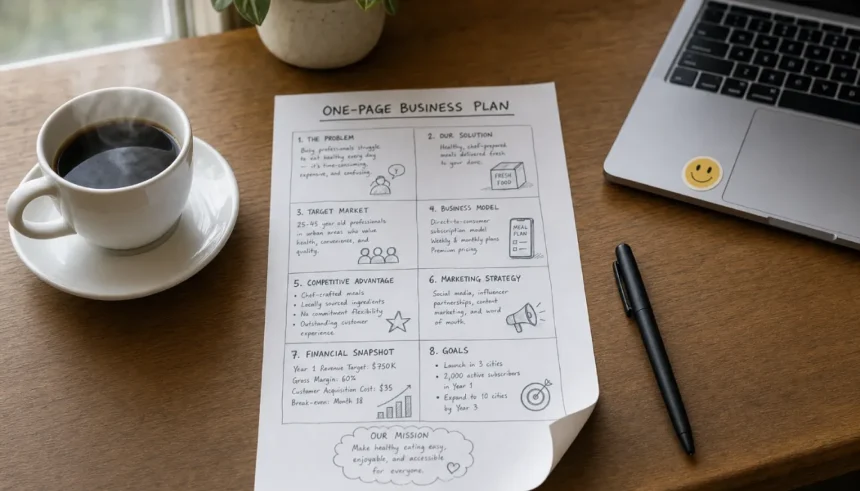
You have a startup idea ready to go, but every time you open a traditional business plan template, you close it. It’s 40 pages long, asks for a five-year financial forecast, and you haven’t even named your business yet.
Here’s the truth: most first-time founders never finish a long business plan. But a simple one-page business plan example? That, you can finish today.
In this guide, you’ll learn exactly how to write a one-page business plan for a startup, with a 5-step process, two real-world examples, and a free fill-in template. Let’s make this simple.
What Is a One-Page Business Plan (And Why It Works)
A one-page business plan is a single document that captures the core of your business idea. It covers who you serve, what problem you solve, how you make money, and what makes you different.
That’s it.
It doesn’t replace a detailed plan if you’re applying for a bank loan or pitching to a VC. But for 90% of early-stage startups and side hustles, it’s all you need to get started and stay focused.
Why it works:
- It forces you to cut vague thinking and be specific.
- It’s fast to write, so you actually finish it.
- It’s easy to share with potential partners, customers, or early investors.
- You can update it in 20 minutes as your business changes.
When I started my first consulting project, I spent two weeks trying to write a “proper” business plan. I got through the cover page and gave up. The moment I switched to a one-page format, I finished it in one afternoon and landed my first paying client the following week. The clarity it gave me was immediate.
What to Include in a One-Page Business Plan
Here’s what goes on your single page. Each section answers one question.
| Section | The Question It Answers |
|---|---|
| Value Proposition | What do you offer, and why should anyone care? |
| Target Market | Who exactly is your customer? |
| Problem & Solution | What problem do you solve, and how? |
| Revenue Model | How does your business make money? |
| Competitive Advantage | Why will customers choose you over others? |
| Goals & Next Steps | What are your first 90-day targets? |
You don’t need long paragraphs. Each section is 1 to 3 sentences, or a short bullet list. Think of it as a snapshot, not an essay.
This is what to include in a one-page business plan. Nothing more, nothing less.
How to Write a One-Page Business Plan for a Startup: A 5-Step Process
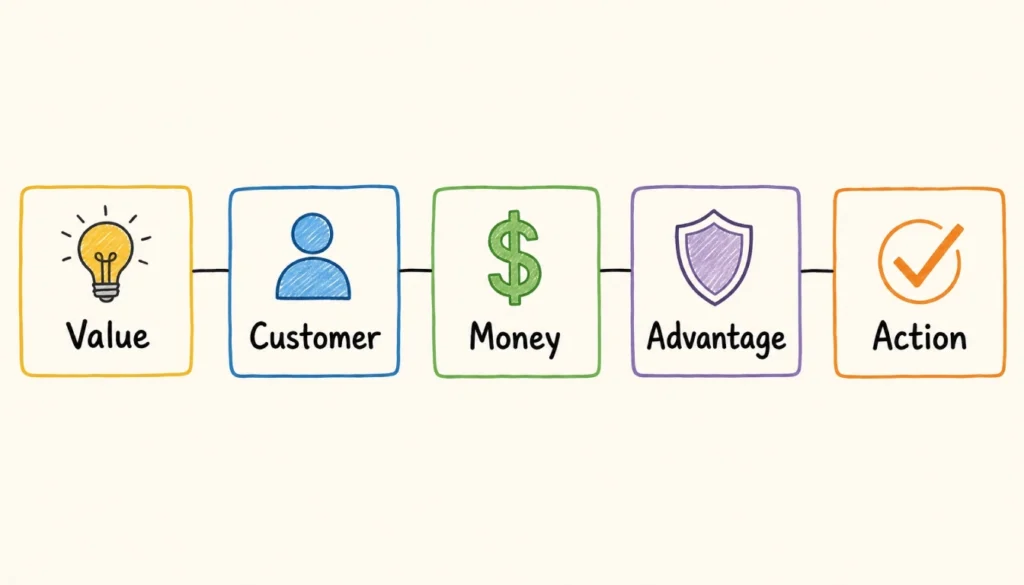
Follow these steps in order. Don’t skip ahead to formatting until you’ve answered each question in plain language.
Step 1: Write Your Value Proposition
Your value proposition is one sentence that explains what you do and who you do it for.
Use this formula: “I help [specific person] do [specific outcome] without [specific pain].”
Example: “I help busy parents find reliable dog walkers in under 10 minutes without any phone calls.”
Keep it simple. If you can’t explain it in one sentence, your idea isn’t clear enough yet.
Step 2: Define Your Target Market
Don’t write “everyone” or “small businesses.” That’s not a market.
Be specific. Age, occupation, location, behavior, budget. The tighter your target, the sharper your message.
Example: “Millennial homeowners aged 28–40 in urban areas who work 9-to-5 jobs and own one or two dogs.”
Step 3: Describe the Problem and Your Solution
State the problem in one sentence. State your solution in one sentence.
- Problem: Dog owners in cities struggle to find same-day, trusted walkers.
- Solution: An app that connects owners with vetted local walkers with availability visible in real time.
That’s it. Two lines.
Step 4: Choose Your Revenue Model
Pick the simplest model that makes sense for your business.
Common options:
- Flat fee per transaction (e.g., 15% of each booking)
- Monthly subscription
- One-time product sale
- Hourly or project-based service fee
Write down your price point here, even if it’s a rough estimate. “Approximately $25 per 30-minute walk, with 15% platform fee” is far more useful than “to be determined.”
Step 5: Name Your Competitive Advantage and First 90-Day Goals
Your competitive advantage is one specific reason customers will pick you. Not “great service.” Something real: location, price, speed, niche expertise, existing relationships.
Then set three goals for your first 90 days:
- Validate the idea with 5 paying customers.
- Build a simple landing page.
- Get 3 online reviews.
Write these down. They become your roadmap.
Free One-Page Business Plan Template (Just Fill In the Blanks)
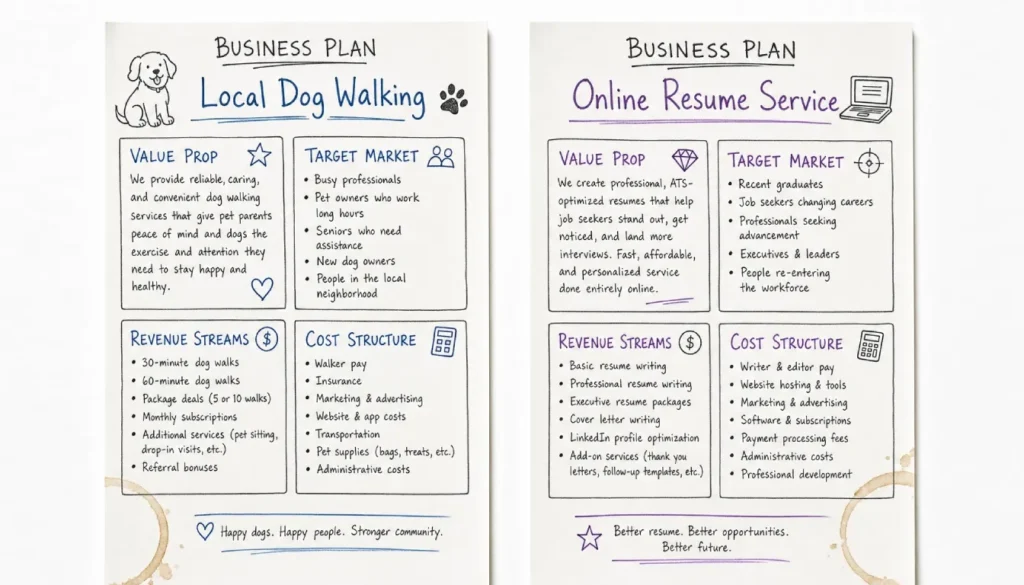
You can download the free template below. It’s a Google Doc. Open it, go to File > Make a Copy, and it’s yours.
Download the Free One-Page Business Plan Template
The template includes:
- A pre-formatted single-page layout
- Six labeled sections with fill-in prompts
- A “test your plan” checklist at the bottom
- Notes column for rough thinking
This one-page business plan template free version works for any type of business, from freelancers to product startups to local shops.
2 Simple One-Page Business Plan Examples
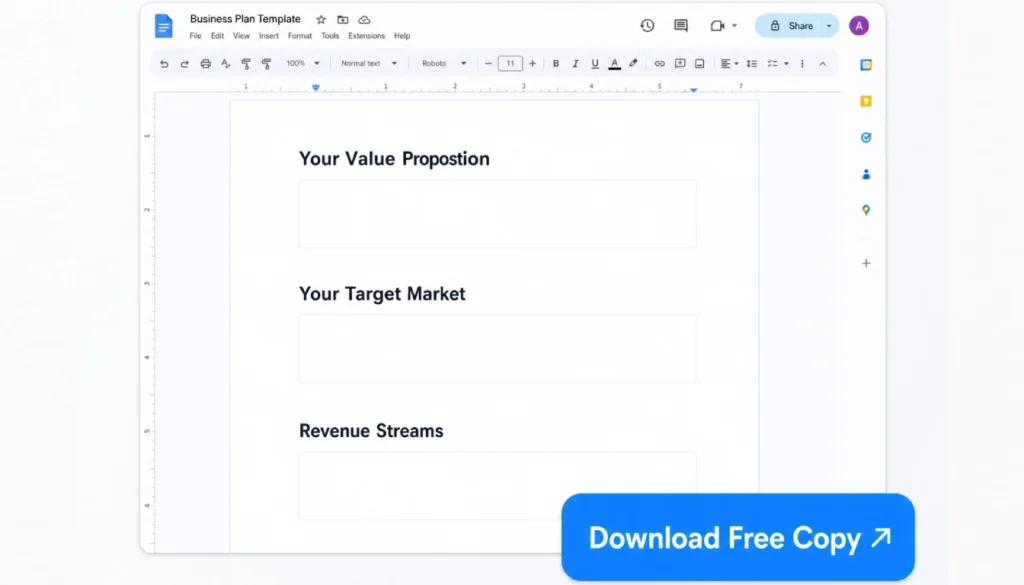
Example 1: Local Dog Walking Service
Value Proposition: I connect busy dog owners in Chicago with trusted, background-checked walkers available for same-day bookings.
Target Market: Urban professionals aged 25–40, single or couples without children, earning $60K+, who own one dog.
Problem: Finding a reliable walker last-minute is stressful and time-consuming.
Solution: A simple booking app with real-time walker availability and GPS tracking.
Revenue Model: 15% commission per booking. Average booking is $25. Goal: 100 bookings per month by month 3.
Competitive Advantage: Fastest booking confirmation in the market; walkers are rated within 2 hours.
90-Day Goals: Sign up 20 walkers, get 50 first-time customers, reach $3,000 in total bookings.
Example 2: Online Resume Writing Service
Value Proposition: I write ATS-optimized resumes for mid-career professionals who haven’t job-searched in five-plus years.
Target Market: Professionals aged 35–50 re-entering the job market or switching industries, earning $70K–$120K previously.
Problem: Their resume looks outdated and gets filtered out by automated hiring software.
Solution: A done-for-you resume rewrite in 72 hours, tailored to the target job title.
Revenue Model: Flat fee of $197 per resume. Optional LinkedIn profile add-on for $97.
Competitive Advantage: Specialized in mid-career transitions; not a general writing service.
90-Day Goals: Complete 15 paid resumes, collect 10 testimonials, publish 4 SEO blog posts.
These are simple one-page business plan examples you can model directly. Adjust the numbers and the niche to fit your idea.
Common Mistakes That Make Your Plan Useless
I’ve worked through this process with dozens of early-stage founders, and the same mistakes come up every time.
1. Being vague about the customer. “Anyone who needs this” is not a customer. You need a specific person. Name them. Give them a job title, a problem, and a budget.
2. Skipping the revenue model. A lot of founders write everything except how they’ll get paid. That section is not optional. Even a rough estimate keeps you grounded.
3. Treating it as a one-time document. Your one-page business plan for a small business or startup should be a living document. Review it monthly. Update it when your assumptions change.
4. Making it sound like a brochure. You’re writing this for yourself first. Don’t try to impress anyone. Write like you’re explaining it to a smart friend over lunch.
5. Waiting until it’s “perfect.” Done is better than perfect. A finished rough plan beats a polished one you never complete. Get it on paper, then improve it.
FAQs
Can I really get funding with a one-page plan?
For friends, family, and early angel investors, yes. For banks or institutional investors, you’ll need more detail. But a one-pager is often how you start the conversation.
How long should it actually take to write?
Two to four hours for your first draft. One hour for every update after that. If it’s taking longer, you’re overthinking it.
What if my idea changes?
Update the plan. That’s the point. A lean business plan in one-page format is built for change. It’s not carved in stone.
Do I need a financial model?
Not on the one-pager. Include your pricing and a revenue target. Save detailed projections for a separate spreadsheet if you need one.
Is a one-page plan the same as a lean canvas?
Similar, but not identical. A lean canvas focuses on problem-solution fit and is designed for very early-stage validation. A one-page business plan is slightly broader and more practical for someone ready to start selling.
Now Write Yours
You now have everything you need to write a one-page business plan for a startup today.
Start with your value proposition. Keep each section to two or three sentences. Fill in the free template. Share it with one person you trust and ask them to explain it back to you. If they get it, you’re done.
Download the free template, fill in the six sections, and test your plan with a real conversation before the end of this week. That single step puts you ahead of 80% of people who say they’re “working on their business plan.”