
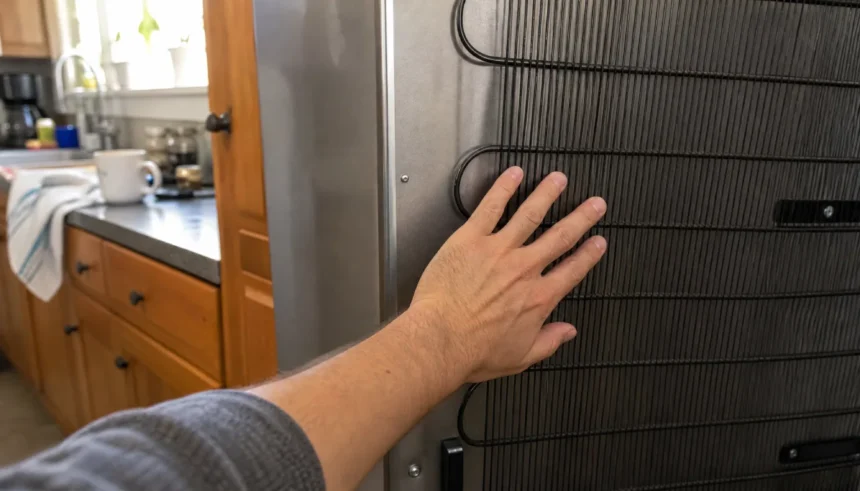
Last summer, I woke up at 2 a.m. to a low, steady hum coming from my kitchen. My fridge had been running nonstop for hours. I stood there in my pajamas, half asleep, wondering if I was about to lose everything in the freezer or just about to lose my mind.
If you’re here because your refrigerator runs constantly and you’re starting to panic about your food, your energy bill, or your sanity, I get it. That sound never stops, and neither does the worry.
Here’s the good news. A refrigerator running all the time doesn’t always mean it’s broken. Sometimes it just needs a little help. In this checklist, I’ll walk you through every common cause, from dirty condenser coils to bad door seals, and show you exactly what to check first.
Is It Normal for a Refrigerator to Run Constantly?
Let’s clear this up right away. A refrigerator running a lot is not automatically a problem. Modern frost-free models run more often than old ones. They don’t have the same off cycles your grandmother’s fridge used to have.
A healthy refrigerator typically runs 80 to 90 percent of the time in a normal kitchen. That means it should still shut off for short stretches, especially at night when your kitchen is cooler and the door stays closed.
The real issue is when your refrigerator runs continuously and never cycles off at all. That’s when you know something needs your attention.
Quick Way to Check
Put your hand near the vents at the back or bottom of the fridge. Listen for the motor. If it never stops humming for more than a few minutes at a time, over several hours, move on to the checklist below.
1. Check Your Door Seals First
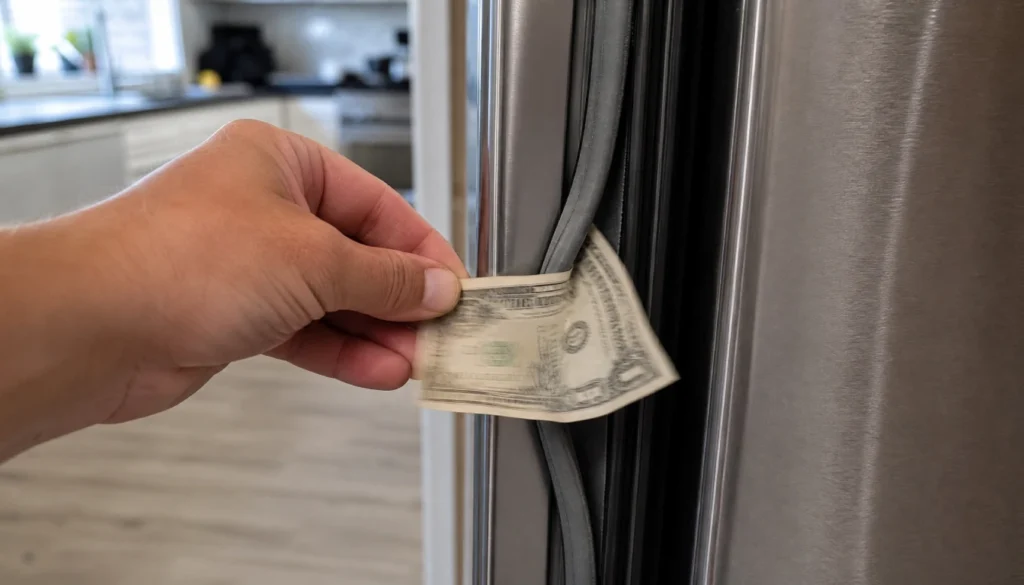
A worn door gasket is one of the most common reasons a refrigerator runs nonstop. Warm air sneaks in through the gap, and your fridge has to work overtime just to keep up.
I learned this the hard way. My old fridge had a gasket with a small tear near the bottom corner. I didn’t notice it for months. My fridge ran constantly, and my energy bill crept up every single month.
How to test it: Close the door on a dollar bill or a piece of paper. Pull it out. If it slides out easily, your seal isn’t gripping the way it should.
What to do: Clean the gasket with warm soapy water first. Sometimes crumbs and grease are the real problem. If it’s cracked or brittle, order a replacement gasket for your model.
2. Clean the Condenser Coils
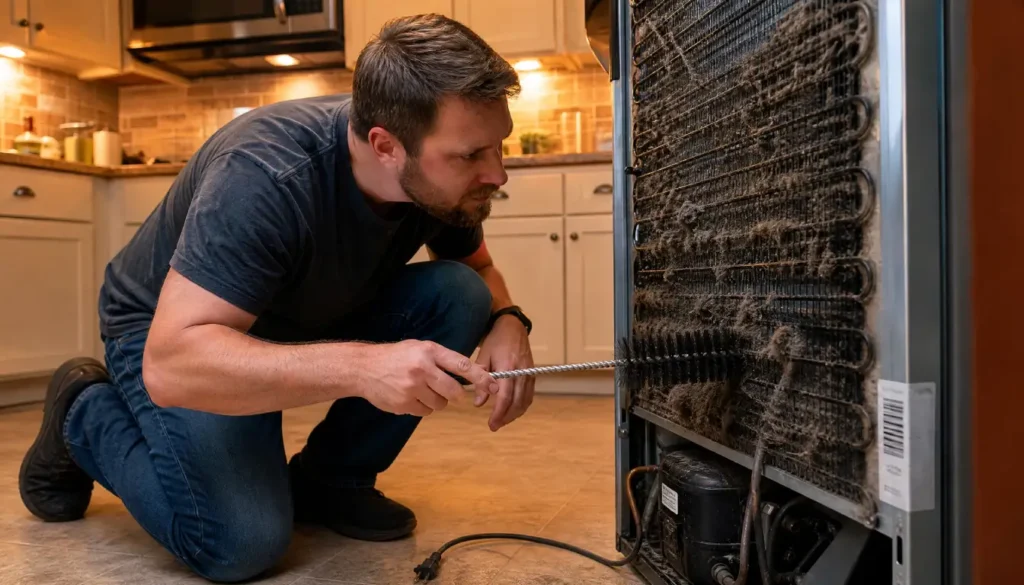
Dirty condenser coils are the second biggest reason your refrigerator keeps running. These coils release heat from inside your fridge. When they’re covered in dust and pet hair, they can’t release heat properly, so your compressor keeps running to compensate.
This is the fix I recommend first to almost everyone, because it’s simple and it works.
Steps to clean them:
- Unplug the refrigerator.
- Find the coils. They’re usually behind a bottom panel or on the back of the unit.
- Use a coil brush or a vacuum with a narrow attachment.
- Wipe away loose dust with a damp cloth.
- Plug the fridge back in and give it a few hours to settle.
Do this every six months, especially if you have pets. It’s the easiest way to stop a fridge running constantly.
3. Give It Some Breathing Room
Refrigerators need airflow around the back and sides to release heat. If yours is jammed against a wall or squeezed into a tight cabinet, it has nowhere to send that heat. So it just keeps running.
Leave at least one to two inches of space behind the fridge and on the sides. Pull it out, check the clearance, and adjust if needed. This alone can calm down a refrigerator that runs all day.
4. Check Your Temperature Settings
Sometimes the fix is as simple as a dial. If your thermostat is set too low, your fridge will run overtime trying to reach a temperature that’s colder than it needs to be.
The ideal range is 37 to 40 degrees Fahrenheit for the fridge and 0 degrees for the freezer. Check your settings and adjust them if they’re set colder than that.
Also check if anyone in your house has been fiddling with the dial. Kids and curious guests are more common than you’d think.
5. Look at the Evaporator Fan Motor
This one’s less obvious, but it explains a lot of cases where the freezer is cold, but the fridge keeps running and running.
The evaporator fan moves cold air from the freezer into the fridge. If it’s weak or not spinning right, your fridge compartment stays warm while the compressor keeps working to fix it.
How to check: Open the freezer and listen closely. You should hear a soft whirring sound. If it’s silent or making a grinding or clicking noise, the fan motor may be failing.
This repair is doable at home if you’re comfortable with tools, but it does involve accessing the back panel of your freezer. If that feels like too much, this is a good one to call a technician for.
6. Test the Defrost Timer
A stuck defrost timer can trap your fridge in a permanent cooling cycle. It’s supposed to pause the compressor periodically to melt any frost buildup on the coils. When it’s stuck, that pause never happens.
You’ll often notice ice buildup on the coils along with a refrigerator that runs nonstop. If you see frost where there shouldn’t be any, this is worth checking.
Most defrost timers are located behind the kickplate near the bottom of the fridge. You can manually advance the dial with a flathead screwdriver to see if the compressor pauses. If it does, the timer might just need replacing.
7. Consider the Room Temperature
Where your fridge sits matters more than people realize. A refrigerator in a hot garage, a sunny kitchen corner, or right next to the oven will run more just to keep up with the extra heat around it.
During a heatwave, it’s completely normal for your fridge to run more than usual. Give it a break by making sure nothing hot, like a dishwasher or oven, is running right beside it.
Common Symptoms and What They Usually Mean
| What You’re Noticing | Likely Cause | First Fix to Try |
|---|---|---|
| Fridge runs but not cold | Blocked airflow or low refrigerant | Check vents, call a tech if refrigerant is low |
| Fridge runs constantly, freezer fine | Weak evaporator fan or seal leak | Test door seal and fan motor |
| Loud humming plus running nonstop | Dirty condenser coils | Clean coils |
| Runs after power outage | Compressor catching up | Give it 24 hours before worrying |
| Runs constantly in summer | Room temperature or door seal | Check clearance and gasket |
Mistakes to Avoid
- Don’t unplug your fridge for hours to “reset” it unless you’re sure the food inside can handle the temperature swing.
- Don’t ignore small gasket tears. They get worse fast.
- Don’t skip coil cleaning because it seems too simple to matter. It’s often the whole fix.
- Don’t assume a new fridge running a lot means it’s broken. New models cycle differently than older ones.
When to Call a Repair Technician
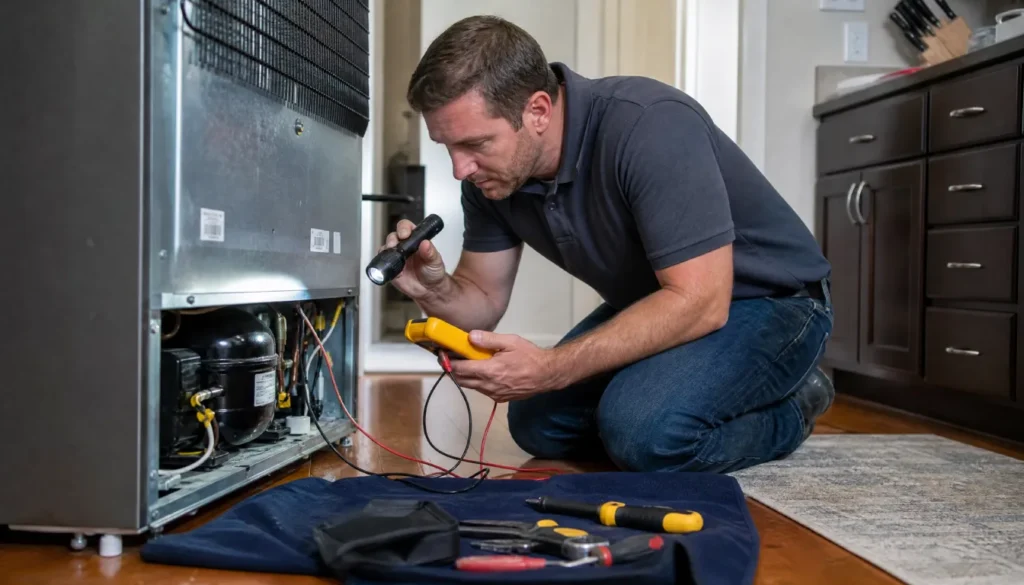
If you’ve gone through this checklist and your fridge still runs nonstop, it might be a deeper issue like a failing compressor, a refrigerant leak, or a broken start relay. These repairs need a trained hand.
As a rule, if your fridge is more than 10 years old and the repair cost is close to half the price of a new one, replacing it is usually the smarter move.
Frequently Asked Questions
Why does my refrigerator keep running even though it’s cold inside?
This usually points to a dirty condenser coil, a bad door seal, or a fridge placed too close to a wall. The fridge is cold, but the compressor still thinks it needs to keep working.
Is it normal for a refrigerator to run all night?
Yes, especially with frost-free models. What matters is whether it cycles off at some point, even briefly. Nonstop running with zero pauses is the real red flag.
Why is my refrigerator running constantly after a power outage?
Your fridge is trying to catch up and cool everything back down to a safe temperature. Give it 24 hours. If it’s still running nonstop after that, check the coils and seals.
Can a full refrigerator run less than an empty one?
Yes, actually. A full fridge holds cold air better, which can reduce how often the compressor kicks on. An empty fridge often runs more.
How long should a refrigerator run before shutting off?
A normal cycle lasts anywhere from 30 minutes to a few hours, followed by a pause. If your fridge never pauses at all, something on this checklist likely needs attention.
Final Thoughts
A refrigerator running all the time can feel stressful, especially when you’re worried about spoiled food or a scary energy bill. But most of the time, the fix is something small. A dirty coil. A worn seal. A little breathing room behind the unit.
Work through this checklist one step at a time. Start with the easy stuff, the coils and the door seal, before assuming the worst. You might be surprised how often that’s all it takes.
If you’ve tried one of these fixes, I’d love to hear how it went. Drop a comment and let me know what worked for you, or ask a question if your fridge is still giving you trouble. We’ll figure it out together.