

If morning fatigue after a full night’s rest is your daily reality, you are not broken. Millions of people experience this exact frustration. The truth is, waking up tired after 8 hours sleep causes more confusion than almost any other health complaint, because the obvious fix, sleeping more, clearly is not working. This guide breaks down the real reasons it happens and gives you a clear plan to fix it.
What Does “Unrefreshing Sleep” Actually Mean?
Most people think sleep is sleep. You close your eyes, you open them eight hours later, you feel rested. That is how it should work in theory.
But unrefreshing sleep is a recognized medical term. It describes sleep that does not restore your body or mind, regardless of how many hours you log. You wake up with the same fatigue you went to bed with.
This matters because it shifts the focus away from duration. Eight hours of poor sleep is not the same as eight hours of good sleep. If your body never reaches the deep or REM stages it needs, you will wake up exhausted, every single time.
Sleep Quality vs. Quantity: Why 8 Hours Can Still Leave You Tired
Here is the most important thing to understand: sleep quality beats sleep quantity, every time.
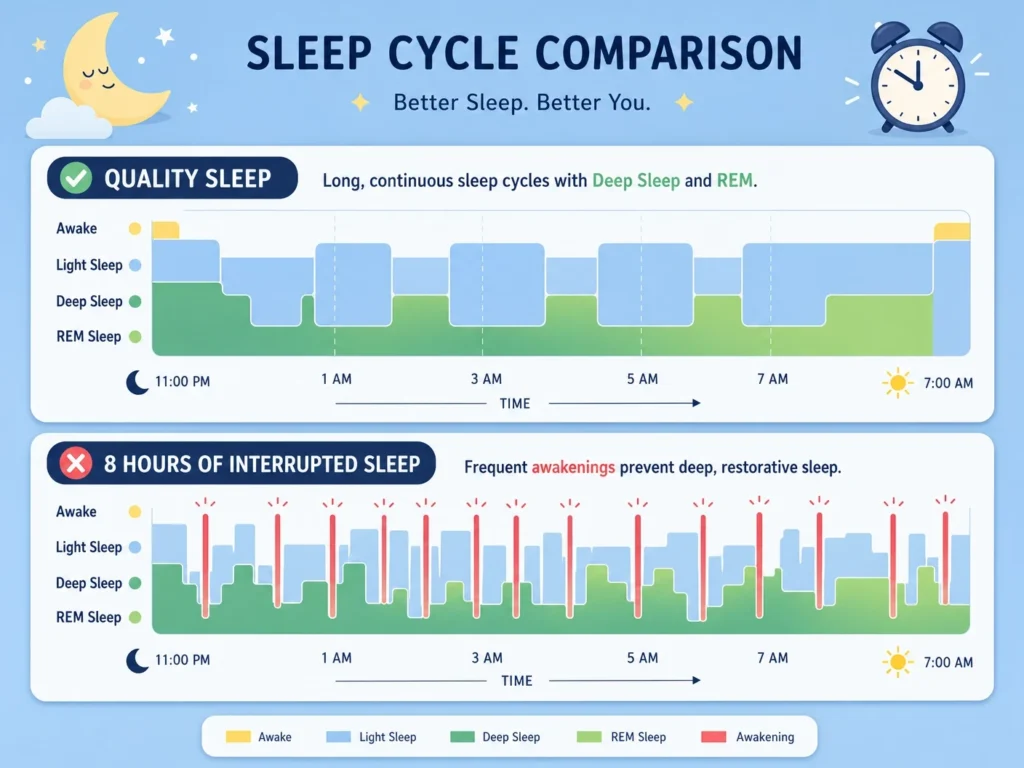
Your body moves through sleep cycles, each roughly 90 minutes long. Each cycle includes light sleep, deep sleep (slow-wave sleep), and REM sleep. Deep sleep repairs tissue, strengthens your immune system, and clears waste from the brain. REM sleep processes emotions and consolidates memory.
If your sleep is fragmented, meaning you wake up briefly, toss and turn, or spend too long in light sleep stages, you can clock 8 hours and still get almost no deep or REM sleep. You wake up feeling groggy after 8 hours of sleep because your body never actually recovered.
Sleep quality vs. quantity is not a minor distinction. It is the core reason most people feel tired despite adequate sleep.
10 Surprising Causes of Morning Fatigue After a Full Night’s Sleep
1. Sleep Inertia
Sleep inertia is the grogginess you feel immediately after waking. It happens when your brain is still clearing adenosine, a chemical that builds up during sleep. For most people, it fades within 15 to 30 minutes. For some, especially if you wake during deep sleep, it can last hours.
2. Dehydration
Your body loses fluid overnight through breathing and sweating. Even mild dehydration reduces blood volume, which means your heart works harder to push oxygen through your body. The result? You feel sluggish before you even stand up.
3. Blood Sugar Imbalance
If you eat a high-carb meal late at night, your blood sugar spikes and then crashes during the night. That crash can disrupt sleep and leave you fatigued in the morning, even if you technically stayed asleep.
4. Alcohol Before Bed
A drink before bed feels like it helps you relax, but alcohol suppresses REM sleep. You may fall asleep faster, but your sleep quality drops significantly, and you will feel the difference in the morning.
5. Screen Time at Night
Blue light from phones and laptops suppresses melatonin, the hormone that signals your body to sleep. Scrolling at 11 PM pushes your internal clock later. Even if you fall asleep at midnight and wake at 8 AM, your body thinks it is still the middle of the night.
6. Chronic Stress and High Cortisol
Stress keeps cortisol elevated. High cortisol at night interferes with deep sleep. You might sleep a full 8 hours, but the quality will be shallow and restorative cycles will be cut short. This is one of the most common hidden causes of unrefreshing sleep.
7. Nutritional Deficiencies
Low ferritin (iron stores), vitamin D, vitamin B12, or magnesium can all cause persistent fatigue. These deficiencies often go undiagnosed for years because they do not show obvious symptoms beyond tiredness.
8. Undiagnosed Sleep Disorders
Sleep apnea is particularly common and often undetected. If you stop breathing repeatedly during the night, your body jolts you awake to resume breathing, sometimes hundreds of times. You will have no memory of this, but you will feel destroyed in the morning.
9. Poor Sleep Environment
A room that is too warm, too bright, or too noisy prevents deep sleep cycles. The ideal sleep temperature is 65 to 68°F (18 to 20°C). Even low levels of light or noise can keep your brain in a lighter sleep stage.
10. Circadian Rhythm Mismatch
If your natural sleep tendency (your chronotype) does not match your schedule, you will feel morning fatigue after a full night’s rest no matter what. A natural night owl forced to wake at 6 AM is being asked to wake up in the middle of their biological night.

Is It Sleep Inertia? The Science Behind Grogginess That Won’t Lift
Sleep inertia is worth its own section because it is widely misunderstood.
When you wake up, especially if an alarm pulls you out of a deep sleep stage, your prefrontal cortex (the decision-making part of your brain) takes 15 to 60 minutes to fully come online. During that window, you feel confused, slow, and exhausted. Many people interpret this as proof they did not sleep enough. Often, it is simply poor timing.
The fix is straightforward. If you can, wake up during a light sleep stage. Apps like Sleep Cycle and Oura Ring track your sleep and wake you within a 30-minute window when you are already in light sleep. The difference in how you feel is significant.
I tested this myself after years of waking up with a heavy, foggy feeling. I switched from a fixed 7 AM alarm to a smart alarm set between 6:30 and 7 AM. Within a week, the morning grogginess I had lived with for years was noticeably lighter. It was not a complete fix, but it was a meaningful one.
Lifestyle Traps That Steal Your Energy (Even If You “Did Everything Right”)
Some habits feel harmless but directly erode sleep quality.
The evening glass of wine. It is marketed as relaxing, but it cuts your REM sleep significantly. Three nights of wine before bed and you will feel the cumulative deficit.
The “catch-up sleep” weekend habit. Sleeping until noon on Saturday and Sunday feels restorative but shifts your circadian rhythm 1 to 2 hours later, making Monday morning feel like jet lag. Sleep scientists call this social jet lag.
Skipping morning light. Your circadian clock resets through light exposure. If you wake up and stay in a dark apartment, your body clock stays in sleep mode. Even 10 minutes of natural morning light significantly improves alertness and nighttime sleep quality.
Caffeine after 2 PM. Caffeine has a half-life of about 5 to 7 hours. A coffee at 3 PM still has half its caffeine in your system at 10 PM, keeping your brain more alert than it should be for deep sleep entry.
When to Talk to a Doctor About Waking Up Exhausted
If you have cleaned up your sleep habits for 2 to 3 weeks and still wake up exhausted every morning, see a doctor. Some conditions require testing to diagnose and will not improve with lifestyle changes alone.
Ask your doctor to test:
- Ferritin levels (not just general iron; ferritin specifically)
- Vitamin D
- Vitamin B12
- Thyroid function (TSH, free T3, free T4)
- Blood glucose (for insulin resistance)
If you snore, wake with headaches, or your partner reports you stop breathing, ask specifically for a sleep study. Sleep apnea is dramatically underdiagnosed, especially in women, and it will cause morning fatigue after a full night’s rest regardless of how many hours you sleep.
Keep a sleep diary for two weeks before your appointment. Record your bedtime, wake time, sleep quality score (1 to 10), evening habits, and how you feel in the morning. This gives your doctor far more to work with than a vague complaint of tiredness.
A 3-Step Plan to Finally Wake Up Refreshed

If waking up tired after 8 hours sleep causes daily frustration, here is a practical plan to address it systematically.
Step 1: Pinpoint your hidden sleep killer
For 3 nights, track your evening routine in detail. Write down what you ate and drank within 3 hours of bed, your stress level (1 to 10), screen time, room temperature, and bedtime. Most people find a clear pattern within the first 3 nights. Common culprits include late meals, alcohol, stress from work, or inconsistent bedtimes.
Step 2: Fix sleep quality before adding more hours
- Set your bedroom temperature to 65 to 68°F (18 to 20°C)
- Use blackout curtains or a sleep mask
- Stop screens 45 minutes before bed
- Try a consistent sleep and wake time, even on weekends
- Drink a glass of water before bed to offset overnight dehydration
- Get 10 minutes of direct morning sunlight within 30 minutes of waking
Most people see measurable improvement within 5 to 7 days of following these consistently.
Step 3: Rule out medical and nutritional gaps
If Step 2 does not help within 2 weeks, book a blood panel. Low ferritin, vitamin D, and B12 are the most commonly missed causes of persistent fatigue. If you share a bed, ask your partner whether you snore or seem to stop breathing. If the answer is yes, push for a sleep study. Identifying and treating sleep apnea is one of the most life-changing medical interventions for morning fatigue.
Frequently Asked Questions
Why am I so tired after 8 hours of sleep?
The most common causes are poor sleep quality (fragmented cycles), sleep inertia, dehydration, high cortisol, alcohol, nutritional deficiencies, or an undiagnosed sleep disorder like sleep apnea.
Is 8 hours of sleep enough for adults?
For most adults, yes, 7 to 9 hours is the recommended range. But if those 8 hours are broken or spent mostly in light sleep, the duration becomes irrelevant. Sleep quality is what matters.
What is unrefreshing sleep?
Unrefreshing sleep means waking up after a full night’s sleep and still feeling exhausted. It is a recognized symptom and can indicate sleep disorders, stress, poor sleep hygiene, or nutritional issues.
Can dehydration cause morning fatigue?
Yes. Even mild overnight dehydration reduces blood volume and oxygen delivery, which contributes directly to sluggishness and morning fatigue.
When should I see a doctor about being tired?
If you have followed good sleep hygiene for 2 to 3 weeks and still wake exhausted every morning, especially if you snore or wake with headaches, see your doctor and ask for a blood panel and sleep evaluation.
The Bottom Line
Waking up tired after 8 hours sleep causes real disruption to your day and your health. But the solution is rarely sleeping more. It is sleeping better.
Start by tracking 3 nights of your evening habits. Fix your sleep environment. Cut alcohol, late screens, and late meals. If fatigue persists after two weeks of consistent effort, get your ferritin, thyroid, and vitamin levels tested.
You deserve to wake up feeling human. The fix exists, and it is usually simpler than you think.
If this helped you, share it with someone who keeps saying “I’m so tired” despite sleeping enough. And if you have tried something specific that finally worked for you, drop it in the comments below.