
Last year I booked a flight to see my sister and got stuck on a checkout page. A little box popped up asking if I wanted to “offset my carbon emissions” for $12. I stared at it for a full minute. What was I actually paying for? Would it plant a tree? Would it do anything at all?
I clicked yes anyway, then spent the whole flight wondering if I’d just wasted twelve dollars. That moment is exactly why I wrote this guide. If you’ve ever felt confused, skeptical, or a little guilty scrolling past that checkout box, you’re not alone.
This article breaks down what carbon offsetting for flights actually means, how it works, what it costs, and whether it’s worth your money. No jargon. No lecture. Just the plain facts you need to make your own call.
What Is Carbon Offsetting for Flights?
Carbon offsetting flights means paying money to balance out the pollution your flight creates. Airplanes burn fuel and release carbon dioxide into the air. That CO2 traps heat and adds to climate change.
When you buy a flight carbon offset, your money goes toward a project that removes or prevents an equal amount of CO2 somewhere else. Think of it as canceling out your share of the damage, even though the plane still burns the same fuel.
So what is carbon offsetting for flights in the simplest terms? You pollute a little here. Someone else reduces pollution somewhere else. On paper, the total stays even.
How Does Offsetting Flight Emissions Actually Work?
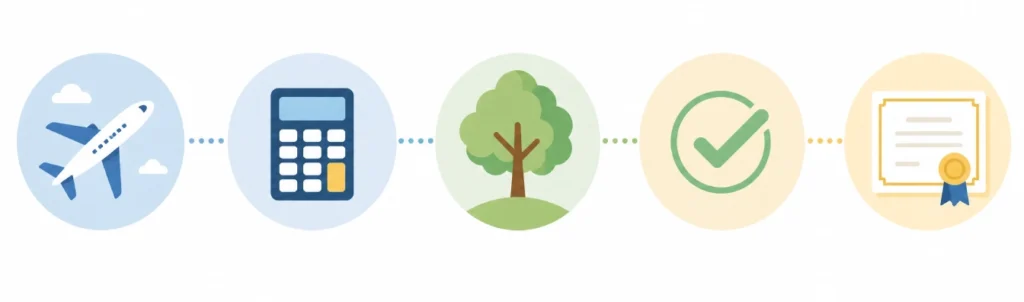
Here’s the process in five steps:
- You calculate your flight’s carbon footprint, often through a carbon offset calculator on the airline site or a third-party tool.
- You pay a fee based on that footprint. This is usually a few dollars to a few dollars per hour of flight.
- That money funds a verified project, such as tree planting or clean energy.
- The project removes or prevents CO2 emissions equal to your flight.
- You get a certificate or confirmation showing the offset was purchased.
It sounds tidy. But the real question is whether these projects actually deliver what they promise. We’ll get to that.
Why Flights Produce So Much Carbon
A single round-trip flight from New York to London creates roughly one tonne of CO2 per passenger. That’s close to what some people produce driving a car for an entire year.
Long flights burn huge amounts of fuel at high altitude, where emissions have a stronger warming effect. This is sometimes called the radiative forcing index, a fancy term for saying plane pollution hits the atmosphere harder than pollution at ground level.
This is why carbon offsetting in aviation gets so much attention. Flying is one of the fastest ways an average person can rack up a large carbon footprint in just a few hours.
Types of Carbon Offset Projects

Not all offset projects work the same way. Here are the main categories you’ll run into:
- Reforestation projects. Trees are planted to absorb CO2 over time.
- Renewable energy projects. Wind or solar farms replace fossil fuel power plants.
- Clean cookstove projects. Communities get efficient stoves that burn less fuel.
- Avoided deforestation. Money protects forests that would otherwise be cut down.
- Direct air capture. Machines pull CO2 straight out of the atmosphere.
Reforestation is the most common and the most debated. Trees take decades to absorb the CO2 they’re credited for, and forest fires can wipe out the gains overnight.
How Much Does It Cost to Offset a Flight?
Prices vary a lot depending on the airline and the certification standard behind the project. Here’s a rough breakdown:
| Flight Type | Estimated CO2 | Typical Offset Cost |
|---|---|---|
| Short domestic flight | 0.2–0.3 tonnes | $2–$5 |
| Medium international flight | 0.5–1 tonne | $8–$15 |
| Long-haul international flight | 1–3 tonnes | $15–$40 |
Most flight carbon offset programs charge somewhere between $10 and $20 per tonne of CO2. Some cheaper providers charge less, but a low price can be a warning sign of a weak or unverified project.
Airline Carbon Offset Programs Compared
Many major airlines now offer their own offsetting option at checkout. Here’s how some of the well-known ones stack up.
| Airline | Program Name | Offset Type |
|---|---|---|
| Delta | Delta carbon offset program | Reforestation and renewable energy |
| United Airlines | United Eco-Skies | Verified carbon standard projects |
| British Airways | BA carbon offsetting | Sustainable aviation fuel and offsets |
| Lufthansa | Compensaid | SAF and verified offsets |
| Qantas | Fly Carbon Neutral | Reforestation and renewable energy |
| KLM | CO2ZERO | Reforestation and SAF |
| Cathay Pacific | Fly Greener | Verified offset projects |
If your airline doesn’t offer a program at checkout, you can still buy offsets independently through third-party providers before or after you fly.
Do Carbon Offsets for Flights Really Work?

This is where things get honest. Studies on carbon offset programs have found mixed results. Some projects deliver real, measurable reductions. Others overstate their impact or fund projects that would have happened anyway.
The case for offsetting:
- It funds real environmental projects that need money.
- Gold standard and verified carbon standard certifications add a layer of accountability.
- It’s a simple action anyone can take at checkout.
The case against offsetting:
- Some projects fail to deliver the CO2 reduction they promise.
- Tree planting takes years to show results, while your flight pollutes today.
- Critics call weak offset programs a form of greenwashing, letting airlines look responsible without cutting real emissions.
I’ll say this plainly. Offsetting a flight is not the same as not flying. It’s a small step, not a fix.
How to Choose a Credible Carbon Offset Program
Not every offset provider deserves your money. Here’s what to check before you buy.
- Look for Gold Standard or Verified Carbon Standard certification. These are the two most trusted labels in the industry.
- Check if the project is additional, meaning it wouldn’t exist without offset funding.
- Avoid providers that don’t explain exactly where your money goes.
- Compare a few options using a carbon offset comparison chart before you commit.
- Favor renewable energy or direct air capture projects if you want faster, more measurable results than tree planting.
Mistakes to Avoid When Offsetting Flight Emissions
- Don’t assume every airline offset checkbox uses a certified project. Some don’t.
- Don’t pick the cheapest option without checking the certification behind it.
- Don’t treat offsetting as a free pass to fly as much as you want.
- Don’t forget that reducing flights, packing light, and choosing direct routes also cuts your footprint.
- Don’t skip reading the project details. A five-second click deserves at least a two-minute read.
What’s Changing in Carbon Offsetting for Flights in 2026
Aviation offsetting rules are shifting fast. The ICAO CORSIA scheme, which requires airlines to offset emissions growth, is moving into a stricter phase this year. More airlines are also blending offsets with sustainable aviation fuel, known as SAF, instead of relying on tree planting alone.
Public trust in offset programs took a hit after several greenwashing scandals made headlines. Because of this, airlines are under pressure to use offset projects with stronger verification and clearer reporting.
Frequently Asked Questions
What is carbon offsetting for flights in simple terms?
It means paying to balance out the CO2 your flight produces by funding a project that reduces or removes carbon somewhere else.
How much does it cost to offset a flight?
Short flights usually cost a few dollars. Long-haul flights can cost $15 to $40, depending on distance and the certification standard used.
Is carbon offsetting a flight worth it?
It’s a small, positive action, but it doesn’t erase your flight’s impact. Pairing offsets with fewer flights and better route choices makes a bigger difference.
Can I offset my flight emissions when I book?
Yes. Most major airlines show an offset option at checkout. You can also buy offsets separately through independent providers.
What’s the difference between carbon offset and carbon neutral?
A carbon offset is the payment or credit that funds emission reduction. Carbon neutral means your total emissions and your offsets balance out to zero.
A Final Word
That $12 checkbox I clicked last year still crosses my mind every time I fly. I’ve learned it’s not a magic fix, but it’s nothing either. It’s one small piece of a much bigger picture.
If you’re weighing whether to offset your next flight, start by checking the certification behind the program, read where your money goes, and make the choice that feels honest to you. There’s no perfect answer here, only a better-informed one.
I’d love to hear what you think. Have you tried offsetting a flight before? Did it feel worth it, or did it leave you with the same questions I had? Drop a comment and let’s figure this out together.