Published for travelers who need calm, clear help — fast.
That Sinking Feeling Is Real (And You’re Not Alone)
I’ll never forget the moment a friend texted me from Rome, 11 PM, pure panic: “My passport is gone. Flight is in 14 hours. What do I do?
She’d checked every pocket, every bag corner, every hotel drawer. Nothing. Her US passport was lost abroad — the one document that was supposed to carry her home.
If you’re reading this right now with that same hollow feeling in your stomach, take a breath. Seriously. This situation is scary, but it is not the end of your trip — or your life.
Thousands of travelers lose their passports every single year. Embassies handle this every day. There are real, clear steps you can follow, and most people get home just fine.
This guide covers exactly what to do if you lose your passport abroad — from the first 30 minutes to the moment you’re back on home soil.
Step 1: Don’t Panic — Do This First
I know. Easy to say. But the first thing you need to do is slow down and think clearly, because the next few actions matter.
Here’s your immediate checklist:
- Search everywhere again — jacket pockets, hostel locker, under the hotel bed, the seat pocket on your last transport
- Ask hotel staff — front desks find lost passports surprisingly often
- Check with the restaurant, museum, or tour you last visited
- Retrace your steps mentally — where did you last show your passport?
If after all that it’s still missing, it’s time to accept: your passport is genuinely lost (or stolen), and you need to move into action mode.
Step 2: File a Police Report for Your Lost Passport
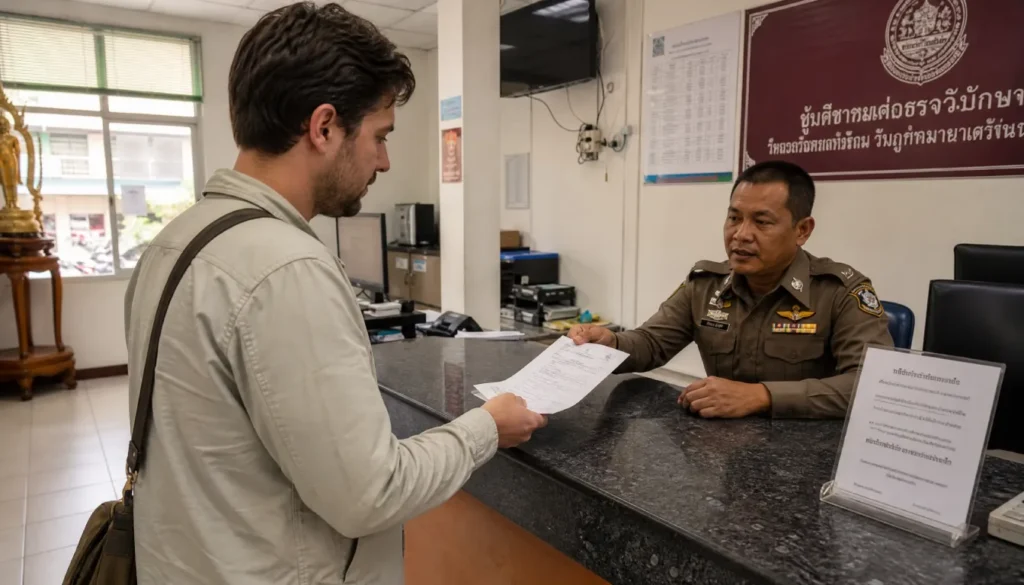
Whether your passport was lost or stolen abroad, your first official step is to file a police report at a local station.
This isn’t just bureaucracy. The US embassy (or your country’s consulate) will ask for it. Some countries even legally require you to report a lost passport within 24 hours.
What to bring to the police station:
- Any ID you have (driver’s license, a photo of your passport)
- Your travel itinerary
- Hotel address or local contact info
Ask for a written copy of the report. You’ll need it at the embassy. If there’s a language barrier, your hotel can often help with basic translation.
Step 3: Contact Your Embassy or Consulate Immediately

This is where things start moving in the right direction.
Every country has a US embassy or consulate (or equivalent) in major cities. These are the offices that can issue you an emergency passport for international travel so you can get home.
How to find yours:
- US citizens: visit travel.state.gov or call the 24/7 emergency line
- UK citizens: gov.uk/world/embassies
- Canadian citizens: international.gc.ca/world-monde/embassy-ambassade
Call ahead and explain your situation. Tell them:
- Your name and nationality
- Where you are
- When your flight home is
- That you’ve filed a police report
Most embassies have specific emergency passport appointments for situations exactly like yours.
Step 4: Gather the Documents You Need
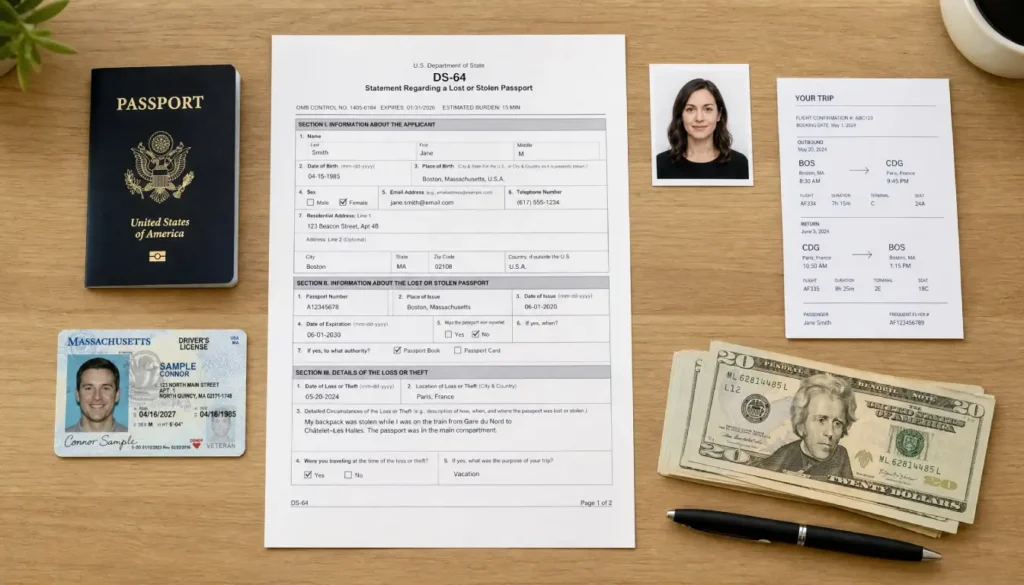
Here’s where having digital backup copies saves you so much stress.
For an emergency US passport at a US consulate, you’ll typically need:
| Document | Details |
|---|---|
| Form DS-64 | Statement Regarding a Lost or Stolen Passport |
| Form DS-11 | Application for a US Passport |
| Proof of citizenship | Copy of lost passport, birth certificate, or naturalization cert |
| Government-issued photo ID | Driver’s license works |
| Passport photos | Usually 2 photos, specific size requirements |
| Police report copy | From Step 2 |
| Travel itinerary | Proof of your upcoming flight |
| Payment | Emergency passport fees (typically $130–$170 USD) |
Quick Tip: Most cities near US embassies have passport photo booths — or ask your hotel to point you to a pharmacy or print shop nearby.
Step 5: Know the Difference — Lost vs. Stolen Passport
It matters more than you’d think.
If your passport was stolen, your police report should say that explicitly. A stolen passport can be used for identity fraud, so it needs to be officially reported as stolen — not just lost.
If it was lost, that’s different wording on the forms. Either way, the DS-64 handles both, but the circumstances should be accurate.
Also worth noting: once you report your passport lost or stolen, that passport number is flagged in international systems. Even if it later turns up, you cannot use it to travel. You’ll need the new one.
Step 6: What About Your Visa?
This is a really common stress point — especially if your visa was inside your lost passport.
Here’s what to know:
- Your visa isn’t automatically void, but you may need to contact the country’s immigration office for guidance
- Some countries allow proof of your previous visa (like a photo or copy) combined with your new passport
- If you had an electronic visa (eVisa), you’re in much better shape — it’s tied to your passport number digitally, not the physical booklet
Ask the embassy staff about this specifically. They deal with it regularly and can advise based on your destination.
Step 7: Getting Home — Can You Travel Without a Passport?
Technically, yes — with an emergency travel document.
An emergency passport (also called a limited validity passport) is exactly what it sounds like: a real but temporary passport issued specifically to get you home. It typically has a validity of one year or less.
For US citizens, emergency passport processing time at a US consulate can be as fast as same-day if your flight is within 24–72 hours. They take these situations seriously.
Once you have it, you travel home just like normal. Airlines accept it. Border control accepts it.
What you usually cannot do with a temporary passport: re-enter countries that require a full valid passport for entry. It’s designed to get you home, not extend your trip.
Step 8: Should You Use Travel Insurance?
If you purchased travel insurance before your trip — check your policy now.
Many comprehensive travel insurance plans cover:
- Emergency passport replacement fees
- Additional hotel nights while you wait for documents
- Rebooking fees if you miss your flight
- Emergency travel assistance services
This is one of those moments where travel insurance for lost passport coverage genuinely earns its cost.
Mistakes to Avoid When Your Passport Is Lost Abroad
A few things that make this harder than it needs to be:
- Don’t wait to report it — the sooner you act, the better your chances of getting an emergency appointment
- Don’t try to travel without documentation — border agents will turn you away
- Don’t assume a copy of your passport is enough — it helps, but it’s not a substitute for the real thing or an emergency document
- Don’t forget to cancel/freeze accounts if your wallet was stolen along with your passport
Quick Reference: Emergency Steps at a Glance
- Search thoroughly and retrace your steps
- File a police report (get a written copy)
- Call your embassy or consulate — book an emergency appointment
- Gather documents: DS-64, DS-11, citizenship proof, photos, itinerary, police report
- Attend your appointment and pay the fee
- Receive your emergency passport
- Fly home
Frequently Asked Questions
Can I travel with a copy of my lost passport?
No — a photocopy is not a valid travel document. It helps during the embassy process as proof, but you need an official emergency passport to board an international flight.
How long does an emergency passport take at a US consulate?
It varies by embassy, but for urgent cases (flights within 24–72 hours), same-day or next-day processing is common. Always explain your flight date when you call.
What do I do if I lost my passport in a country without a US embassy or consulate?
Contact the nearest US embassy in a neighboring country. In some cases, the US State Department can coordinate assistance through other embassies.
Does travel insurance cover lost passport costs?
Many comprehensive policies do — including replacement fees, hotel extensions, and rebooking. Read your policy carefully, and keep receipts for everything.
What if I lose my passport at the airport before my international flight?
Go directly to airport security or the airline desk, then contact your embassy immediately. Airport staff deal with this more often than you’d think and can help connect you to the right resources.
You’ll Get Through This
Losing your passport while traveling internationally feels like the world is ending. I get it. But thousands of people go through this every year — and almost all of them get home.
The key is to act fast, stay calm, and follow the steps. Your embassy exists specifically to help you in moments like this. That’s their job, and they’re good at it.
If you’re going through this right now, I’m rooting for you. And if you’re reading this as preparation — smart move. Save this page, take photos of your passport before every trip, and email yourself a copy of all your travel documents.
Have you ever lost your passport abroad, or do you have a travel emergency story to share? Drop it in the comments — your experience might be exactly what someone else needs to read today.