

You’ve been told the path to wealth is a groundbreaking startup, a viral app, or a flashy brand. But you’re not a coder. You hate the spotlight. And you’re not ready to burn your savings on a “cool” idea that might flop.
Here’s the truth most people miss: why boring businesses make the most money comes down to one thing. They solve problems that never go away. In this article, I’ll show you why unsexy businesses consistently create more millionaires than trendy startups, and I’ll give you real examples and stories that prove it.
The Million-Dollar Secret Hiding in Plain Sight
Everyone wants to build the next big app. Almost nobody wants to run a laundromat.
That gap is exactly why boring businesses work. Less competition. Steady demand. Customers who need you, not customers who need convincing.
A tech startup has to invent a need. A pressure-washing business just has to show up when someone’s driveway is dirty. One of these is much easier to sell.
The businesses that print money quietly are usually the ones nobody brags about at a dinner party.
Why Our Brains Are Wired to Ignore the Best Opportunities
Ego gets in the way. We want a business that sounds impressive. We want to answer “so what do you do?” with something exciting.
This is why people ignore the most profitable business ideas. A septic tank service doesn’t win you followers. A SaaS app might, even if it never turns a profit.
Status chasing costs people money. I’ve watched friends spend three years and thousands of dollars building an app nobody downloaded, while a guy down the street quietly built a six-figure gutter cleaning business with a used truck and a ladder.
The businesses that feel embarrassing to start are often the ones that pay you the fastest.
7 Real Examples of Unsexy Businesses That Quietly Print Money
These are real examples of unsexy businesses that are profitable, right now, in almost any city.
Waste Management: The Literal Gold Mine
Waste Management (the actual public company, ticker WM) generates tens of billions in annual revenue collecting garbage. Nobody dreams of running a trash route. But the demand never stops, contracts often run for years, and route density makes margins strong once you scale.
Commercial Cleaning: Recurring Revenue in Overalls
Offices, medical clinics, and retail stores all need cleaning every week. Contracts are typically monthly. Once you land a client, they tend to stay for years. Low equipment cost. High repeat revenue.
Laundromats: Cash Flow and Low Labor
A laundromat runs itself for hours at a time. Machines don’t call in sick. Owners often run multiple locations with minimal staff, collecting cash flow that barely dips.
Vending Machine Routes: The Introvert’s Dream
No employees to manage. No storefront to rent. You restock, you collect, you repeat. Margins on snacks and drinks can run 40 to 50 percent.
Septic Tank Services: Dirty Job, Clean Profits
Nobody wants this job. That’s the point. Low competition, high demand in areas without city sewer lines, and customers who need service on your schedule, not theirs.
Uniform Rentals: The B2B Subscription Model
Restaurants, mechanics, and medical offices all rent uniforms weekly. This is a subscription business before “subscription” was a buzzword in tech. Predictable, recurring, boring, and profitable.
Bookkeeping for Small Businesses: Digital But Boring
Every business needs someone to track the money. Bookkeepers often charge monthly retainers, work remotely, and rarely lose clients once trust is built.
3 Boring Business Success Stories That Prove It’s Possible
A friend of mine spent years chasing app ideas that never launched. Tired of burning cash, he bought a small pressure-washing setup for $400. He was embarrassed at first. Within six months, he was making $8,000 a month working three days a week. His website looked like it was from 2005. His customers didn’t care. They just wanted a clean driveway.
I’ve also worked with a client who inherited a small commercial cleaning contract list. She had zero interest in cleaning. But she saw the numbers: steady monthly billing, low overhead, clients who stayed for years. She grew it into a $300,000-a-year operation by hiring two part-time crews and managing the schedule herself.
A third example comes from a family-owned laundromat business I researched while writing this piece. They bought a run-down laundromat for under $100,000. Two years later, they own three locations and net over $150,000 a year combined, with one part-time attendant covering all three.
These are boring business success stories, but the pattern repeats everywhere you look. Low drama, steady cash, patient owners.
Why Boring Businesses Laugh at Recessions
Recession-proof boring businesses share one trait: people need them no matter what the economy is doing.
Nobody skips their trash pickup because the stock market dropped. Nobody stops needing their office cleaned because interest rates went up. Septic tanks still need pumping in a downturn.
Compare that to a trendy DTC brand selling $80 candles. When budgets tighten, that’s the first thing people cut. Essential services rarely see that kind of drop.
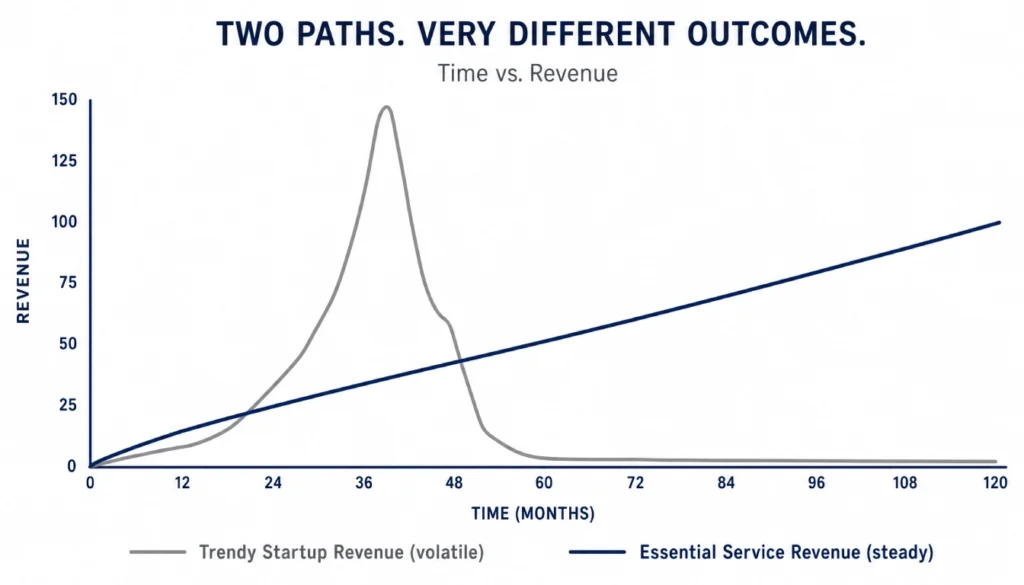
According to Small Business Administration data, roughly 20 percent of new businesses fail within their first year. Essential service businesses, the boring kind, tend to post lower failure rates because demand doesn’t disappear when trends shift.
Starting Small: 5 Boring Business Ideas You Can Launch on a Budget
You don’t need investors or a business plan to start. Here are five small boring businesses that make good money with low startup costs.
- Pressure washing: Startup cost under $1,000. High demand from homeowners and property managers.
- Mobile car detailing: Low overhead, no storefront needed, strong repeat business.
- Gutter cleaning: Seasonal but steady, minimal equipment required.
- Pet waste removal: Growing demand in suburban neighborhoods, easy to schedule as a route.
- Junk removal: A pickup truck and a trailer can get you started this weekend.
If you’re stuck wondering which boring business to start, follow this simple three-step filter:
Step 1: List five daily annoyances you’ve paid someone else to solve. Clogged gutters, a dirty car, a messy house.
Step 2: Search for local companies offering those services. If their websites look outdated and reviews are thin, you’ve found an underserved market.
Step 3: Validate by asking five people in your neighborhood if they’d pay for that service. If three say yes, you have a business.
No business plan required. No fancy name needed. Just solve a boring problem that won’t go away.
Frequently Asked Questions
Is it true that boring businesses make more money?
Not always more, but often more reliably. Lower competition and steady demand tend to produce consistent profit rather than the boom-or-bust pattern common in trendy startups.
What is an example of a boring business?
Waste management, commercial cleaning, laundromats, vending machine routes, and bookkeeping services are all common examples.
What businesses will always be in demand?
Essential services tied to daily life: cleaning, waste removal, plumbing, basic repairs, and bookkeeping. People need these regardless of economic conditions.
Can I start a boring business with no money?
Not with zero dollars, but many boring businesses start with under $1,000. Pressure washing and mobile detailing are common low-cost entry points.
Why do unglamorous businesses have lower failure rates?
Demand is steady and predictable. Owners face less competition because fewer people want to start these businesses, which keeps margins healthier.
Your Next Step: How to Pick the Right Boring Business for You
You don’t need to reinvent anything. You need to pick a service people already pay for and do it reliably.
Go back to the three-step filter above. Write down five annoyances. Check the local competition. Ask five neighbors if they’d pay. That’s your starting point, not a business plan, just a real answer.
This is why boring businesses make the most money: they solve problems that never stop happening, for customers who are relieved you showed up at all. If you’re ready to build something that pays you steadily instead of chasing a headline, start with the filter above this week.
Try it, then leave a comment below with the boring business idea you’re considering. I’d like to hear what you land on.