
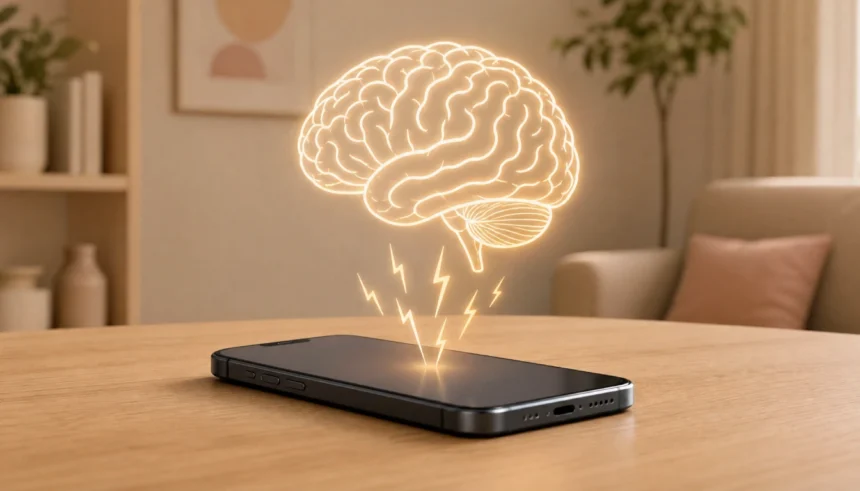
Your phone buzzes. Your heart jumps. You are not in danger. But your brain reacts as if you are. Sound familiar?
You are not weak, dramatic, or broken. Your brain is doing exactly what it was built to do—and your phone has learned to exploit it. If you have ever felt a wave of dread when your battery hit 5%, checked your phone before realising it never rang, or felt weirdly irritable after a long scroll session, you already know why my phone makes you anxious from a simple neuroscience point of view. And you deserve a clear answer.
This article walks you through the exact brain science behind that feeling—no textbook jargon, no vague advice. Just the real mechanics, explained simply, with practical steps you can use today.
What Phone Anxiety Actually Feels Like (And Why It Is Normal)
Before getting into the science, take a second to name what you experience.
Phone anxiety does not always look like a full panic attack. It is often quieter than that. It feels like:
- A low hum of restlessness when you have not checked your phone in a while
- A spike of urgency when a notification appears, and you cannot answer it immediately
- Phantom vibrations, where you feel your phone buzz but there is no message
- A tight chest the moment someone leaves you on “read”
- Genuine panic when your phone battery is dying, and a charger is not nearby
All of these are real, recognised responses. Studies suggest that over 65% of smartphone users check their phones within five minutes of waking up, and a significant portion describe their phone use as feeling “compulsive” rather than intentional. You are not alone in this.
The reason these feelings exist comes down to three key players in your brain: the amygdala, dopamine, and cortisol. Let us look at each one.
Your Brain’s Built-In Alarm System: The Amygdala on High Alert
Your amygdala is a small, almond-shaped structure deep in your brain. It has one job: scan for threats and fire the alarm when it spots one.
For most of human history, that alarm meant “a predator is nearby, run.” Today, your amygdala cannot tell the difference between a tiger and a text message from your boss at 9 PM. Both register as a potential danger. Both get the same alarm response.
When a notification hits your screen, your amygdala processes it in roughly 100 milliseconds—faster than conscious thought. It asks: “Is this a threat? Do I need to act?” If the answer is even slightly uncertain, it sends a distress signal. Your heart rate climbs. Your muscles tense. Your attention narrows.
Here is what I noticed personally: when I started tracking my own reactions, I realised my shoulders physically tensed every time my phone lit up, even for something as harmless as a weather alert. My amygdala was treating every ping like a mini-emergency. Once I understood that, I stopped judging myself for the reaction and started working with my brain instead of against it.
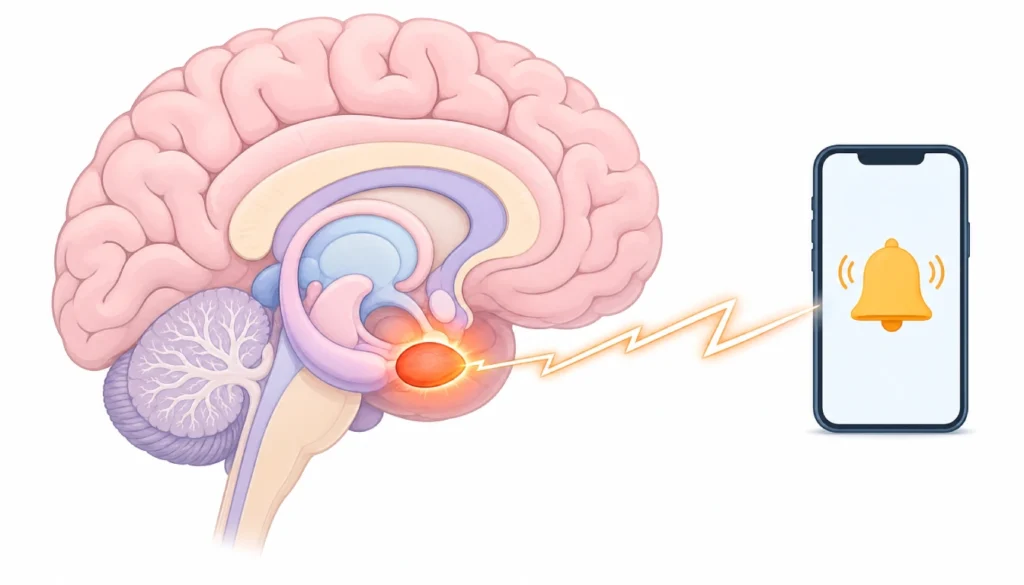
The problem with modern life is that notifications never stop. Your amygdala is supposed to fire, calm down, and reset. But when alerts arrive every few minutes, it never fully resets. You end up in a low-grade threat state all day long.
How Dopamine Keeps You Hooked (and Anxious)
Dopamine is your brain’s “go get it” chemical. It gets released in anticipation of a reward—not just when you receive one.
This is the key to understanding phone anxiety dopamine explained simply. Every time you pick up your phone, your brain does not know what is waiting for you. It might be an exciting message. It might be nothing. That unpredictability is the problem—and also what makes it so hard to stop.
Psychologists call this a variable reward schedule. Slot machines work the same way. You pull the lever, and sometimes you win, sometimes you lose. The uncertainty is what keeps you coming back. Your phone works identically. You swipe down to refresh your inbox, and sometimes something is exciting, sometimes nothing. That “sometimes” is enough to keep dopamine dripping and keep your hand reaching for your phone.
Here is where anxiety enters the picture. Dopamine in anticipation mode creates a restless, seeking state. You feel a pull, a need to check, a vague discomfort if you resist. That discomfort is what many people call phone anxiety. Your brain is not just craving the reward. It is experiencing mild withdrawal when the reward is delayed.
Why a Single Notification Can Spike Cortisol
Cortisol is your stress hormone. Your body releases it when your brain perceives pressure, urgency, or threat. It is designed for short bursts—sprint away from danger, then return to baseline.
Research from the University of California, Irvine, found that it takes an average of 23 minutes to fully regain focus after an interruption. Every notification is an interruption. And every interruption triggers a small cortisol response and phone notifications. Simple explanation: your body reads the alert as something that demands your attention, something unresolved, something that could go wrong if you ignore it.
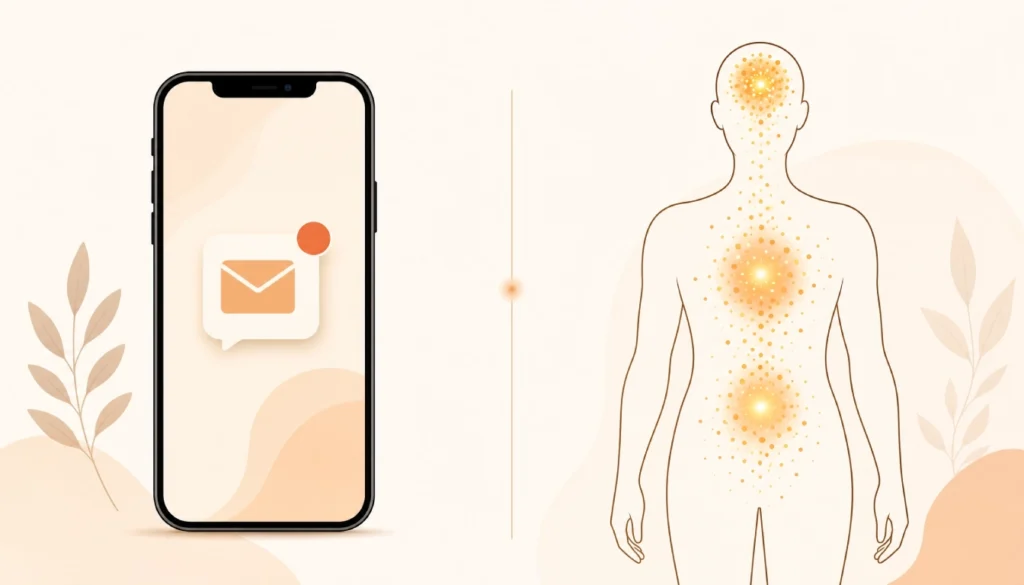
You do not need to read the message for this to happen. The badge alone—a red number sitting on an app icon—is enough to spike cortisol. That small red dot signals “unfinished business” to your nervous system, and cortisol rises until you deal with it.
Now multiply that by the average 80 to 100 times per day most people check their phones. That is a lot of cortisol flooding your body on a daily basis. Over time, chronically elevated cortisol contributes to poor sleep, irritability, difficulty concentrating, and yes, more anxiety.
The Panic of Separation: When Your Phone Is Not There
Have you felt a sudden, irrational anxiety when you could not find your phone—even for 30 seconds?
That feeling has a name: nomophobia, or phone separation anxiety. Research from Iowa State University found that a significant percentage of people experience measurable psychological discomfort when separated from their phones, even briefly.
The reason is straightforward. Over years of use, your brain has built dense neural connections around your phone. It is associated with safety, social connection, entertainment, navigation, and communication. When it is missing, your brain interprets that as a loss of resources. The threat response fires. Cortisol rises. Dopamine drops because the reward source is gone.
Phone separation anxiety brain explanation, stripped to basics: your brain no longer treats your phone as a tool. It treats it as an extension of your survival system. That is not a flaw in you. It is a predictable result of years of conditioning.
The good news is that conditioning can be reversed. Neural pathways that fire together, wire together—and they can also be gently unwired.
5 Simple Brain Hacks to Calm Phone Anxiety (Neuroscience-Backed)
These are the steps I use personally, and the ones I keep coming back to when anxiety creeps back in. They work because they target the exact brain mechanisms causing the problem.
Step 1: Name your trigger before you react.
Identify what specifically sets off your anxiety. Is it the notification sound? The red badge? A low battery? Being specific matters because the amygdala responds differently to named threats versus unnamed ones. Research shows that labelling an emotion reduces amygdala activation. Simply thinking “that is my cortisol spiking because of the badge” gives your prefrontal cortex a chance to step in.
Step 2: Use a 10-second breathing pause before checking.
When you feel the urge to check your phone, pause. Breathe in for 4 counts, hold for 2, breathe out for 4. This is not a cliché. Slow breathing directly stimulates the vagus nerve, which tells your nervous system to stand down from the threat response. Do this before you look at the notification, not after. You are retraining the sequence.
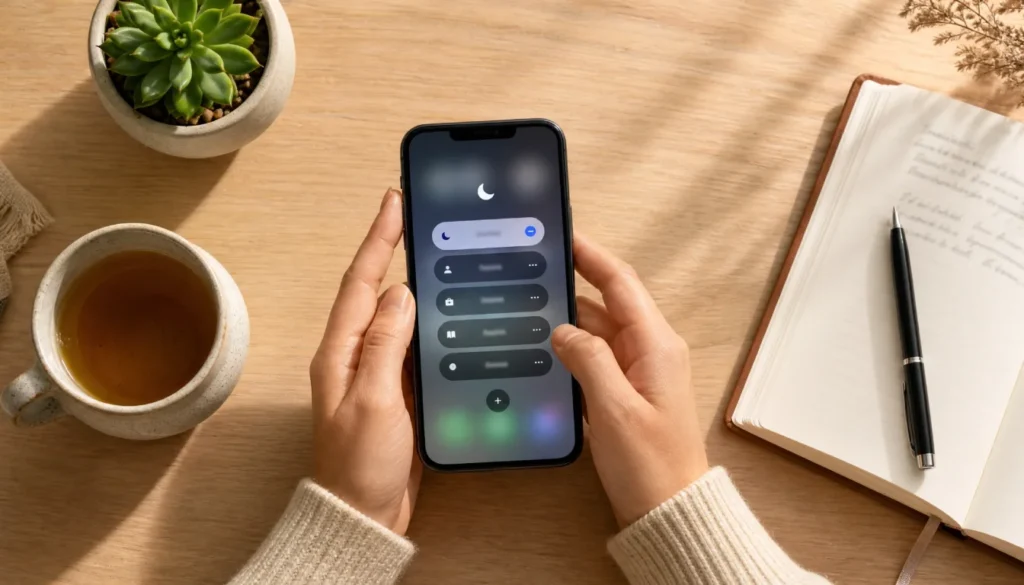
Step 3: Turn off non-essential notifications.
This is the structural fix. Go into your phone settings and turn off every notification that does not require immediate action. Email, social media, news apps, shopping deals—these can all wait. The goal is to reduce the frequency with which your amygdala gets pinged throughout the day. Fewer interruptions equal fewer cortisol spikes.
Step 4: Schedule specific phone-checking windows.
Instead of checking reactively, set two or three fixed times per day to catch up on messages and notifications. This flips the dopamine loop from reactive to intentional. Your brain learns that the reward is coming at a set time, and the restless seeking state calms down between windows.
Step 5: Redesign your physical environment.
Charge your phone outside your bedroom. Leave it face-down during meals. Put it in a drawer during focus work. Physical distance reduces the ambient threat signal your amygdala picks up just from seeing the device. Out of sight genuinely does mean lower cortisol for most people.
I tried the scheduled checking windows for two weeks and noticed the difference by day four. The constant background pull reduced noticeably. I was not checking out of anxiety—I was checking because I had decided to. That distinction matters more than it sounds.
What If It Is More Than Phone Anxiety? A Quick Self-Check
Phone anxiety is common and manageable. But sometimes it signals something deeper.
Ask yourself these questions honestly:
- Do you feel anxious even when your phone is with you and fully charged?
- Does checking your phone rarely give you relief, and the anxiety quickly return?
- Are you avoiding social events, work responsibilities, or relationships because of phone-related stress?
- Has a friend, partner, or colleague expressed concern about your phone use?
If you answered yes to two or more, it may be worth speaking to a therapist or counsellor. Phone anxiety that does not respond to basic habit changes can sometimes be rooted in underlying anxiety disorders, social anxiety, or fear of missing out tied to deeper self-worth patterns. There is no shame in that—and a professional can help far more than any article can.
Key Takeaways and Your Next Step
Understanding why my phone makes you anxious from a simple neuroscience view is the first step to changing it.
Here is the short version:
- Your amygdala treats every notification as a potential threat, even when you are safe.
- Dopamine keeps you in a restless, seeking state tied to unpredictable phone rewards.
- Cortisol spikes with every interruption and takes time to come back down.
- Phone separation anxiety is your brain protecting what it now sees as a survival resource.
- Naming triggers, breathing pauses, and structural changes to your notification settings can genuinely retrain these responses over time.
You do not have to quit your phone or go on a digital detox retreat. Start with one thing today. Turn off three non-essential notifications. Try the 10-second breathing pause the next time you feel the urge to check. Small changes, done consistently, shift the neural patterns that drive phone anxiety.
Your brain built this pattern. Your brain can also rebuild it.